

Lebedev called Uzbekistan one of the main driving forces of the CIS
CIS Secretary General Sergei Lebedev spoke about Uzbekistan's role in the Commonwealth, economic cooperation, and the republic's initiatives.
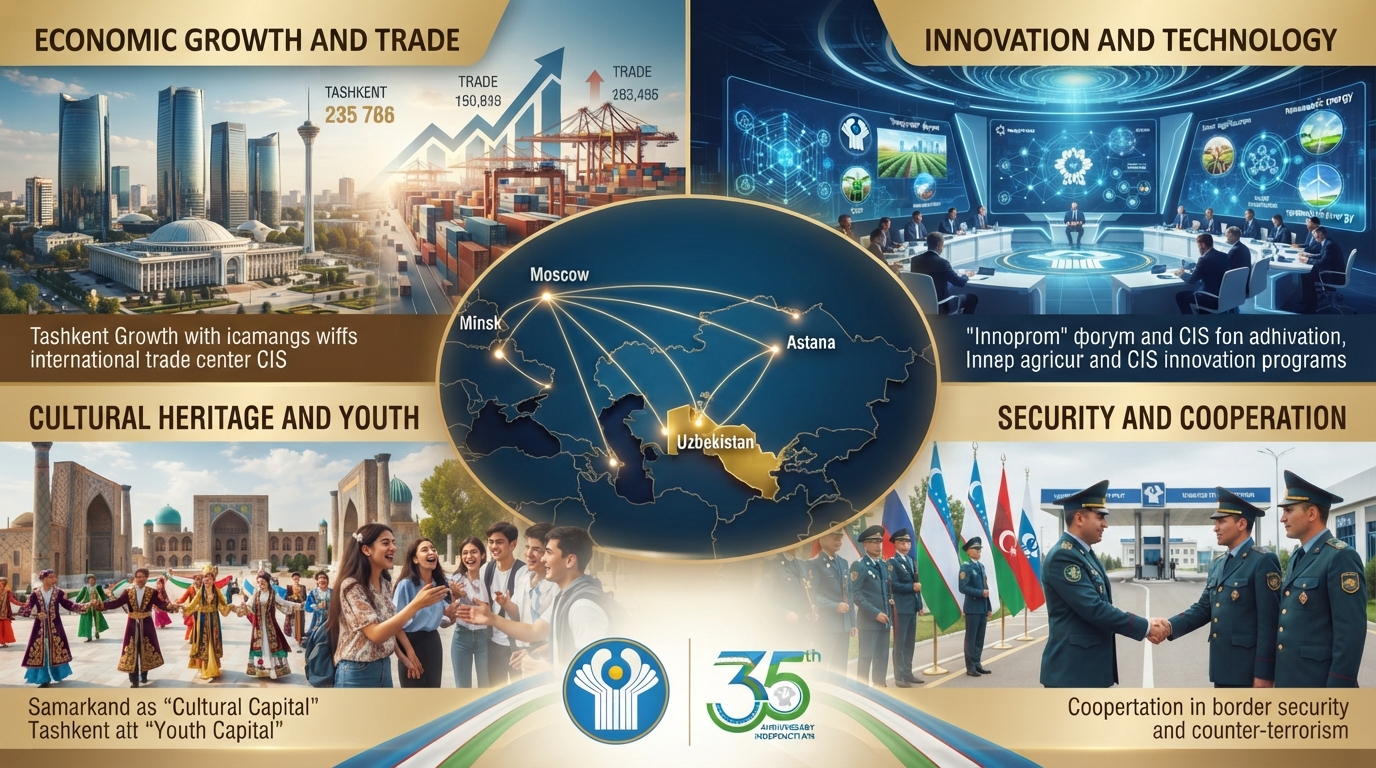
CIS Secretary-General Sergei Lebedev stated that Uzbekistan has become a key driving force in the Commonwealth's development, significantly expanding its participation in its activities in recent years. In an interview with the Dunyo news agency, timed to coincide with the 35th anniversary of Uzbekistan's independence, he also emphasized the republic's growing economic performance and its contribution to the development of cooperation among CIS countries.
Lebedev recalled that Uzbekistan stood at the origins of the Commonwealth, signing the Alma-Ata Declaration on December 21, 1991, acceding to the Agreement Establishing the CIS, and adopting its Charter.
The republic's active participation in CIS activities has been particularly notable over the past decade. While in 2016, the Uzbek side was represented in 29 key areas of cooperation, it currently participates in 51 sectoral bodies. Representatives from relevant Uzbek agencies are involved in all 66 areas of the Commonwealth's activities in various capacities.
Lebedev noted that Uzbekistan is the second-largest country in the CIS by population and the third-largest economy. Last year, the country's GDP grew by 7.7%, and by 8.5% in the first half of 2026. Uzbekistan ranks second in the CIS in agricultural production after Russia, and third in industrial output.
The CIS Secretary General specifically focused on economic integration. According to him, over the past 10 years, Uzbekistan's foreign trade turnover has quadrupled, from $20 billion to $81 billion. In 2025, CIS countries accounted for a third of the country's foreign trade, and in the first half of 2026, this figure reached 37.8%.
Russia and Kazakhstan are among Uzbekistan's top three foreign trade partners. Moreover, according to Lebedev, Russia is the largest market for Uzbek exports, significantly ahead of China.
Uzbekistan's exports to the CIS countries have also shown growth. In 2023, the indicator increased by 4.1% compared to the previous year, by 11.9% in 2024, and by 19.4% in 2025.
Lebedev emphasized that Uzbekistan is one of the most active participants in shaping CIS solutions in the areas of economic digitalization, public administration, and social services. The country is also interested in jointly developing its innovative potential.
He cited Uzbekistan's initiatives as the preparation of a roadmap for the support and development of special economic zones, the creation of a CIS venture platform for promoting startups and innovation, and the development of a program for the innovative development of the Commonwealth's energy sector.
In April 2026, at the initiative of Uzbek President Shavkat Mirziyoyev, the forum "Innovative Industry of the CIS: A New Model of Interstate Cooperation" was held as part of the INNOPROM. Central Asia industrial exhibition.
Lebedev also identified interregional cooperation as a significant area. According to him, at Mirziyoyev's initiative, the first Forum of Regions of the CIS Member States was held in Tashkent in 2025, bringing together representatives of regional authorities and business circles from the Commonwealth countries.
Speaking about foreign policy cooperation, Lebedev noted the consistent coordination of CIS states' positions on international platforms. In recent years, the UN General Assembly has adopted more than 10 resolutions proposed by Uzbekistan. One of the most recent was the resolution "Strengthening the Role of Parliaments in Accelerating Social Development," adopted in July 2026.
Humanitarian cooperation also remains a significant area of cooperation. Lebedev highlighted the holding of the interstate program "Cultural Capitals of the Commonwealth" in Samarkand in 2024. Throughout the year, the city hosted cultural events with the participation of representatives from CIS countries, including a Week of Culture, Art, and Cinema, literary and educational meetings, presentations, and a librarians' conference.
Tashkent became the Youth Capital of the CIS in 2024. According to Lebedev, the program demonstrated to young people from the Commonwealth countries the potential of the Uzbek capital in the areas of education, sports, culture, work, and recreation.
Uzbekistan also currently chairs the Consultative Council on Labor, Employment, and Social Protection of the Population of the CIS Member States.
Security issues received special attention in the interview. According to Lebedev, Uzbekistan participates in most CIS programs aimed at strengthening external security, including the CIS Program for Cooperation in Strengthening Border Security at External Borders for 2026–2030.
Cooperation is also underway in the fight against crime, terrorism, and extremism. One of Uzbekistan's initiatives is the CIS Deradicalization Cooperation Program for 2025–2027, aimed at eliminating the causes and conditions for the spread of radical views and returning people involved in radical extremist activities to normal life.
Lebedev stated that Uzbekistan has approached the 35th anniversary of its state independence with achievements in all areas of public life and prospects for further development. He also expressed his wishes for peace and prosperity for the country's people and noted the CIS's readiness to continue strengthening cooperation with the republic.