

Leather and footwear industry in Central Asia in 2021–2025
The Center for Economic Research and Reforms analyzed the development trends of the leather and footwear industry in Central Asian countries for the period 2021–2025. The study examined the dynamics of production, export, and import, the state of the domestic market, as well as opportunities for industry development and expanding regional cooperation.
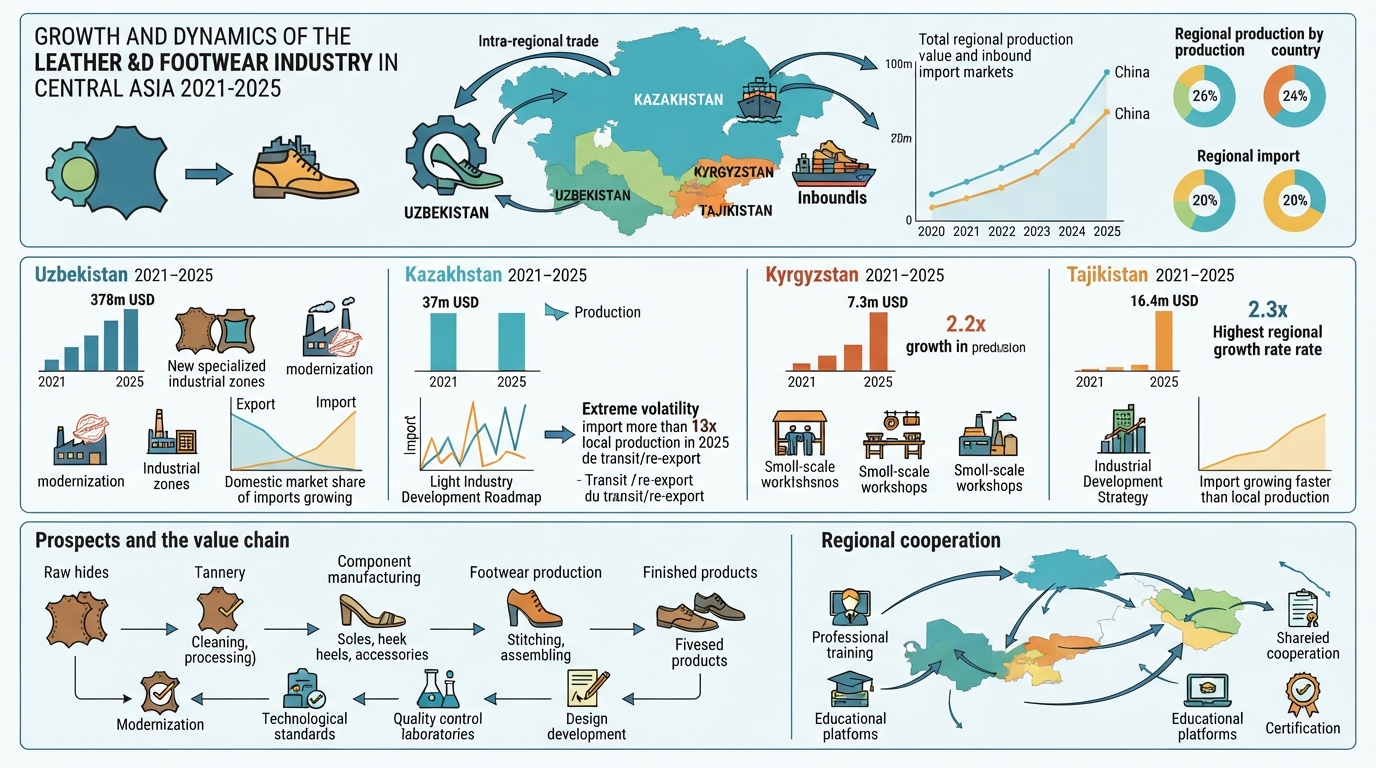
**The Leather and Footwear Industry in Central Asia in 2021–2025**
The leather and footwear sector plays an important role in the development of the manufacturing industry in Central Asia. This sector provides opportunities for the deep processing of a broad raw material base, the production of finished consumer goods, and increasing employment. In 2021–2025, production in the countries of the region developed at varying paces. Therefore, under growing market conditions, how effectively enterprises can utilize the available raw material base to produce competitive products remains one of the key issues.
The article mainly analyzes the development dynamics of the sector (NACE 15 — leather and related products) in 4 countries of Central Asia — Kazakhstan, Kyrgyzstan, Tajikistan, and Uzbekistan. Official data on most indicators for Turkmenistan is not available in open sources. The material was prepared based on data from national statistical agencies, the CIS Statistical Committee, the Eurasian Economic Commission of the EAEU, trademap.org, media, and open sources.
### Sector Development Trends by Country
Uzbekistan is the largest producer of leather and footwear products in the region. Over five years, the value volume of product manufacturing increased by 22% in real terms, reaching $378 million in 2025. The sector's share in the manufacturing industry remained virtually unchanged, slightly decreasing from 0.53% in 2020 to 0.50% in 2025. By the end of 2025, 782 enterprises were operating in the sector.
Over the five years, exports of the sector's products decreased by 6.6% to $67 million. Meanwhile, imports increased 3.4 times, reaching $72 million. The calculated volume of the domestic market grew 3.4 times to $383 million, and the share of imports in the domestic market rose from 19% to 25%. Despite Uzbekistan remaining the largest producer in the region, demand grew faster than production, and part of the new needs was met through imports.
In 2021–2025, targeted measures were adopted in Uzbekistan to support the leather and footwear industry. In particular, dedicated credit lines were launched for projects producing finished leather goods and other high-value-added products, and preferential loans were provided for the purchase of equipment. 16 specialized small industrial zones were established. State support was provided for the creation of clusters, construction of treatment facilities, establishment of cooperation with foreign brands, and product certification.
The measures taken increased the attractiveness of the sector for business and capital, yielding specific results. Last year, a record $600 million of investment was attracted to the leather and footwear industry. This is 8 times more compared to 2020. The significant growth in investment inflows was also reflected in a 35% increase in production during the 7 months of 2026. This is the highest growth rate in the region for this period.
Kazakhstan is the largest market for leather and footwear products in the region, where domestic demand is mainly met through imports. The volume of domestic production in the country is relatively small, and the sector faced serious challenges over the last five years.
Over the five years, the production of leather and footwear products decreased by 9% in real terms, amounting to $37 million in 2025. The decline in the sector was observed for two consecutive years — in 2023–2024. In 2025, production began to recover and grew by 16.7%. In 2021–2025, the sector's share in the manufacturing industry decreased from 0.10% to 0.06%.
During the period under review, foreign trade indicators fluctuated sharply. This situation may be related to transit and re-export flows, making it difficult to estimate the volume of domestic consumption. In particular, while exports increased several times, imports rose from just over $400 million in 2020 to over $1 billion in 2023, and then decreased again to $0.5 billion in 2025. In 2025, the calculated volume of the domestic market was nearly $500 million, representing an 11% growth compared to 2020. The main part of the market was accounted for by imports.
During the period under review, the Roadmap for the Development of Light Industry for 2022–2025 was in force in Kazakhstan, which also covered the leather and footwear sector. The Roadmap defined measures for developing the raw material base and processing, including increasing the volume of raw hide processing up to 40%, attracting investments, increasing the capacity utilization rate of enterprises and exports, and strengthening state support. Additionally, sector projects gained access to preferential financing through the Industrial Development Fund and the general instruments of the "Business Roadmap – 2025" program.
Overall, the last five years were difficult for the Kazakh leather and footwear industry. The main structural problem of the sector was low competitiveness, which manifested in a large gap between trade and local production volumes. In 2025, the volume of imports was more than 13 times higher than domestic production.
### In Kyrgyzstan
In 2021–2025, the production of leather and footwear products grew 2.2 times in real terms, reaching $7.3 million. The sector's share in the manufacturing industry remained small, accounting for about 0.1%.
In certain years of the period under review, export and import indicators also fluctuated sharply. This may be largely related to transit and re-export flows. The domestic market was mainly supplied through imports, the volume of which amounted to $169 million in 2025.
Overall, the leather and footwear industry in Kyrgyzstan developed at higher rates compared to the general growth of the industrial and manufacturing sectors.
### In Tajikistan
The leather and footwear industry in Tajikistan showed the highest growth rate among the countries of the region. Although production increased 2.3 times in 2021–2025, the scale of the sector is still relatively small. In 2025, production reached $16.4 million. Exports decreased from $2.9 million to $2.5 million. The sector's share in the manufacturing industry remained below 0.5%.
68% of Tajikistan's domestic market is supplied through imports. Over the five years, imports increased 3 times, reaching $30 million. The calculated capacity of the market expanded from $16 million to $44 million. Thus, the growth of domestic production in Tajikistan was accompanied by an even higher rate of increase in product deliveries from abroad.
In 2021–2025, within the framework of development programs, the Government of Tajikistan set tasks and implemented relevant measures for processing local raw materials, supplying footwear enterprises with raw materials, and increasing the production of high-value-added products. In particular, the Industrial Development Strategy until 2030 envisages a 3.3-fold increase in the volume of raw hide processing and a 1.8-fold increase in footwear production.
Sufficient and comparable statistical data for a comprehensive comparison of the sector's development in Turkmenistan is not available in open sources. Nevertheless, according to official media reports, the production of leather goods at the enterprises of the Ministry of Textile Industry in 2025 increased by 11.4% compared to 2024. Open data indicates that during the period under review, the sector developed through the processing of local raw leather, expanding the range of footwear and leather goods, and increasing private production. State policy is aimed at import substitution and increasing exports.
### Five-Year Development Trends of the Regional Market
In recent years, the development of the leather and footwear industry in the countries of the region has proceeded differently. In 2021–2025, the total production volume of leather and footwear products grew, while production became increasingly concentrated in Uzbekistan. Uzbekistan's share in the total production of the four countries increased from 78% to 85%. Meanwhile, Kazakhstan remained the largest market for imported products.
In all countries, the growth rates of imports exceeded production dynamics. When taking into account "mirror" statistics for Turkmenistan, the total import of the sector's products increased from approximately $525 million to $792 million, or by 50%. The main part of the leather and footwear products imported into the Central Asian market was supplied from China.
In 2025, Kazakhstan accounted for about 63% of the region's leather and footwear imports, Kyrgyzstan for 21%, Uzbekistan for 9%, Tajikistan for 4%, and Turkmenistan for 2%. Footwear and footwear parts constituted the bulk of imports. During the period under review, the volume of footwear deliveries to the region increased from $440 million in 2020 to $540 million in 2025.
The calculated capacity of the domestic market of the four countries increased from nearly $630 million in 2020 to $1.1 billion in 2025. In this regard, it should also be taken into account that a certain part of the market may be related to re-exports to third countries.
A comparison of trade and production indicators shows different specializations of the countries. While in Uzbekistan the production volume in 2025 was more than five times higher than imports, the opposite ratio was observed in Kazakhstan and Kyrgyzstan. Export dynamics also varied by country. Therefore, the general growth of trade and production volumes does not mean that a single export-oriented model has formed in all countries. Overall, the last five years were not easy for the Central Asian leather and footwear industry.
### Prospects for the Development of the Leather and Footwear Industry in the Region
At the same time, the five-year dynamics show that there are growth opportunities in the Central Asian leather and footwear industry. Such opportunities are primarily related to domestic demand, which is currently met through imports.
The availability of the market and raw leather does not in itself guarantee the expansion of domestic production. The further development of the sector depends on the ability of enterprises to establish deep processing of raw materials, produce high-quality components and finished footwear, and establish stable links between manufacturers in the region's countries and sales markets.
Further development of the hide collection and sorting system, improving the quality of its primary processing, and modernizing leather enterprises will allow for an increase in the volume of material suitable for production. For the stable operation of this chain, treatment facilities, compliance with technological standards, and coordination of the requirements of finished product manufacturers with leather suppliers are also necessary.
There is also a need to develop the production of accessories, footwear details, and other components. Their availability affects the cost of products, order fulfillment times, and the ability to regularly update the model range. Given the relatively small size of some national markets, it may be beneficial for specialized suppliers to work simultaneously with enterprises in several countries of the region. The opportunity for small enterprises to jointly fulfill large orders is also important.
The expansion of production must be accompanied by the development of design, training of technologists and workers, product testing, and certification. This will allow for the establishment of high-quality and modern product manufacturing and entry into high-price market segments. In this regard, it is advisable to organize training platforms, establish cooperation between manufacturers and specialized educational institutions, and expand access to testing laboratories.
Regional production cooperation also provides additional opportunities. Enterprises in different countries can cooperate at various stages of production, starting from raw material preparation and leather processing to the production of components, footwear sewing, and its sale.
### Conclusion
In 2021–2025, the leather and footwear industry in Central Asian countries developed at varying paces. The five-year data shows that there are opportunities to develop local enterprises, primarily through the domestic market. For the further development of the sector in the region, it is important to deeply process raw materials, update equipment, train specialists, ensure stable supplies of components, expand sales markets, and develop cooperation between countries to increase product competitiveness and strengthen positions in the regional market.