

Furniture industry in the countries of Central Asia in 2021–2025
CERR has prepared a review dedicated to the development dynamics of the furniture industry in the countries of Central Asia in 2021–2025.
**The Furniture Industry in Central Asian Countries in 2021–2025**
Furniture manufacturing in Central Asian countries is an industry with a fairly high growth potential. It is labor-intensive and generates demand for products from related sectors—woodworking, textiles, chemical, and metalworking industries.
The development of the furniture industry in the region's countries provides them with the opportunity to increase value added in the economy, reduce dependence on imports of finished products, and gradually expand exports of their own goods.
Over the past 5 years, the Central Asian furniture market has grown actively, primarily due to rising domestic demand: steady economic growth, dynamic business development, and a stable increase in the population's well-being have ensured constant demand for furniture.
This material focuses on the development indicators of the furniture industry in 4 countries—Kazakhstan, Kyrgyzstan, Tajikistan, and Uzbekistan. For Turkmenistan, official data for most indicators are not publicly available.
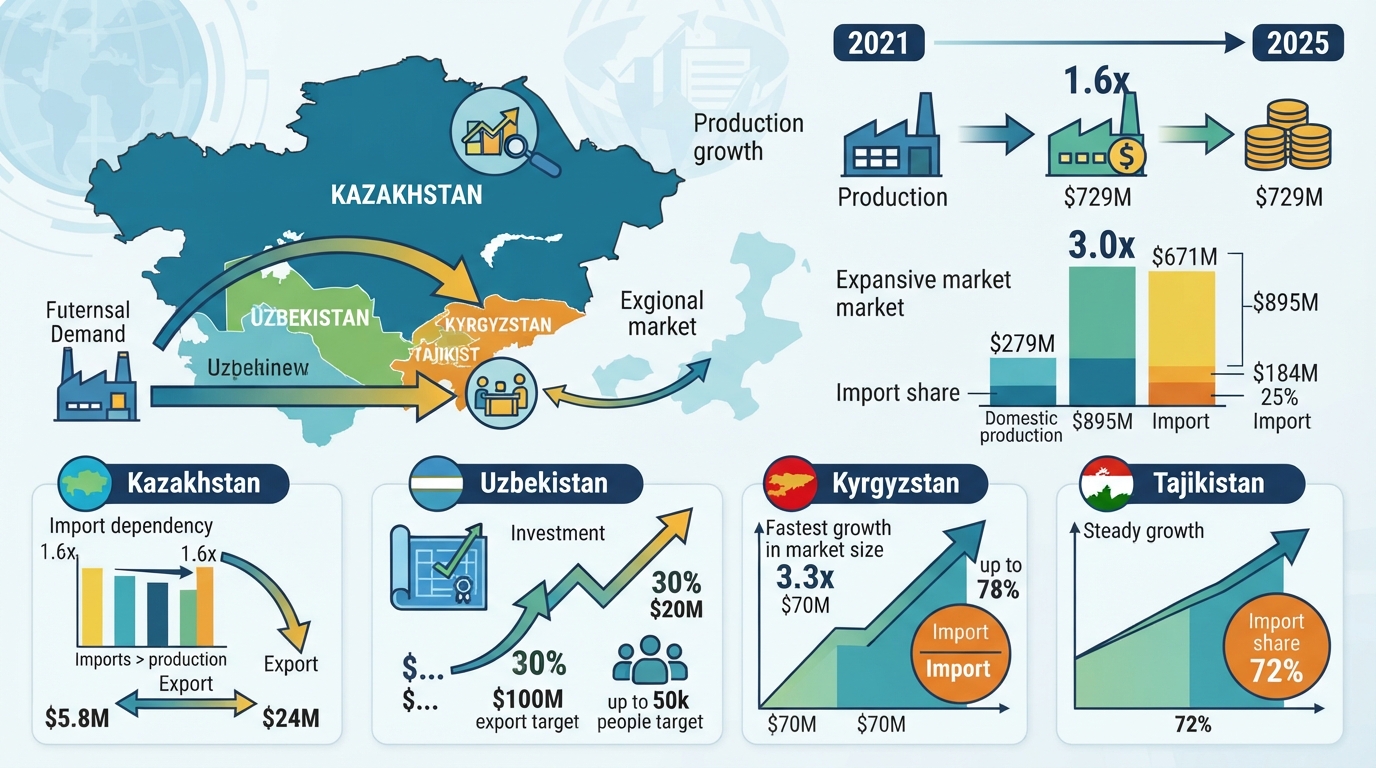
Furniture production grew 1.6 times over 5 years, reaching $729 million in 2025 (with an average annual output growth rate of 10.7%). The share of furniture manufacturing in the manufacturing industry increased from 0.7% to 1%. At the end of last year, 4.1 thousand enterprises operated in the industry. During the period under review, the sector significantly increased investments—nominally by 5.8 times, to $147 million.
However, the expansion of output is still mainly linked to the domestic market, and the export model in this segment is still in the early stages of formation. Thus, furniture exports grew 5.3 times over the past 5 years but remain relatively small at $19 million.
At the same time, the domestic furniture market is estimated to have increased 3 times—from $362 million to $895 million—and is the largest in Central Asia. Meanwhile, furniture imports grew from $82 million to $184 million, and the share of imported products in the market rose from 23% to 25%. In other words, the remaining 75% of domestic demand is covered by domestic production.
It should be noted that in Uzbekistan, attention has recently been paid to the development of the furniture industry at the highest level. In 2025, a comprehensive plan for the development of the furniture industry was adopted, including support for the digitalization of production and personnel training. Individual districts are specializing in furniture production, following the example of the Khanka District. In particular, furniture centers are being established in 8 districts.
The program plans to increase the production of furniture and woodworking products by 30%, bring their exports to $100 million, implement investment projects with a total value of $200 million, and provide employment for 50 thousand people. Thus, the industry is expected to receive a noticeable boost to its development in the coming years.
Furniture output over the past 5 years increased by 75% in real terms, to $290 million in 2025 (with an average annual output growth rate of 12.6%). The share of the furniture industry in Kazakhstan's manufacturing industry in 2025 accounted for 0.5% (compared to 0.4% in 2020). Investments grew from $3.4 million to $20 million (while in 2024 they stood at $31 million).
The Kazakh domestic furniture market is estimated to have grown by 77% to reach $721 million, with the bulk of the market accounted for by imports—63% in 2025. However, compared to 2020, when imports accounted for 70%, this figure has decreased, indicating faster growth in local supply. At the same time, the growth of the industry was also supported by the external market: furniture exports during this period increased from $5.8 million to $24 million.
In Kazakhstan, the state also pays attention to the development of the furniture industry. In particular, it was covered by support instruments for the manufacturing industry and entrepreneurship. The Government of Kazakhstan reported the approval of a roadmap for the development of the furniture industry within the framework of the "economy of simple things."
Overall, in Kazakhstan, the industry under review developed actively under the influence of strong domestic demand. At the same time, imports in 2025 still exceeded output by a notable 1.6 times. That is, the expansion of local production does not yet change the leading role of foreign suppliers.
In 2021–2025, furniture output increased in real terms by 2.2 times, to $20 million in 2025 (by 22% on average per year). It was 2025 that provided a significant part of this result, when the volume of products manufactured in the industry almost doubled. Nevertheless, the share of the furniture industry in the manufacturing industry decreased slightly—from 0.32% to 0.28%—and remains small.
The estimated volume of the domestic furniture market in Kyrgyzstan grew significantly—by 3.3 times, to $70 million—due to an increase in foreign supplies: the share of imports in the market volume rose from 58% to 78%, and the volume of imports grew from $12 million to $55 million. Exports also increased 2.5 times—from $1.9 million to $5 million, but their volumes remain small.
Furniture production in 2025 amounted to $12 million, increasing 2.4 times compared to the level of 2022. The domestic market is estimated to have reached $40 million, where imports accounted for 72%. Over 5 years, imports grew 2.6 times, to $29 million. Imports in 2025 exceeded output by 2.4 times. Exports remained negligible—at the level of $0.5 million.
In general, the Central Asian furniture market grew actively in 2021–2025—this is evident both from the output data presented above and from the increase in import volumes. According to a rough estimate, the region's domestic market in 2025 was at least $1.7 billion.
Also, according to estimates, the volume of external supplies of furniture products to the region during the period under review grew by 78%—from $434 million to $774 million (mirror import data were used for Turkmenistan). Of this volume, the largest importer was Kazakhstan—59% of regional imports, followed by Uzbekistan—24%, Kyrgyzstan—7.1%, Turkmenistan—6.6%, and Tajikistan—3.7%. Compared to 2020, Kazakhstan's share decreased by 6.6 percentage points, while Kyrgyzstan's share grew by 4.3 percentage points. In absolute terms, the main increase in imports was provided by Kazakhstan (+$171 million) and Uzbekistan (+$102 million).
At the same time, it should be noted that Kazakhstan, Kyrgyzstan, and Tajikistan are more dependent on foreign supplies, while Uzbekistan relies on its own capabilities to supply the market. However, despite this, a trend of a gradual increase in the share of imports in the domestic market has been observed over the past 5 years. In general, with such a scale of imports, the most rational direction for manufacturers in the region's countries seems to be focusing on replacing certain categories of imported furniture in the domestic market.
At the same time, there is a modest export return compared to the size of the domestic market. Exports of the four countries with available data grew from $11 million in 2020 to $48 million in 2025. The growth in exports was mainly driven by Kazakhstan and Uzbekistan. This shows that exports are not yet a significant channel for industry growth.
In general, in 2021–2025, the common trends in the development of the industry for the four countries of the region with available data were growth in output, exports, and imports, as well as the expansion of the domestic market. Meanwhile, analysis shows that the industry has significant potential for development.
The volumes of the regional domestic market and the dominance of imports in it create natural incentives for businesses in the region's countries to increase furniture production, increase the number and expand furniture enterprises, and strengthen supplies to the domestic market and the markets of neighboring countries. Of course, the development of markets by local manufacturers primarily depends on the competitiveness of their products—price, quality, assortment, and delivery times.
In this context, measures to increase the sustainability and potential of domestic enterprises look promising, in particular, ensuring reliable supplies and reducing costs for importing raw materials and production materials (wood-based panels, fittings, finishing materials), expanded access to financial resources for working capital, equipment modernization, as well as measures for staffing (training of designers, technologists, and product developers), etc.
Additional opportunities may be provided by the development and deepening of regional cooperation among enterprises, and the formation of value chains between countries for the production of panels, components, soft elements, and finished furniture.
Overall, during the period of 2021–2025, the Central Asian furniture industry expanded noticeably, and growing domestic demand creates broad opportunities for the successful development of the sector. The main criterion for further progress in the furniture industry is the ability of enterprises to steadily increase production, improve quality, and supply competitive furniture to domestic and foreign markets.