

Central Asia’s industrial output grows in 2026, led by Tajikistan and Kyrgyzstan
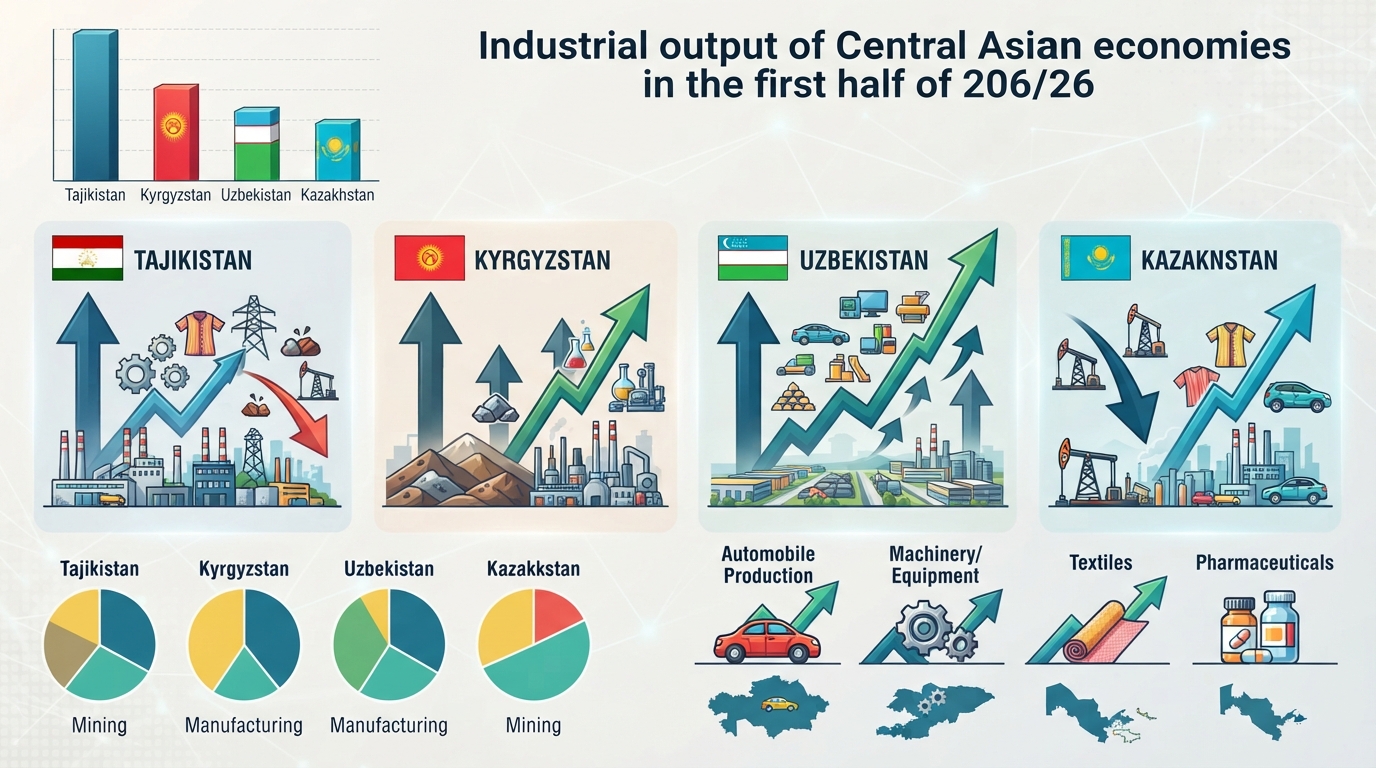
Industrial output across Central Asia saw continued expansion in the first half of 2026, with Tajikistan and Kyrgyzstan leading the growth. Tajikistan registered the highest increase at 14.1%, followed by Kyrgyzstan at 12.7%, Uzbekistan at 8%, and Kazakhstan at 3.5%. These figures are derived from a review conducted by Uzbekistan’s Center for Economic Research and Reforms, which analyzed four regional economies due to the unavailability of comparable public data for Turkmenistan.
Uzbekistan's industrial production reached a value of $53 billion, with its growth rate accelerating from 6.6% in the first half of 2025 to 8% in the corresponding period of 2026. Manufacturing served as the primary catalyst, expanding by 8.8% compared to 7.1% a year prior, and its contribution to total industrial production rose from 85% to 86%. Mining experienced slower growth at 2.1%, while the electricity, gas, and air-conditioning supply sector grew by 7.9%. Water supply, waste collection, and disposal recorded the most rapid growth among these sectors, at 15.9%.
Several manufacturing industries in Uzbekistan demonstrated particularly robust growth. The production of other machinery and equipment surged 1.6-fold, while wood processing increased by 48%, computer and electronic equipment by 37%, furniture by 31%, pharmaceuticals by 22%, and automobiles by 20%. Food production saw a 12% rise, textiles 10.1%, and construction materials 12%. Conversely, primary metals remained the largest industrial segment, comprising 29% of total production, despite its output growing by only 1.3%.
Kazakhstan's mining sector experienced a 4% decline, including an 8.3% drop in oil and gas extraction. Given that mining constitutes nearly 46% of Kazakhstan's industrial production, this downturn negatively impacted overall industrial growth. However, manufacturing expanded by 9.8%, reaching $33 billion, slightly surpassing the mining sector's output. Textile production increased 2.5-fold, pharmaceuticals grew by 43.6%, fabricated metal products by 39.9%, machinery repair and installation by 34.7%, and automobile production by 31.6%. Overall, the machinery sector expanded by 23.1%.
Kyrgyzstan's industrial production rose by 12.7% to $5.2 billion. Mining grew by 12.8%, primarily driven by increased extraction of metal ores and other minerals, while manufacturing increased by 15.1% and accounted for 79.1% of total industrial output. Primary metallurgy remained the country's largest industrial segment, representing 48.7% of production, with its output increasing by 12.2% after a 2.2% decline a year earlier. Chemical production nearly tripled, pharmaceutical output rose by 83%, petroleum refining by 70%, transport equipment by 41%, and construction materials by 33%.
Tajikistan's industrial production increased by 14.1% to $2.1 billion. However, this pace slowed from 24% in the first half of 2025. Manufacturing was particularly strong, growing by 26% and increasing its share of total industrial production from 47% to 52%. Electricity, gas, and air-conditioning supply expanded by 16.8%, with electricity generation rising by 17.1%. In contrast, the country's mining sector contracted by 6.7%, primarily due to declines of 7.4% in metal ore extraction and 41.9% in oil and gas production.
Across the four economies, manufacturing outpaced overall industrial production, indicating a gradual shift towards processing and higher-value production. This trend was particularly evident in Kazakhstan and Tajikistan, where manufacturing expanded despite contractions in mining. The review also highlighted significant growth in automobile production across the region, with output increasing by over 30% in Kazakhstan, Kyrgyzstan, and Tajikistan, and by approximately 20% in Uzbekistan.
Despite the expansion of manufacturing, raw materials and primary processing continue to be crucial components of the region's industrial structures. Metals account for 28.7% of Uzbekistan's industrial production and 20.4% of Kazakhstan's, while primary metallurgy alone represents almost half of Kyrgyzstan's industrial output. Industrial investment also remained substantial, with industry accounting for 47% of total investment in Uzbekistan, 41% in Kazakhstan, 35% in Tajikistan, and 17% in Kyrgyzstan.