

"It is important not only to build new buildings." The Legislative Chamber discussed the quality of education
During the first half of the year, 49.5 trillion soums were allocated to education in Uzbekistan. MP Dilnoza Azizova asked how these expenditures affect the quality of teaching and educators. The Ministry of Preschool and School Education reported on 6 budget programs and 36 indicators, as well as a new procedure for teacher selection.
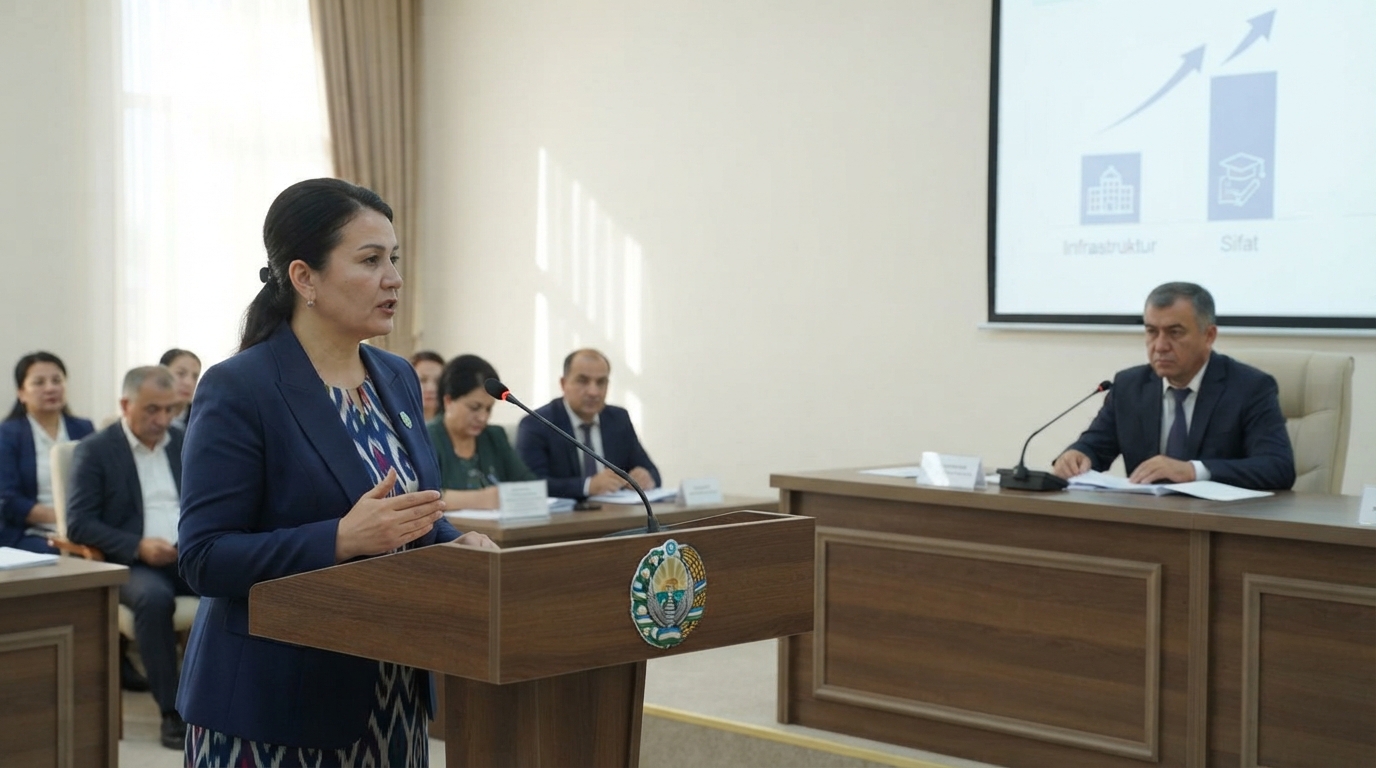
"It is important not only to build new buildings." The Legislative Chamber discussed the quality of education
Dilnoza Azizova, a deputy of the Legislative Chamber, raised the question of how much the increase in budget funding for education affects the quality of teaching and the level of educators in Uzbekistan. The discussion took place on September 15 during the review of the report on the execution of the state budget for the first half of 2026.
During this period, 49.5 trillion soums were directed to education. Azizova emphasized that the growth in funding, as well as the construction of schools and kindergartens, indicate the priority of the sector; however, in her opinion, attention should be paid not only to the material base.
"There is another issue that is at the center of our party's attention — the quality of education and personnel. A parent, when sending a child to school or kindergarten, trusts the state education system not only with their education and upbringing, but also, in fact, with their life during this time," the deputy said.
She pointed to cases of negative attitudes of educators towards children, which are reported on social media and cause public discontent.
"It turns out that we need to pay more attention not only to new buildings and material conditions, but also to the knowledge, professional skills, responsibility, and moral potential of a worthy educator who works with the child, shows care for them, teaches them honesty, loyalty to the Motherland, and our values," she stated.
Azizova asked whether the Ministry of Preschool and School Education has developed a specific methodology and criteria for evaluating results, and what effect the allocated 49.5 trillion soums produce specifically in terms of the quality of education.
"Most importantly — will we be able to turn the funds allocated today into tomorrow's generation of educated, honest, patriotic, and independent-thinking people?" the deputy asked.
Deputy Minister of Preschool and School Education Temurjon Komilov reported that to evaluate the effectiveness of budget funds, 6 budget programs and 36 target indicators have been established in the system.
According to him, these indicators assess not only the state of the material and technical base, but also the quality of education, the qualifications of educators, the admission of graduates to higher education institutions, and changes in the qualitative composition of teachers. The results of budget programs and indicators are regularly discussed with the relevant committees of parliament.
As one of the indicators, the ministry representative cited the results of graduates.
"If we look at the approximately 450,000 graduates of this year, their average score was 91.6. Compared to last year, it increased by 11.6 points," he said.
The number of schoolchildren holding national or international certificates exceeded 56,000.
According to the ministry, six to seven years ago, the share of teachers of the highest category was about 5–6%. By September 1, 2026, it grew to 14%, and the share of educators of the first category approached 22%.
"The dynamics are growing. Many examples can be given of how this is reflected in the quality of education," Komilov noted.
He also reported that by September 1, Uzbekistani schoolchildren had won about 230 medals at prestigious international olympiads. For comparison, the ministry representative pointed out that two years ago there were more than 100.
Responding to the deputy's question about fostering honesty, patriotism, and independent-thinking people, the ministry representative stated that a corresponding methodology exists and takes into account the age and psychological characteristics of children.
For primary classes, the main emphasis is on rules of conduct, morality, and basic social interaction skills. For older schoolchildren, the focus is on honesty and social relations, and for high school students, on independent thinking, legal awareness, and active citizenship.
According to Komilov, these areas are included in the subject "Tarbiya" ("Upbringing"), extracurricular activities, and additional content within the framework of "Kelajak soati" ("Hour of the Future").
Separately, the ministry representative focused on the quality of teaching staff.
Starting this year, a new teacher selection system has been launched on an experimental basis. It operates in one district of each region, as well as in all 13 districts of the Bukhara region.
"On an open platform, the selection of educators has been established on the basis of testing and interviews," the ministry representative reported.
After summarizing the results of the experiment, the ministry intends to present the information to parliament and then gradually roll out the system to the remaining regions of the country.