

It has been identified which professions and specialties are in high demand in various regions of Uzbekistan
Which professions and specialties are in high demand in different regions of Uzbekistan has been identified
The National Agency for Quality Assurance in Education analyzed the efficiency of forming, distributing, and implementing the admission parameters of technical schools for the 2025/2026 academic year. According to the results, it was revealed that the most in-demand field in the republic is car repair and maintenance. Region-specific fields were also identified.
### Admission plan fulfillment for technical schools has increased
According to the analysis, 201,203 admission quotas were approved for technical schools in the 2024/2025 academic year, of which 156,528 applicants were admitted. Thus, the fulfillment of the admission plan stood at 76 percent. This means that one out of every four places remained unfilled.
In the 2025/2026 academic year, a total of 287,301 admission quotas were allocated to technical schools, of which 249,130 applicants were admitted. This shows that the admission plan was fulfilled by 86 percent. Thus, the fulfillment rate rose from 76 percent to 86 percent. However, despite positive changes in admission indicators, significant differences persist across professions and specialties, forms of education, and regions.
### More than 83 percent of students were admitted on a grant basis
According to the analysis, out of 249,130 students admitted to technical schools in the 2025/2026 academic year, 206,761 were admitted on a state grant basis, and 42,369 were admitted on a fee-paying contract basis. As a result, the share of state grants was 83.0 percent, and the share of contracts was 17.0 percent.
### Admission for dual education was below the plan
For the 2025/2026 academic year, 59,680 of the total admission quotas were allocated for the dual education form. However, in practice, 41,080 students were admitted under dual education, accounting for 16.5 percent of the total admitted. As a result, 68.8 percent of the admission parameters allocated for dual education were fulfilled.
In some regions, the limited participation of employers, insufficient development of opportunities for organizing practical training, and varying forms of cooperation between technical schools and enterprises may have caused the admission parameters for dual education to fall below the planned level.
### The main part of admissions is concentrated in a limited number of professions and specialties
Despite the fact that the number of professions and specialties in technical schools exceeds 450, a large part of the admissions is concentrated in limited fields. The 7 professions and specialties with the highest demand accounted for 49 percent of the total admissions.
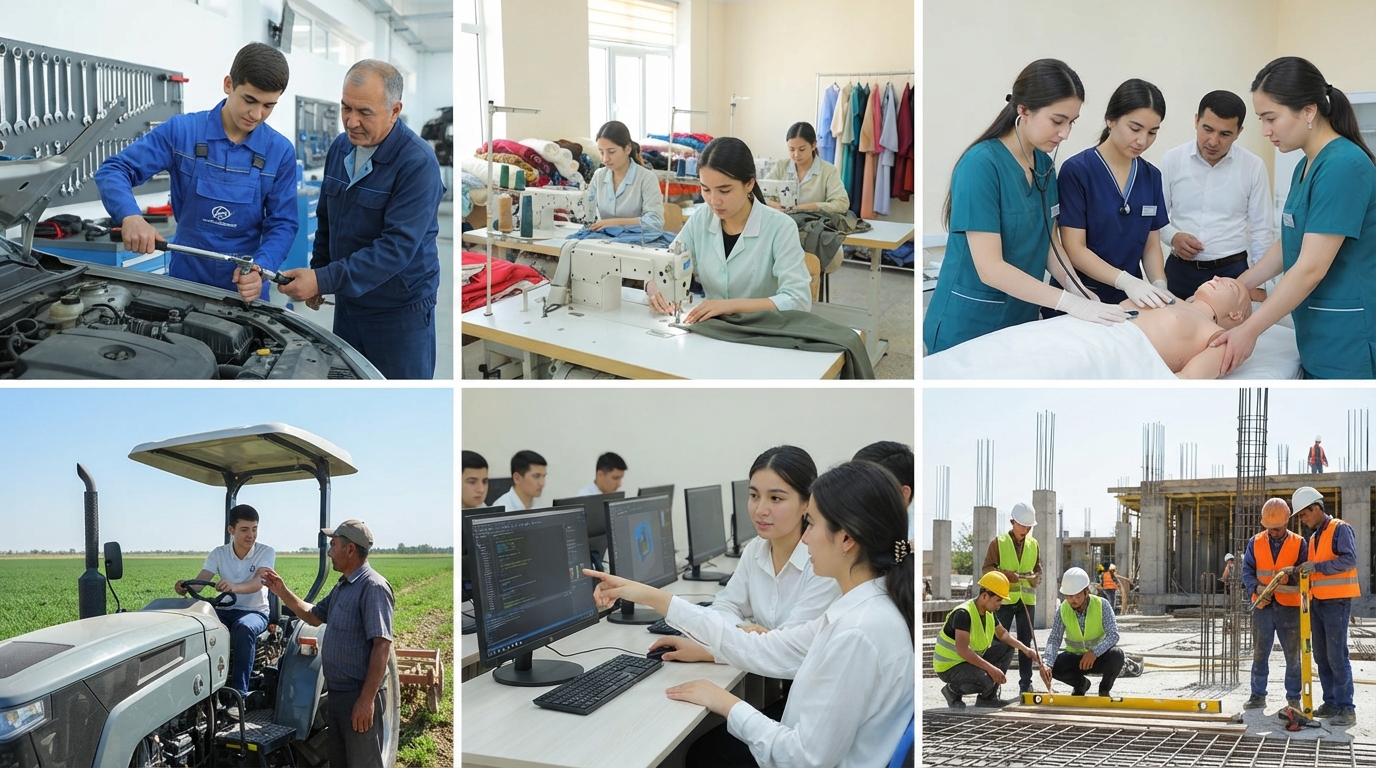
In particular, the profession of "Car repair and maintenance" occupied 20 percent of the total admissions. Also, "Tailor" accounted for 7 percent, "Nursing" 6.2 percent, "Tractor driver-machinist" 5 percent, "General medicine" 4.1 percent, "Computer graphics and design operator" 3.8 percent, and "Digital information processing master" 3.4 percent.
This situation shows that applicant demand is highly concentrated in certain professions and specialties, and signifies the importance of considering young people's interest in educational professions and specialties along with labor market needs when determining admission parameters.
### Top 5 fields with the highest and lowest demand
During the analysis, it was observed that in some professions and specialties, admission parameters were formed at 300–550 percent in excess of the set quotas. At the same time, the absolute opposite was also recorded in some fields. That is, cases were identified where admission parameters were at zero level, despite the existence of approved admission quotas for a number of professions and specialties.
In particular, more students than planned were admitted in the following 5 fields:
"Car repair and maintenance";
"Tailor";
"Nursing";
"Tractor driver-machinist";
"General medicine".
Fields such as "Accountant", "Secondary recycling", "Furniture manufacturing technology", "Cadastre, Energy" (thermal energy) had the lowest demand.
The analysis notes that the formation of admission parameters at zero or very low levels does not always mean there is no demand for these professions and specialties. In practice, in cases where the number of recommended candidates for certain fields was insufficient to form a group, students were transferred to other related fields with their consent.
"The situations mentioned above show the need to comprehensively consider the possibility of group formation, minimum occupancy standards, student choice, labor market needs, and the efficiency of training costs, along with the approved plan and the number of recommended candidates, when determining admission parameters in terms of professions and specialties. This, in turn, requires reviewing low-demand professions and specialties and adapting admission parameters to real needs," the analysis says.
### Information and communication technologies lead in the field of knowledge
The analysis of admission parameters across 10 fields of knowledge and 22 fields of education showed significant differences between fields in terms of demand and the level of fulfillment of admission parameters. In particular, in terms of the field of knowledge, 40,788 students were admitted for 34,245 quotas in the field of information and communication technologies, which means that the admission parameters were fulfilled by 119.1 percent.
Also, 88.5 percent was recorded in engineering, manufacturing, and construction fields, 85.2 percent in health and social security, 85.1 percent in agriculture, forestry, fisheries, and veterinary, 75.6 percent in services, and 73.8 percent in education.
An indicator of 47.2 percent was recorded in business, administration, and law, 43.7 percent in arts and humanities, 26.7 percent in natural sciences, mathematics, and statistics, and 22.3 percent in social sciences, journalism, and information.
### High demand for technical, technological, and practical fields in the vocational education system
In terms of fields of education, the highest admission fell on the field of engineering, with 76,584 students admitted to this field. This constitutes 30.7 percent of the total admissions. This was followed by information and communication technologies with 40,788 students (16.4 percent), health with 34,245 students (13.7 percent), manufacturing and processing fields with 32,407 students (13.0 percent), and agriculture with 24,842 students (10.0 percent).
In general, the main part of admissions is directed towards fields of practical importance for the economy and the labor market. In particular, engineering, information and communication technologies, health, manufacturing, and agriculture education fields account for 83.8 percent of the total admissions. This shows that the demand for technical, technological, and practical fields in the vocational education system is high.
At the same time, the share of admissions in some fields remained very low. In particular, 90 students were admitted in fisheries, 17 in transport services, and 15 in physics and natural sciences. The share of these fields in the total admissions is less than 0.1 percent, which indicates low demand for these fields or that admission parameters were formed in a limited volume.
### Region-specific fields
The analysis also studied which professions and specialties are in high demand in the regions. According to it, high demand was identified for computer systems programming in Tashkent city, chemical production laboratory assistant in Tashkent region, hairdressing in Samarqand region, rescue work in Surxondaryo region, garment design in Farg‘ona region, and crushing and sorting of minerals in Navoiy region.
### Farg‘ona and Samarqand lead in the fulfillment of admission parameters
The results of the analysis showed significant differences between the regions of the republic in terms of the level of fulfillment of admission parameters. In particular, while the average admission rate across the republic was 84.9 percent, in terms of regions, this indicator ranged from 65 percent to 100 percent. The highest results were recorded in Farg‘ona and Samarqand regions, where the admission plan was fully implemented. Also, the admission rate was 96 percent in Buxoro and Andijon regions, 93 percent in Jizzax region, and 92 percent in Namangan region.
The data on admission quotas, the number of actually admitted students, fields of knowledge, fields of education, directions, professions and specialties, forms of payment, and regions used in this analysis were formed on the basis of official information provided by the Agency for Vocational Education.