

International women media professionals of Central Asia gathered in Tashkent
More than 100 women journalists, editors, media managers, and digital content creators from five Central Asian countries
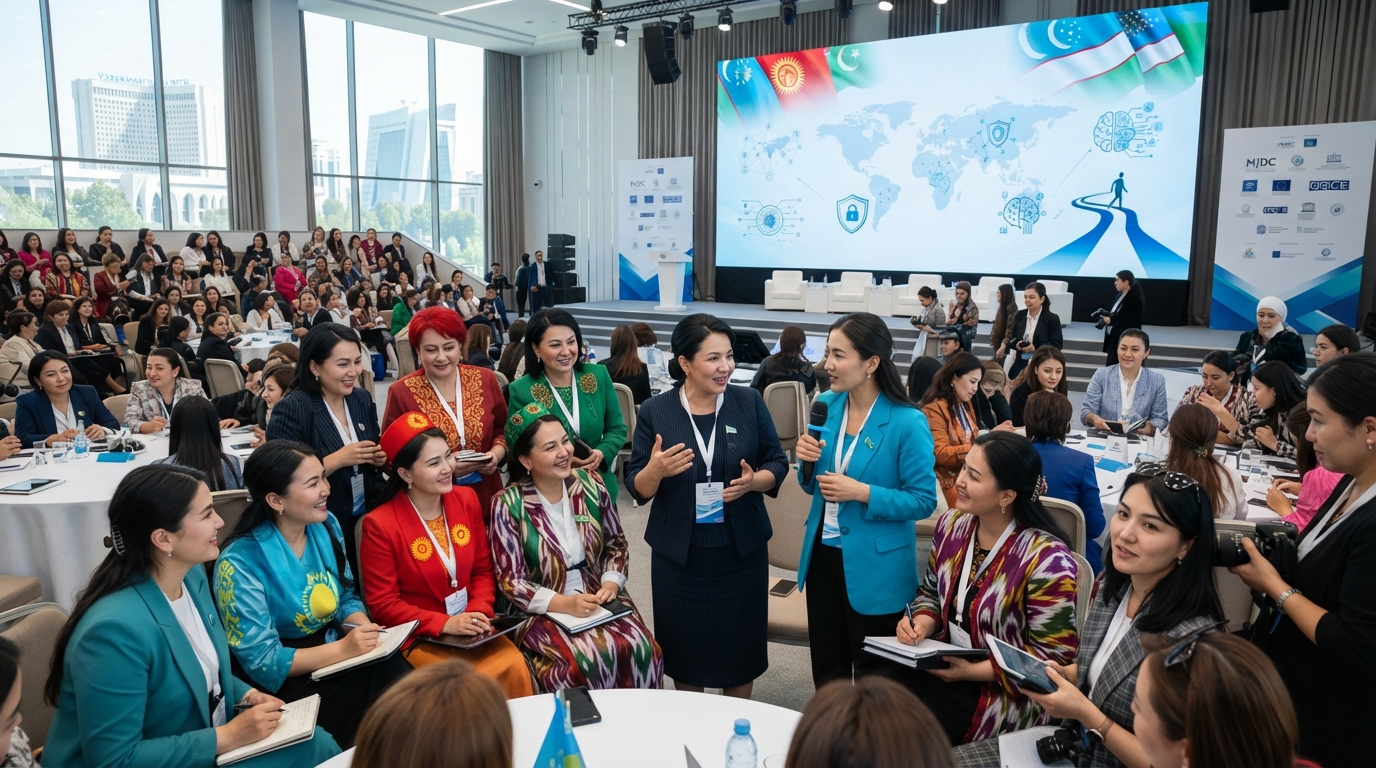
International Women Media Professionals from Central Asia Gather in Tashkent
The International Conference of Central Asian Women Media Professionals has commenced its work. It is attended by more than 100 women media representatives from five Central Asian countries.
In today's information space, regional solidarity is becoming one of the important factors for the development of journalism. Exchanging experience among journalists from different regions and countries, strengthening cooperation, and jointly finding solutions to common problems serve to deliver information quickly and reliably. Especially in the context of expanding digital platforms, increasing journalists' knowledge of cybersecurity and protecting personal data and sources remains an urgent task.
Currently, at the II Central Asian International Conference of Women Media Professionals "Regional Solidarity, Digital Security and the Inclusive Future of Journalism," more than 100 women journalists, editors, media managers, digital content creators, and experts from five Central Asian countries are discussing digital security, artificial intelligence, gender standards, and the development of regional cooperation.
Initiated by the Modern Journalism Development Center of the Republic of Uzbekistan (MJDC), the conference is being held in cooperation with the Center for Content Production for Mass Media under the Administration of the President of the Republic of Uzbekistan, the Public Fund for Support and Development of National Mass Media, the Delegations of the European Union to Uzbekistan, Kazakhstan, and Tajikistan, the Embassy of Switzerland in Uzbekistan, the OSCE Project Co-ordinator in Uzbekistan, the OSCE Office in Dushanbe, the OSCE Programme Office in Bishkek, the UNESCO Offices in Uzbekistan and Kazakhstan, and the Creative Industries Park of Kyrgyzstan. The conference addresses current challenges that are increasingly affecting the activities of women in the Central Asian media sector.
Discussions are also being held on digital violence, deepfakes, and other forms of abuse of artificial intelligence technologies, disinformation, professional burnout, barriers to women's entry into media management, and issues of sustainable professional support among the countries of the region.
According to Saida Sulaymanova, Director of the Modern Journalism Development Center of the Republic of Uzbekistan, the need to unite Central Asian women journalists arose two years ago.
"Today, it is important to take the next step — to turn regional cooperation into an active system of professional relations and mutual support. Regardless of which country they are in, women in the media sector face very similar challenges — from digital harassment and professional pressure to the rapid changes brought by artificial intelligence. Responding to such challenges together is much more effective," notes Saida Sulaymonova.
The impact of artificial intelligence on the work of staff and editorial offices became one of the central topics of the conference. Experts and participants actively discussed the ethical principles of using AI in editorial activities, its capabilities in data analysis and investigative journalism, as well as issues related to the spread of synthetic content and deepfakes, and new forms of information manipulation.
It is worth noting that a significant part of the program was dedicated to digital security and professional sustainability. The role of women journalists and media professionals in the Central Asian media is steadily growing. Nevertheless, they encounter various obstacles in rising to leadership positions and participating in important decision-making processes.
The term "glass ceiling" refers to these invisible but career-limiting barriers. To overcome such situations, it is important to support the professional potential of women, create equal opportunities, and develop leadership skills.
In practical sessions, female participants work with tools for protecting accounts and data, analyze online attack scenarios, and discuss potential mechanisms for providing rapid professional assistance. "Women journalists play a crucial role in ensuring that the media reflects events as they actually happen. Women breaking through the 'glass ceiling' are often expected to succeed even in complex or turbulent environments. Since true equality requires systematic mentoring, institutional support, and long-term investment, the European Union continues to support independent media in the Central Asian region through training programs, including on gender-sensitive journalism and journalist safety, as well as by providing grants and fellowships for journalists," said Toivo Klaar, Ambassador of the European Union to Uzbekistan.