

Infographics: Uzbekistan's cooperation with the countries of Central Asia and Azerbaijan
In recent years, Uzbekistan's economic cooperation with the countries of Central Asia has significantly expanded and strengthened, contributing to sustainable economic growth not only in Uzbekistan but also in other countries of the region.
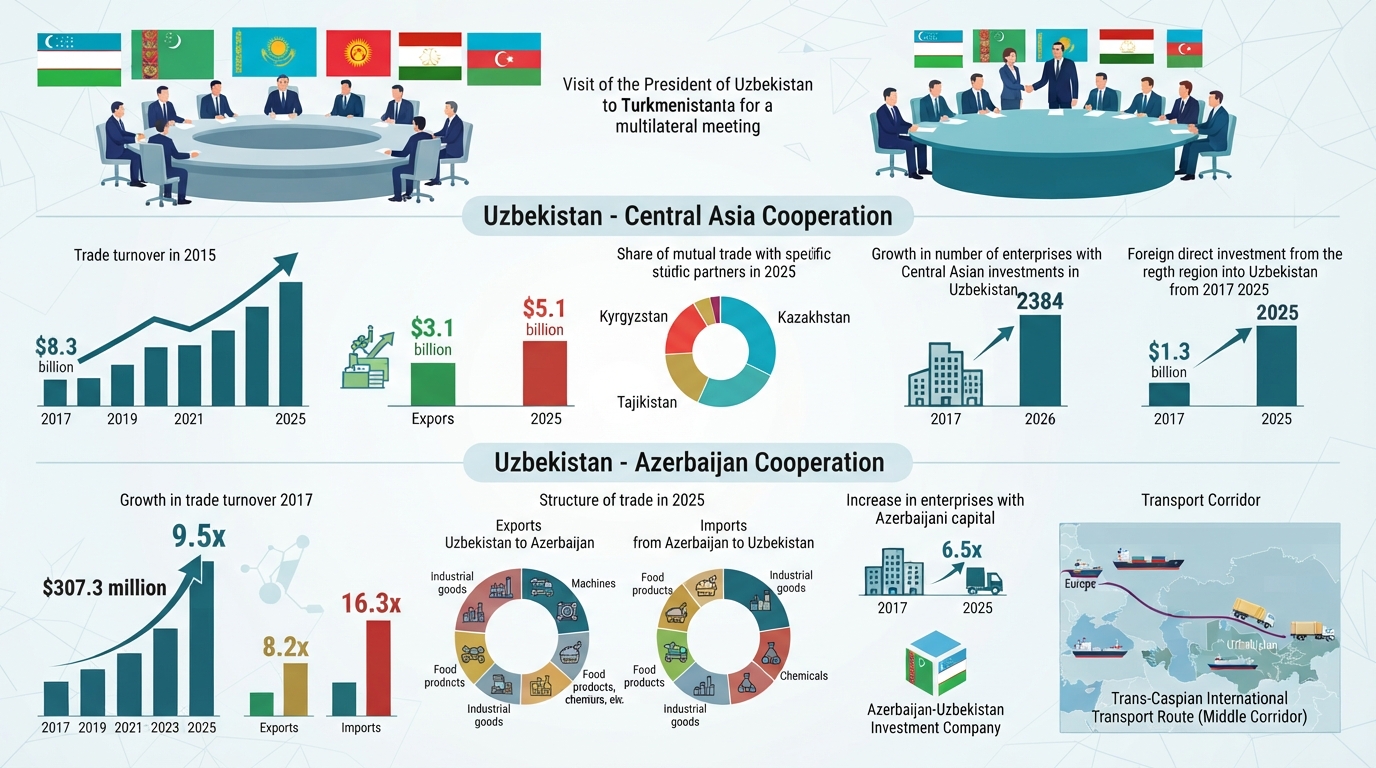
Infographics: Uzbekistan's Cooperation with Central Asian Countries and Azerbaijan
At the invitation of the President of Turkmenistan Serdar Berdimuhamedov, the President of the Republic of Uzbekistan Shavkat Mirziyoyev will pay a working visit to this country on October 7-9.
In the "Avaza" National Tourist Zone, the head of Uzbekistan will participate in the eighth Consultative Meeting of the Heads of State of Central Asia and Azerbaijan, as well as in the regular summit of the Commonwealth of Independent States.
Over the past 9 years, key indicators of Uzbekistan's trade and economic cooperation with Central Asian countries have significantly increased: Uzbekistan's trade turnover with Central Asian countries for 2017-2025 grew 3.1 times and reached $8.3 billion, exports increased 2.1 times and amounted to $3.1 billion, imports grew 4.2 times to $5.1 billion.
The number of enterprises with investments from Central Asian countries grew more than 7 times and exceeded 2.3 thousand units; the volume of annual foreign direct investment and loans attracted to Uzbekistan from Central Asian countries increased more than 600 times and in 2025 amounted to $1.3 billion, whereas in 2017 it was only $2.1 million.
In the structure of mutual trade in 2025, Kazakhstan remains the largest partner — trade turnover amounted to $5 billion, or 60.2% of Uzbekistan's trade with the countries of the region. Trade turnover with Turkmenistan reached $1.2 billion (14.5%), with Kyrgyzstan — also $1.2 billion (14.5%). The volume of trade with Tajikistan amounted to $912.3 million, or 11%.
Uzbekistan's exports to Central Asian countries in 2025 reached $3.2 billion. The share of the region's countries in Uzbekistan's total exports was 9.8%. Imports from Central Asian states stood at $5.1 billion, and their share in the country's total imports reached 11.1%.
Mutual trade between Central Asian countries is conducted under a "free trade" regime based on bilateral free trade agreements signed back in 1996-1997.
According to CERR calculations, by replacing products imported from third countries with export deliveries to each other, the volume of internal trade in the region can be increased by $11.4 billion.
As can be seen, the growth potential of internal trade is very high, and to realize it, it is necessary to eliminate both tariff (exemptions) and non-tariff barriers in mutual trade. In addition, conditions must be created so that exporters and importers of the region's countries receive information on demand and supply of goods within the common market of Central Asian countries on a permanent basis.
In parallel, investment cooperation is developing. The cumulative volume of foreign direct investment and loans from Central Asian countries for 2017–2025 amounted to $2.5 billion. In 2025 alone, the volume of direct investment and loans attracted from the region reached $1.3 billion.
As of June 2026, 2,384 enterprises with capital from Central Asian countries operated in Uzbekistan. Most enterprises were established with the participation of Kazakh capital — 1,283. The number of enterprises with Tajik capital was 442, with Kyrgyz — 362, with Turkmen — 297.
Cooperation between Uzbekistan and Azerbaijan has noticeably intensified over the past few years and reached the highest level of interstate interaction — strategic partnership and allied relations.
The "Supreme Interstate Council" has been established under the chairmanship of the presidents of the two countries, which has become an effective mechanism for promoting multifaceted cooperation between Uzbekistan and Azerbaijan.
Mutual trade between Uzbekistan and Azerbaijan is carried out under a free trade regime.
Over the period of 2017-2025, the volume of Uzbekistan's trade turnover with Azerbaijan grew 9.5 times — from $32.5 million to $307.3 million, exports increased 8.2 times — from $27.6 million to $227.3 million, imports — 16.3 times, from $4.9 million to $80 million.
In 2025, the structure of Uzbekistan's exports and imports to/from Azerbaijan was as follows:
– exports, total $227.3 million, including: manufactured goods — $63.4 million (28% of exports), machinery and transport equipment — $49.3 million (22%), food products — $36.3 million (16%), beverages and tobacco — $34.3 million (15%), miscellaneous manufactured articles — $11 million (5%), chemical products — $5.1 million (2.2%), as well as services — $22.5 million (10%);
– imports, total $80 million, including: food products — $43.2 million (54% of imports), manufactured goods — $17.4 million (22%), machinery and transport equipment — $5.8 million (7.3%), chemical products — $5.4 million (6.8%), crude materials, inedible — $1.3 million (1.6%), mineral fuels and lubricants — $1.2 million (1.5%), as well as services — $4.3 million (5.4%).
Special attention is paid to investment cooperation. In 2023, the Azerbaijan-Uzbekistan Investment Company was established with an authorized capital of $500 million.
Currently, 460 enterprises with the participation of Azerbaijani capital operate in Uzbekistan; compared to 2017 (71 units), their number has grown 6.5 times.
In 2025, the volume of Azerbaijan's investments in Uzbekistan amounted to $173.7 million (in 2017 — $0.1 million).
The total volume of accumulated investments from Azerbaijan in Uzbekistan amounted to $318.6 million.
The main areas of activity of enterprises with Azerbaijani capital are construction, manufacturing, and agriculture.
Capital from Uzbekistan is also expanding its presence in the Azerbaijani market; in particular, joint ventures for the production of cars and textile products have been established.
The transport sector remains an important area of cooperation. Uzbekistan is interested in implementing joint projects to effectively utilize Azerbaijan's transport logistics when delivering goods to Europe via the Trans-Caspian International Transport Route (Middle Corridor).