

Infographics: Trade, economic and investment cooperation between Uzbekistan and India
The Center for Economic Research and Reforms has prepared a review and infographic on Uzbekistan's trade, economic, and investment cooperation with India over the past 9 years.
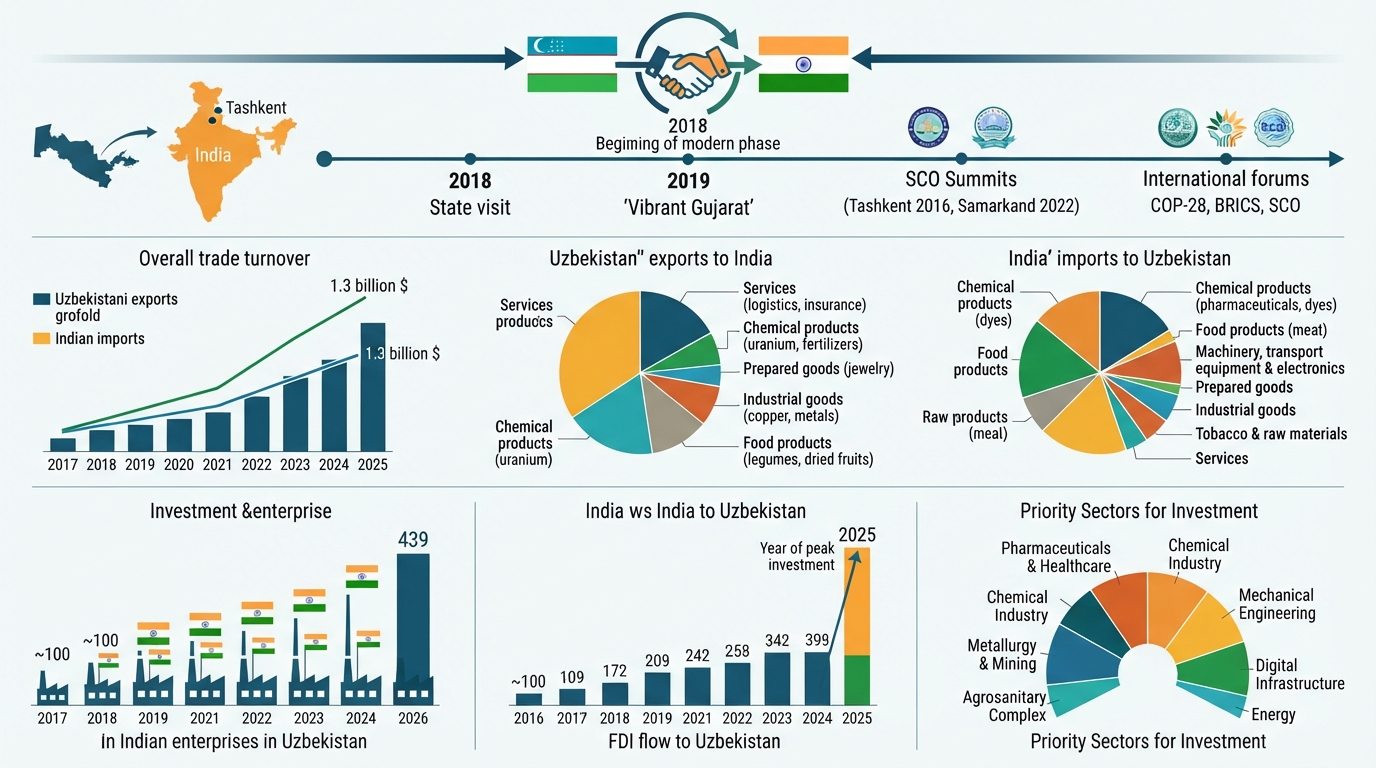
**Infographics: Trade, Economic, and Investment Cooperation between Uzbekistan and India**
A new stage in bilateral relations between Uzbekistan and India began after the state visit of President Shavkat Mirziyoyev to India on September 30 - October 1, 2018. Following the negotiations, 20 documents were signed covering trade and investment, pharmaceuticals, tourism, agriculture, science and technology, healthcare, space, and other fields. Agreements were also reached on establishing the Uzbekistan-India Business Council and developing direct cooperation between the regions of the two countries.
In January 2019, the President of Uzbekistan paid a working visit to India and participated as a guest of honor in the "Vibrant Gujarat" International Investment Summit. During the meeting with Prime Minister Narendra Modi, special attention was paid to the practical implementation of the issues agreed upon during the 2018 state visit. In particular, the parties promoted projects in information technology, pharmaceuticals, education, and infrastructure, and also exchanged an agreement on the long-term supply of Uzbek uranium to India.
Indian Prime Minister Narendra Modi visited Uzbekistan to participate in the SCO summit in Tashkent in June 2016 and the SCO summit in Samarkand in September 2022. In December 2020, a virtual summit between the President of Uzbekistan and the Prime Minister of India took place. In January 2022, the President of Uzbekistan participated in the first "India – Central Asia" summit held online.
In recent years, active high-level dialogue has also continued on international platforms. The President of Uzbekistan and the Prime Minister of India held meetings on the sidelines of COP-28 in Dubai in December 2023, at the BRICS summit in Kazan on October 23, 2024, and within the framework of the SCO summit in Tianjin in September 2025.
Thus, the Uzbekistan-India high-level dialogue has become regular and is developing consistently through mutual visits and within the framework of the SCO and BRICS. The relations are based on a strategic partnership covering trade and investment, industrial cooperation, pharmaceuticals, digital technologies, energy, transport, education, and cultural-humanitarian ties.
In addition, the India-Uzbekistan Intergovernmental Commission on Trade-Economic, Scientific, and Technological Cooperation is active. Its 14th meeting was held on June 19, 2026.
The parties aim to double the volume of mutual trade within three years. At the same time, work is underway to eliminate non-tariff barriers, mutually recognize standards, simplify certification and customs procedures, digitally exchange customs data, and develop payment infrastructure.
The most-favored-nation treatment applies to trade between the countries.
In 2017–2025, the trade turnover between Uzbekistan and India increased 4-fold, reaching $1.3 billion from $324.9 million. Uzbekistan's exports increased 4.9-fold, rising from $33.8 million to $164.8 million, while imports from India increased nearly 4-fold, reaching $1.15 billion from $291.1 million.
During this period, India's share in Uzbekistan's foreign trade also increased. Its share in the total trade turnover rose from 1.2% to 1.6%, its share in exports from 0.2% to 0.5%, and its share in imports from 2.2% to 2.4%.
In **Uzbekistan's exports to India** ($164.8 million), the main share is made up of services (road transport, personal travel, and insurance services) at 37.5% ($61.7 million) and chemical products (radioactive chemical elements, fertilizers) at 33.3% ($54.8 million). Also, various manufactured goods (jewelry) account for 13% ($21.4 million), industrial goods (copper pipes, rare metals) for 11% ($18.2 million), non-food raw materials (shellac, fibrous pulp) for 2.9% ($4.8 million), and food products (leguminous vegetables and dried fruits) for 2.1% ($3.4 million).
In **Uzbekistan's imports from India** ($1,153.1 million), chemical products (medicines, dyes, etc.) are leading, with their share accounting for 36% ($415.3 million). Food products (meat products) account for 27% ($311 million), machinery and transport equipment, and electrical goods account for 26.6% ($306.5 million). Also, various manufactured goods account for 3.9% ($44.7 million), industrial goods for 3.7% ($43.2 million), tobacco and non-food raw materials for 1.5% ($17.4 million), and services (transport and computer services) for 1.2% ($13.7 million).
As of August 2026, 439 enterprises with Indian capital are operating in Uzbekistan. Of these, 89 are joint ventures, and 350 are enterprises with 100% Indian capital. For comparison, in 2017–2018, the number of such enterprises was around 100. This indicates a significant expansion of Indian business presence in Uzbekistan.
In 2025, the volume of foreign direct investment and loans attracted from India amounted to $247 million. Overall, in 2016–2025, the total volume of foreign direct investment and loans attracted from India reached nearly $587 million. The year 2025 alone accounted for about 42% of the Indian investments and loans attracted during the period under review. This is also the highest investment figure among South Asian countries.
Indian capital and joint projects are primarily concentrated in pharmaceuticals and healthcare, the chemical industry, metallurgy and mining, mechanical engineering, energy and digital infrastructure, as well as the agro-industrial complex. These areas are considered by the parties as priority sectors for further expanding investment cooperation.