

India's hospital boom is improving access but pricing millions out of critical care
Indian hospitals have attracted billions in funding, but the gap between public and private care is widening.
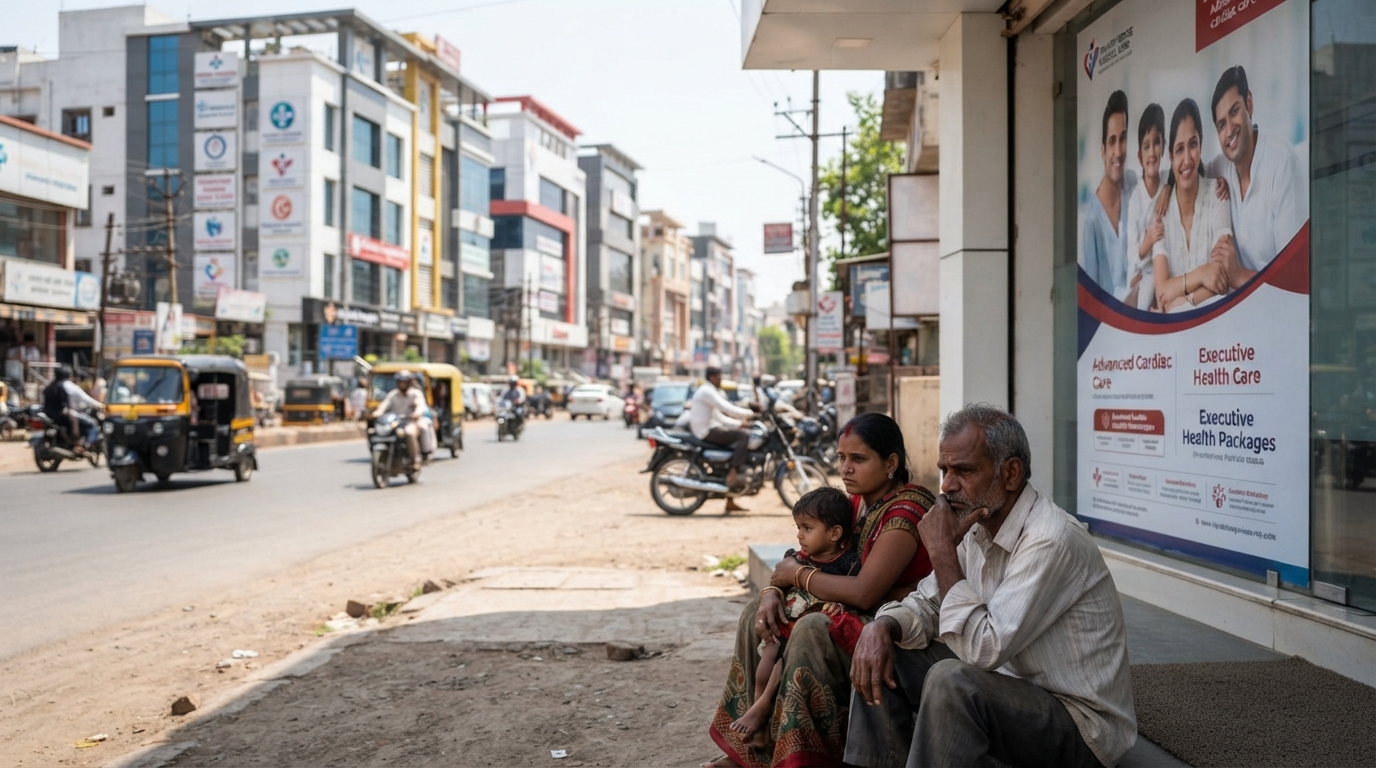
India’s hospital expansion is widening access, but also putting critical care out of reach for millions
India’s private healthcare sector has expanded at an extraordinary pace in recent years
On a recent trip to Miraj, the small western Indian town where I grew up, I counted more than 50 multi-specialty hospitals, diagnostics centres and health clinics lined up along a five kilometre stretch of road.
Many of these facilities have opened only in the past five years, despite the town long serving as a regional medical hub in Maharashtra.
Their rapid spread reflects the unprecedented surge in India’s private healthcare industry in recent years.
Hospitals have been expanding at breakneck speed each quarter by adding thousands of beds, diagnostics chains have been extending their reach into smaller towns, and medical institutes have been raising hundreds of millions of dollars through public markets to widen their presence nationwide.
In early August, Manipal Health, India’s largest multi-specialty hospital, raised nearly a billion dollars in what became India’s second-largest initial public offering (IPO) this year.
The sector has also been a favourite of global private equity (PE) investors. Between 2022 and 2024, Indian healthcare and pharma companies saw nearly 600 mergers and acquisitions and private equity deals worth more than $30bn.
According to Grant Thornton, 40% of that money went to hospitals.
More than $20bn was also raised by the sector over the past two years, according to newer data the consultancy shared with the BBC.
But while this investment wave has dramatically improved access to health infrastructure, it has also priced millions of Indians out of care.
That was underscored by a new report, external released recently by a government panel, which points to the stark inequality in India’s fast-growing healthcare economy and raises serious concerns about a “deepening affordability crisis” in private hospitals.
The report said treatment in private hospitals is often five to 10 times more expensive than in government facilities, with the difference becoming even larger for serious illnesses such as cancer, heart disease and kidney failure.
It also said the “unbridled” growth of clinics, nursing homes and diagnostic centres, along with uneven enforcement of regulatory standards, had created “glaring disparities in both the quality and cost of care in private sector, leaving patients vulnerable to arbitrary pricing and substandard practices”.
It further blamed “rampant commercialisation of private healthcare” for rising complaints from patients over issues such as excessive billing, unnecessary diagnostics and sharply rising costs for routine procedures like childbirth, which it said was “directly pushing vulnerable households into catastrophic debt and distress, causing asset sales”.
Earlier this week, the food and drug regulator in Maharashtra, India’s richest state, also found IV (intravenous) sets being sold at an astonishing profit margin of 2,800% in hospitals, deepening concerns about the pricing of medical devices, which it said was almost entirely unmonitored.
The government panel offered several recommendations to tackle these problems. Among the more controversial were a cap on hospital room tariffs at the level of the nearest three-star hotel, price regulation for essential treatments, diagnostics and routine procedures across all private hospitals, and standard treatment guidelines to curb over-treatment. It also flagged foreign ownership of more than 51% in hospital chains.
India’s private hospitals have rejected some of the proposals.
In a statement to the BBC, Siddhartha Bhattacharya, Secretary General of NATHEALTH, which represents India’s private healthcare sector, said the government should concentrate on lowering the structural costs of healthcare delivery, including taxes, land, capital, manpower and regulatory compliance requirements, rather than capping rates.
He said healthcare delivery is capital-intensive and investment-heavy, and that return on capital employed “hovers at around 10%, significantly lower than many other sectors of the economy, which often generate 1.5-2.5 times higher returns on capital”.
He also warned against comparing hospital tariffs with hotel tariffs, saying that ignores the major compliance obligations hospitals must meet, such as infection control standards and patient safety norms, all of which add to costs.
The country’s largest hospital chains, from Max Healthcare to Fortis, have said such arbitrary caps will “stifle” investment in the sector and deter foreign investors if they cannot earn risk-free returns on their money.
India is considering a cap on hospital room rates
Still, public health experts say price regulation clearly needs to be debated, since private healthcare in India is currently entirely a seller’s market.
“With big foreign private equity money coming in, especially in tertiary care, it is people outside the country who are basically making decisions on price points. That should not be the case,” Dr Srinath Reddy of the Public Health Foundation of India told the BBC.
Government intervention is even more important because of the “super profits” many of these hospitals have been making, said Vivek ND, another health policy expert.
“The increased emphasis of these hospitals on conducting various tests, pushing for diagnostics which might not be required must also be looked into,” he said.
Some of the proposals — including the fairer goods and services taxation regime recommended by the panel — could help lower the cost of private healthcare, according to Vivek, though he said broader consultations with the industry are needed before any recommendations become binding.
Dr Reddy agrees. Before the government imposes price caps arbitrarily, proper nationwide estimates of the exact cost of private healthcare are needed, he said.
“Costs will differ state to state and city by city, so you can’t impose blanket caps across the country,” he said.
But as the debate intensifies, experts say the wider focus must be on strengthening public healthcare to bring down patient costs, something the panel itself recommends.
India’s current government health spending stands at 1.4% of gross domestic product (GDP), below the 2.5% target set in the National Health Policy nearly a decade ago and far short of the 5% recommended by the World Health Organization.
The government panel’s report itself says that low spending on secondary and tertiary healthcare has pushed citizens toward expensive private facilities, leading to “catastrophic out-of-pocket expenditure”.
The government will “have to up its game” with greater public investment to reduce ordinary people’s dependence on private hospitals, Vivek said.
At the same time, India needs an estimated $300bn in additional healthcare investment to build capacity.
A large share of that money will clearly have to come from private domestic and foreign investors, leaving policymakers with the challenge of making sure investors do not walk away while ordinary people are not priced out of essential care.