

India's Gen Z are driving up a mega boom in its beauty market
E-commerce, rising income levels and the world's largest youth population are fuelling India's beauty boom.
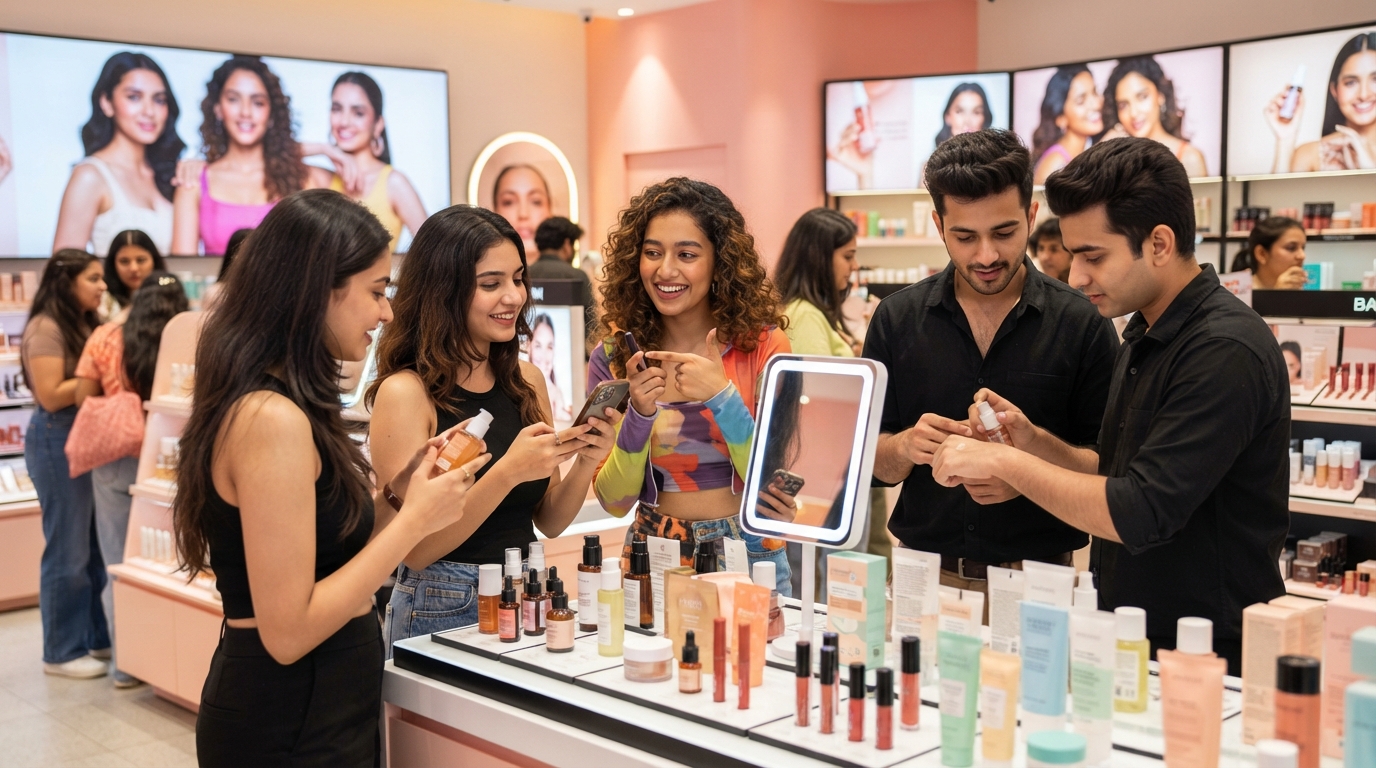
India's Gen Z population is fueling a massive expansion in the nation's beauty market, which is projected to nearly double in value by the close of this decade.
Global investors have recently shown significant interest in Indian beauty brands. In March of this year, American luxury cosmetics company Estée Lauder completed its acquisition of Forest Essentials. Following this, in June, France's L'Oréal Group secured a majority stake in the digital personal care brand Innovist. Over the past two years, Unilever, through its venture capital division, has made at least four investments in the country's beauty sector.
Forest Essentials, founded in a Himalayan foothills garage at the turn of the millennium by Mira Kulkarni, a single mother of two, has evolved from a nascent startup into a billion-dollar global enterprise over two decades. Its trajectory mirrors the explosive growth of India's beauty industry, which was valued at approximately $23 billion (£17.08 billion) in 2025 and is anticipated to reach $40 billion by the end of the decade, expanding at twice the rate of India's GDP and the broader retail market.
Experts attribute part of this boom to the increasing purchasing power within Asia's third-largest economy. According to business consultancy Redseer, India's per capita income surpassed $2,000 in 2019, a point at which discretionary spending typically accelerates. By 2030, an estimated 155 million households are expected to have an annual income exceeding $9,500, further propelling this growth.
Kushal Bhatnagar, a partner at Redseer, informed the BBC, "Historically, we've underspent on beauty because there was just no purchasing power for anything other than the very basic stuff – such as all-purpose soap or face powder." He added, "But now, along with more spending power, there is improved access, distribution and product education. The internet broke these barriers, with brands leveraging the power of social media platforms and influencers to reach consumers directly."
Redseer's estimates indicate that e-commerce is expected to account for about 35% of total beauty spending by 2030, a significant increase from just 8% five years ago. E-commerce, rising income levels, and the world's largest youth population have collectively driven India's beauty boom.
The pandemic also served as a significant catalyst for the industry, according to Vaishali Gupta, whose two beauty ventures have experienced rapid growth since their launches during Covid. In 2023, she co-founded Hyphen, a vegan skincare company, with Bollywood star Kriti Sanon. She also manages mCaffeine, which produces scrubs, washes, and lotions, and identifies itself as India's first caffeinated personal care brand.
Gupta told the BBC, "Covid pushed people inward and toward self-care, and it coincided with a massive wave of digital penetration tier-one, tier-two and tier-three towns. Suddenly Indian consumers had access to beauty and skincare education they'd never had before – such as what was trending in Korea or Europe, or what specific ingredients could do for brightening or acne control." She continued, "That knowledge base created a consumer who knew exactly what they wanted. And that's really where the boom in Indian skincare began."
In the past year, Gupta's brands have seen their top line grow by 100%, and she foresees strong double-digit growth moving forward. She states that both Hyphen and mCaffeine are now among the top 10 brands in their respective categories in India. "This is a structural growth story – and we're just at the beginning of what this market can become," Gupta remarked.
Consequently, numerous Bollywood celebrities, including Deepika Padukone, Katrina Kaif, and Shilpa Shetty of Big Brother fame, have also entered the market by launching skincare companies in recent years.
Customer growth is originating from all parts of the country, not just major cities. Gupta also highlights that Gen Z is a key driver, spending approximately twice as much on skincare and personal care as millennials. Data from Walmart-backed Flipkart, India's largest e-commerce platform, supports this, showing that 56% of its beauty and personal care shoppers are Gen Z, with 70% discovering products through social media. Additionally, two out of three beauty searches on Flipkart originate from non-metro areas.
Redseer projects that the share of beauty spending by Gen Z and Gen Alpha will increase from 32% in 2024 to around 50% by 2030. Priyanka Bhargav, who leads brand strategy at Flipkart, describes this as an inflection point, noting that what was once an "aspirational category has now become a daily expression of self-care" for many young Indians.
As the market continues to expand, consumers are expected to become even more discerning. Experts suggest that the next phase of growth will be driven by niche brands offering innovative specific ingredients, dermatologist-backed products, and a focus on skin nutrition.
While only a few individual brands have achieved significant scale thus far, Bhatnagar predicts that at this growth rate, at least 10-15 beauty companies will exceed $200 million in revenue within the next three to five years. He concluded, "And when that happens, we expect many of them to tap the public markets, and for IPO (initial public offering) and M&A (mergers and acquisitions) activity to really intensify in the sector."