

Indians are discovering the thrill of shopping without paying
Dopamine sites mimic shopping’s thrill without the spending, turning the ritual of consumption into a digital game.
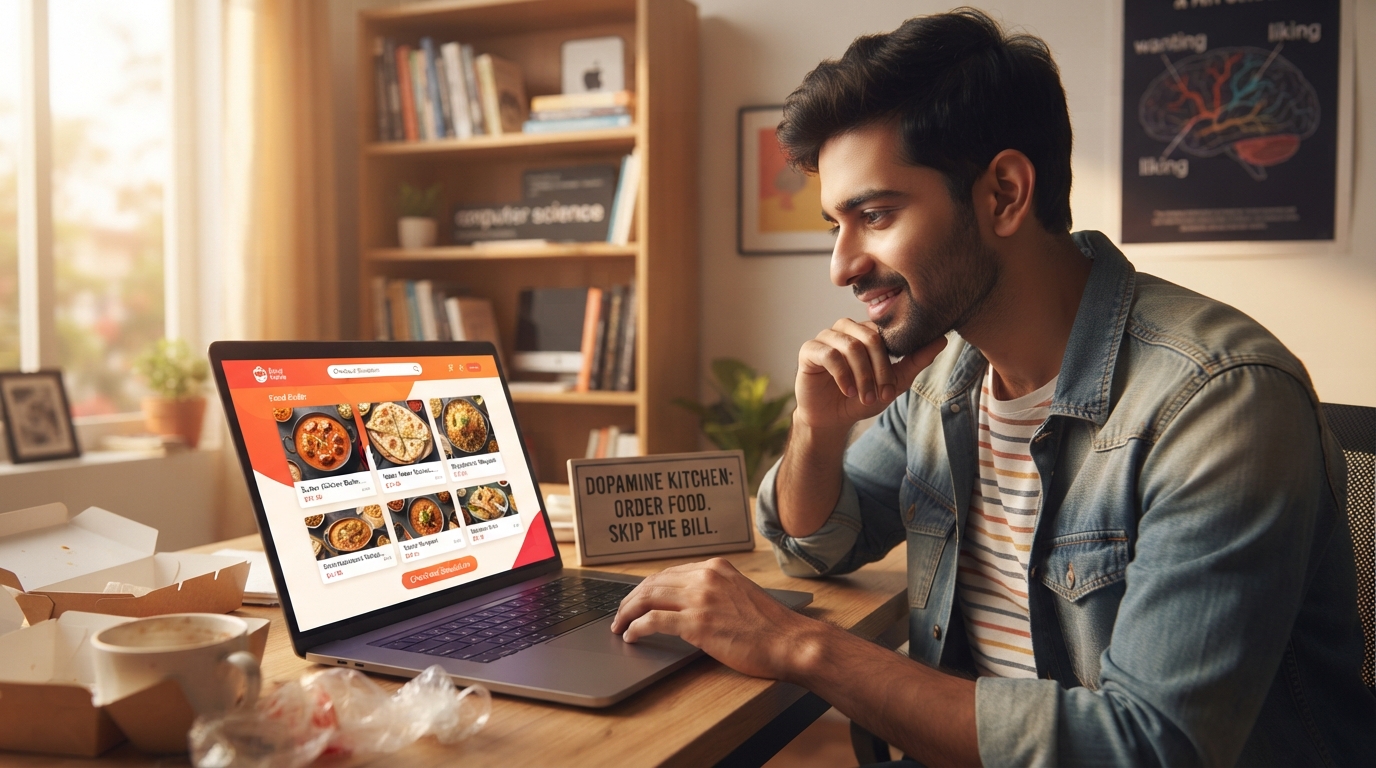
Indians are discovering the thrill of shopping without paying
FoodNeverComes calls itself a "dopamine kitchen"
You are hungry. Or you are not. It makes no difference.
You open FoodNeverComes, choose from 22 cuisines and begin scrolling. Butter chicken looks appealing. Bibimbap does too. You add several dishes, watch the total rise and tap checkout. A tracker shows a rider is on the way.
Then a fake AI-generated call comes from within the site. He says he is outside your building, but cannot locate your street or door. Except there was never any food to begin with. The order exists only on the screen.
"Order the food. Skip the bill," says the site.
Its slogan is even more direct: "The food never comes - but the dopamine does."
Created by two 26-year-old software developers - Purvansh Parmar and Anshul Sharma - from Udaipur in India's northern state of Rajasthan, FoodNeverComes says it has drawn more than 2.7m visitors since launching in June.
It now features 22 kitchens, 327 dishes and 319 real recipes, along with fake prices, a simulated checkout and a fictional delivery experience.
FoodNeverComes is part of a new internet category: "dopamine sites", which reproduce the rituals of consumption without the consumption itself. There are fake shopping sites, fake delivery services and even fake holidays.
The genre took off in South Korea
Dopamine Shop
Fakehaul
, for instance - which imitate everything from food delivery and shopping to travel.
What, exactly, are we enjoying when we enjoy buying something?
The concept grew out of the founders' own shopping habits. Parmar and Sharma met on a computer science diploma course and later founded NeuroX AI, which develops software and AI products and produces Instagram content. They noticed the pattern in their own lives: online baskets filling up with items they wanted, but never actually purchased.
Sharma would browse electronics, fill an online basket and leave it behind. Parmar's mother did much the same. "She would add things to the cart and say, 'I will order this later'," he recalls.
Parmar's own version ended with food delivery checkouts. During a two-month project in Mumbai, he says, he was spending 5,000-10,000 rupees a week on food, sometimes ordering treats he did not really need: Belgian waffles, ice cream and, once, a large jar of sour cream he barely wanted and gave away to friends.
He thinks "perhaps the real craving was not always for the food, but for the ritual of ordering it".
What starts as real hunger, the two argue, can become linked to the pleasure of ordering. Over time, boredom, anxiety or habit can trigger the urge even after hunger has faded.
"Sometimes you're not hungry at all. You're bored or busy, and then you realise that ordering food makes you feel good. You start associating the act of ordering with that dopamine hit. Eventually, it's not just the food you want," says Parmar.
Ravi Dhar, director of the Yale Center for Customer Insights, calls this "anticipatory utility" - the pleasure of looking forward to consumption. It is especially powerful with things that capture the imagination - a new pair of shoes, a holiday, a restaurant meal - because anticipation becomes part of the experience.
Sometimes, Dhar says, anticipation can be more enjoyable than ownership: "The thrill is in the chase." Once the item is obtained and the tension is resolved, psychological arousal drops.
Neuroscience has a term for this gap between the chase and the catch, and it complicates a popular notion. Dopamine is not simply the brain's pleasure chemical, despite the internet's talk of "dopamine hits".
Kent Berridge, a University of Michigan neuroscientist who developed the theory of "wanting" and "liking", says they are distinct processes. Wanting is the motivational pull toward something; liking is the pleasure of having it. They often go together, but not always. In his view, dopamine drives the first, not the second.
Tempting food or products online are likely to activate this wanting system, which Berridge calls "incentive salience".
"Some situations can trigger 'wanting' by itself," he says. We can pursue something intensely even when the eventual pleasure is weak - or, in more everyday terms, want something more than we ultimately like it.
Dr Anna Lembke, a Stanford University addiction psychiatrist and author of Dopamine Nation, makes a similar distinction.
"To call dopamine a chemical of pleasure is an oversimplification," she told me. "Dopamine is the molecule that says 'get more of' or 'do more of', but it doesn't necessarily equate to pleasure."
She also points to ritual. Cues and habits tied to a reward can become reinforcing in their own right, she says: in addiction, the routines leading up to drug use can eventually matter as much as the drug itself. "Anticipation of reward can be as reinforcing as the reward itself," she says.
Can repeatedly ordering imaginary food satisfy a real craving? Berridge says the ritual could create a "dopamine hit and strong 'wanting', and also evoke faint conditioned 'liking'".
But he would expect the "novelty to soon wear off", and would be "surprised" if many people returned to place more than about 10 imaginary orders.
Dhar is more open to the idea that simulated consumption could act as a kind of release valve.
"While we still need more empirical data to know if simulated shopping can satisfy a consumer urge, evidence from simulated consumption in gaming shows it can be highly effective," he says.
But there is an equally plausible risk: the ritual may simply rehearse the behaviour it is meant to replace.
Lembke says the evidence is not yet settled, and the effect may vary by person. But her own view is that, over time, the sites could "reinforce the same addictive neural networks they are trying to simulate".
"The one up side, though, is that people using these sites have on some level already admitted to themselves they have a problem, and that admission is often the first step in recovery," says Lembke.
Sharma carried out an accidental experiment of his own. When his phone screen cracked, he spent a week on Amazon comparing six or seven replacements and adding them to his basket. Then he repaired the handset.
"I enjoyed the process of research and putting the phones in the cart," he says. "Eventually I didn't buy a phone."
He now catches himself doing the same on food delivery sites, especially when anxious, filling baskets without checking out. "I realised that I suffer from this problem," he says.
The site's blog examines the "serious side" of the fake takeaway, from food-delivery addiction and why fake ordering feels good to cravings, guilt and the psychology of the shopping cart.
The founders have since expanded the idea beyond food. A second site, TripNeverLeaves, lets users plan a holiday - destination, flight, seat, hotel and activities - then sends them on a virtual flight that never leaves the runway. They say it has attracted more than 100,000 visitors.
Who those visitors are is harder to determine. But Lembke says younger people may be especially susceptible to reinforcing digital rewards because the "developing brain is a vulnerable brain".
"In childhood and early adolescence, the front lobe, which acts like the brakes on appetite, is not yet fully connected to the emotion centres of the brain. Hence, teens are more likely to take risks without appreciating the negative consequences, and more likely to get addicted to reinforcing substances and behaviours, once exposed," she says.
For now, the founders say the sites are not intended to make money. They plan to keep them free and eventually share the data with neuroscientists and psychologists.
What seems like a joke about ordering too much food has landed on a larger question about modern consumption: if so much of the thrill comes before we get the thing, do we need the thing at all?