

Marketing Tricks: Deceptive Methods to Get You to Spend More
**Marketing Tricks: Tricky Ways to Get You to Spend More**
Everyone knows that you should carefully read prices and look for cheaper products on the lower shelves. However, we still fall for marketers' tricks again and again, buying unnecessary things and regretting it later. We advise you on how they deceive us in stores and how not to fall for these tricks.
**1. It will be more expensive tomorrow**
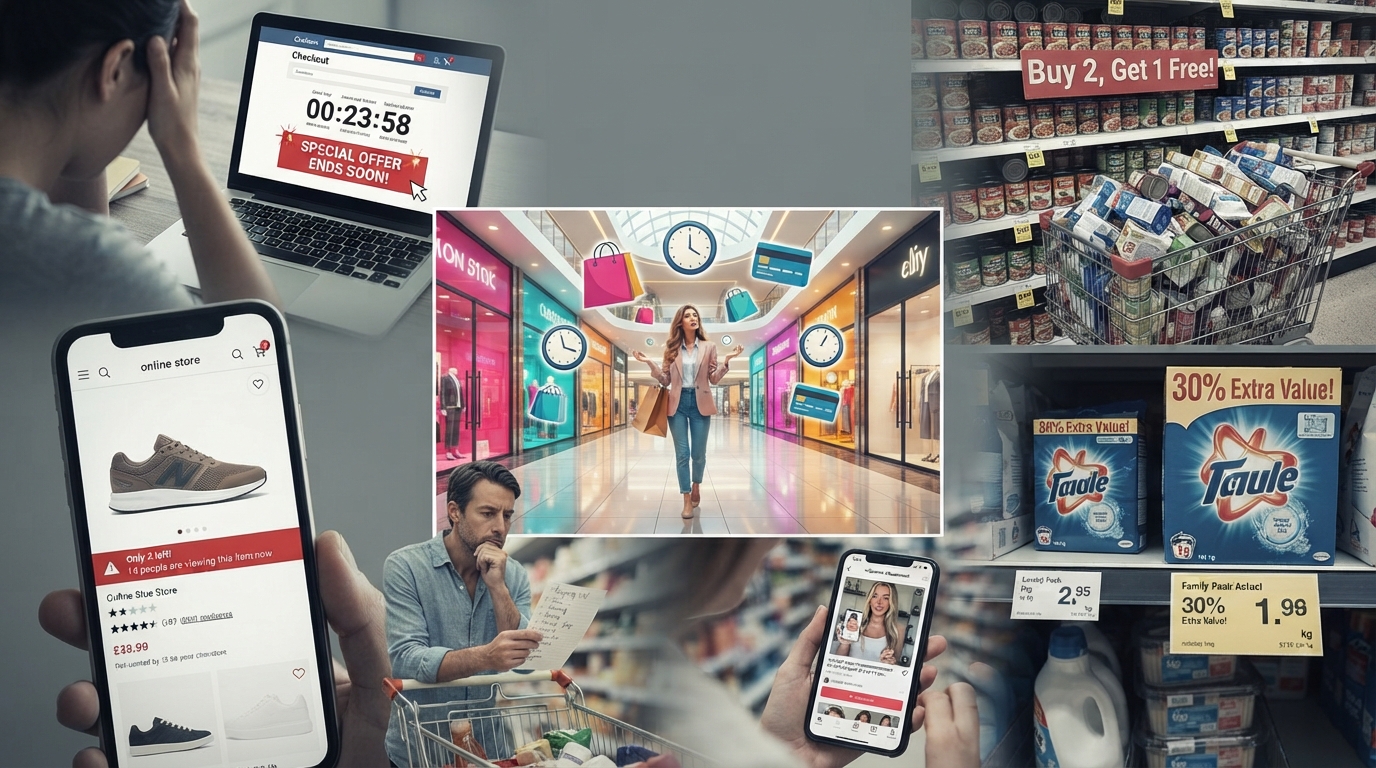
This situation is probably familiar. You paid for an online course or bought an e-book. Immediately you receive an e-mail with a discount coupon. But it is valid for only 24 hours, and a countdown clock even appears in the corner of the screen. You need to immediately pay for the next course or buy five more books for half price. All this, even if you do not need, creates a fear of losing profit. So you find yourself entering your card number.
Offline stores use the same method during limited-time sales and seasonal discounts. The apparent economy encourages people to buy unnecessary things and spend more. And the lack of time does not allow them to think and make rational decisions.
**2. Artificial scarcity**
You go to the website of an online store and see that 27 people are browsing the product page at the same time as you. Moreover, the fact that the last copy is left is flashing in crimson letters. An immediate sense of urgency arises - if you do not add this product to your cart right now, you will not have enough.
Brands use a similar method when releasing limited editions of anything. At the same time, the products may not differ in function. But this does not matter, because there is a desire to get to both and buy.
**3. Three for the price of two**
Simple math: if you buy two cans of corn, you get a third as a gift. A profitable offer, isn’t it? Of course! However, even if half a can is enough for a salad, the rest will sit on the shelf for years.
In addition, through the promotion, they also sell you additional products. For example, for a small additional fee, you get a set of shampoo and shower gel. True, you may not use the shower gel. But the reduced price will encourage you to make this profitable purchase.
Sometimes, a large and seemingly economical package is more expensive than a standard package per gram of the product. However, most buyers, having jumped at the sign “30% free”, do not check this.
**4. The hypnotic effect of shopping centers**
All large shopping centers are similar to each other - bright lights, spacious halls, shiny showcases, pleasant music. As soon as you cross the threshold, you are transported to another world. There are no windows or clocks here, making it harder to tell the time. The excessive light, color, and sound overload your senses and put you in a trance. In this case, it is much more difficult to resist the tricks of marketers.
This phenomenon is called the Grune effect, named after the American designer Victor Grune. He designed the first shopping malls in the 1930s and developed the principles of organizing space that are still used today. Their goal is to make you spend as much time and spend as much money as possible in the mall.
**5. Social pressure**
People tend to follow the behavior of others when making decisions. If your friend enjoys her coffee maker, you may want to buy one too.
Marketers try to create this effect artificially. For example, they use paid positive reviews from fake buyers and recommendations from bloggers. You can understand that influencers are not just talking about the next cream or fitness mat. But you still trust them and want the same for yourself.
**How not to buy too much?**
* **Check the price carefully.** Sometimes a large “promotional” shampoo or two boxes of powder can cost more than one gram of the product.
* **Go to the store with a list.** Determine in advance what you need. Try to refrain from buying food and cosmetics that you do not usually use on a “promotional” basis. There is a high probability that you will not like them or will not fit.
* **Stay away from large shopping centers.** If you must go there, determine in advance which stores you plan to visit. Set a limited time for shopping and try to stick to a schedule.
* **Set aside a specific amount in advance for impulse purchases.** This method will help you control your finances, while still allowing you to enjoy unexpected purchases.
* **Pay attention to the methods of marketers.** Then you notice that there is always a discount on some product in the neighboring grocery store. And the “last pair” of sneakers has been on sale in the online store for a month. Such observations will help you not to succumb to pressure and avoid thoughtless purchases.