

India faces 100% tariff threat over Russian oil after US House vote
Trump’s tariff threat puts India’s Russian oil strategy- and its access to the US market - in a new bind.
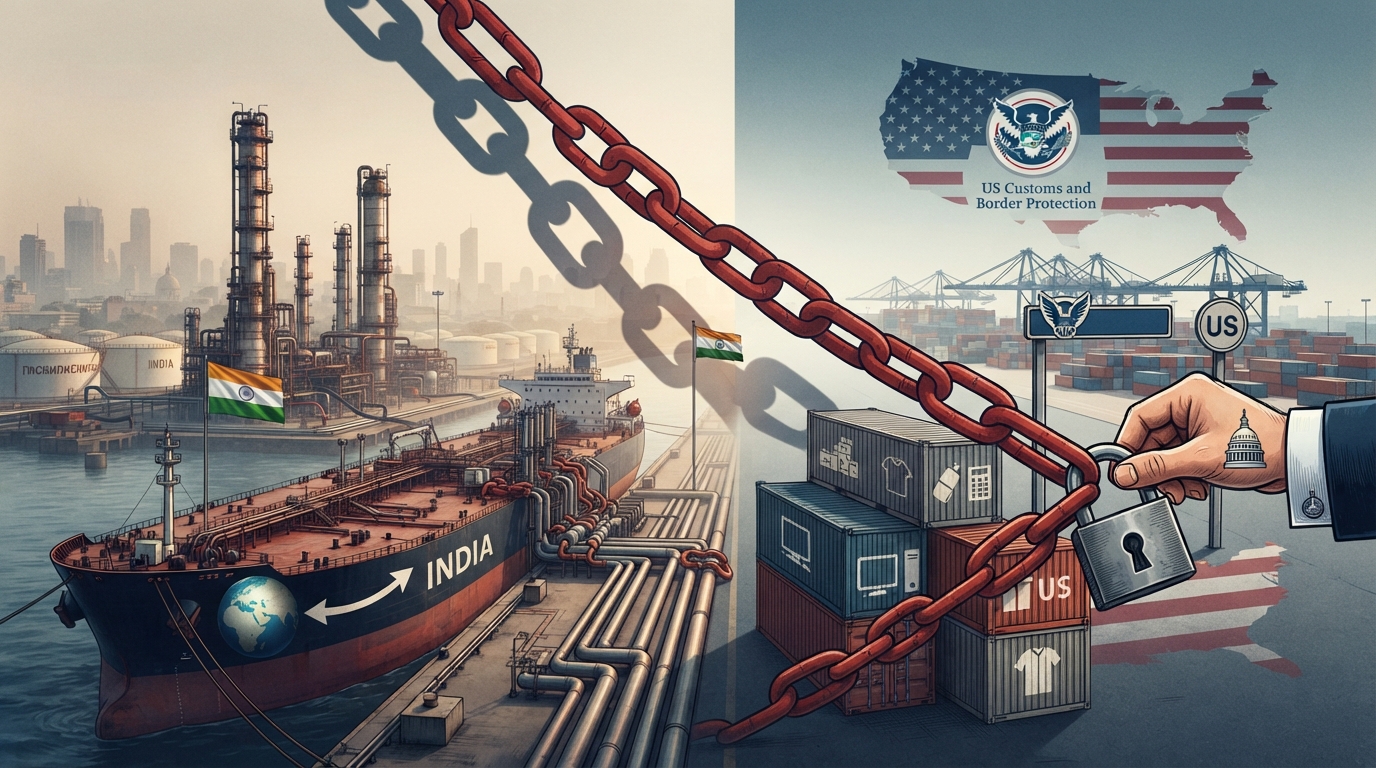
India faces 100% tariff threat over Russian oil after US House vote
For four years, India, one of the world’s largest oil importers, has benefited from the disruption to global oil markets caused by Russia’s war.
Russian crude, pushed out of western markets after the invasion of Ukraine, has instead gone to Indian refineries, often at appealing discounts. That has reduced the cost of one of India’s biggest imports and provided its refiners with a plentiful crude supply.
Now, that advantage is turning into a geopolitical risk.
On Wednesday, the US House of Representatives approved legislation that would give President Donald Trump wide authority to impose sanctions on Russia and tariffs of as much as 100% on countries buying Russian oil and gas. The measure now goes to Trump to be signed into law.
India and China are among the most exposed, since both are major purchasers of Russian oil. Between December 2022 and August 2026, China made up half of Russia’s crude exports, followed by India at 37%, Turkey at 5% and the EU at 5%, according to the think-tank Centre for Research on Energy and Clean Air (CREA).
Russia provided 30.3% of India’s crude imports in fiscal 2026, equal to $40.8bn out of a total crude import bill of $134.7bn, according to the Delhi-based think tank Global Trade Research Initiative (GTRI). In July, Russian crude made up more than half of India’s imports.
Far behind were other suppliers: the UAE supplied 10.8% of India’s July imports, Saudi Arabia 9.6%, Venezuela 6.3%, Brazil 5.5%, Oman 5.3% and the US 2.9%. Russia alone delivered more crude than all six combined.
“The bill is a blunt and dangerous attempt to pressurise India to sign the bilateral trade agreement on one-sided terms. India buys Russian oil to secure affordable energy for 1.4 billion people, not to finance war, and these purchases have helped stabilise global supplies and prices,” says Ajay Srivastava, a former Indian trade official who runs GTRI.
To be fair, the economics of Russian oil have changed. The crude no longer comes with the deep discounts that made it especially attractive to Indian refiners in the early years of the war, while competition for Russian barrels has grown and shipping, insurance and sanctions risks have increased.
“China and India, you better buy your oil and gas somewhere else,” Democratic Senator Richard Blumenthal told reporters
Under normal circumstances, these countries would have 180 days to reduce Russian energy imports or negotiate with Washington, though the president can shorten that deadline.
India said in a statement that it was “monitoring further developments on this matter” and remained “firmly committed to ensuring energy security” for its people.
“This issue has been discussed at high levels in recent months with various US interlocutors. Its potential implications for not just the bilateral relationship but also the international energy market have been very clearly articulated by the Indian side,” it added.
India can source alternative crude, but replacing Russian oil at scale would be costly. S&P Global says alternative supplies can mean higher crude, freight and insurance costs, while longer shipping routes add further expense.
But the tariff threat would also hit India in other ways.
The US is threatening tariffs on Indian exports to America, not a tax on Russian crude entering India. The effects would be felt through Indian exporters, the rupee, refinery margins and the trade balance.
“This new bill could have major problematic impacts for India, and at the worst possible time, amid sensitive final-stage trade talks and shaky broader relations,” Michael Kugelman, a senior fellow at the Atlantic Council, told the BBC.
“India has built some insulation to fend off the shocks of US tariffs through new trade deals with key markets in the EU and elsewhere, and through bolstering an already strong trade partnership with China. But [up to]100% tariffs from a critical export destination is real bad news, no matter how you slice it and even with successful hedging tactics.”
Indian refineries supplied some 70% of Russia’s oil product imports in August
The exposure is substantial. The US imported about $104bn of goods from India in 2025, while two-way US-India trade in goods and services was roughly $240bn, according to the US Trade Representative.
India’s exports to the US include electronics, pharmaceuticals, machinery, jewellery, chemicals, textiles and petroleum products. In 2025, electrical and electronic equipment alone accounted for about $25.8bn of Indian exports to America, pharmaceuticals about $9.7bn and machinery about $7.2bn.
The new threat follows an earlier round of Trump tariffs on Indian goods, which reached 50% in 2025 before being lowered.
That leaves Delhi with an awkward calculation: how much should India pay for Russian crude before the savings are outweighed by the danger to its exports to the US?
There is no straightforward answer. It will depend on the Russian discount, global crude prices, freight and insurance costs, the tariff Trump ultimately imposes, and whether Washington grants exemptions or reaches a wider settlement with Delhi.
The situation becomes even more complex once the crude is refined. India is not just a buyer: its refineries process Russian crude into fuels that can then be exported.
Ukrainian strikes on Russian refineries have forced the world’s once-largest oil-products exporter to import fuel. In August, imports reached a record 172,000 tonnes, more than seven times the previous monthly high, according to CREA. India supplied about 120,000 tonnes, or roughly 70%, mostly petrol refined from Russian crude at a refinery in Gujarat, worth around €78m.
China buys more Russian crude than India, but Kugelman says Beijing has greater leverage because of its role in global supply chains and the size of its economic ties with the US.
“China has massive leverage over the global economy, particularly through its dominance of critical supply chains. India, despite being one of the world’s biggest economies, does not have the same leverage. The Trump administration appears to believe that its economic interests are more exposed if China retaliates than if India does,” says Kugelman.
For India, the question is not only how much Russian oil it buys, but how resilient its alternatives are.
The threat is serious because India imports more than 88% of its crude oil.
More than 85% of India’s crude comes from just six countries, several in conflict-prone regions, while its refineries are not always able to switch easily between crude grades, according to the think-tank Council on Energy, Environment and Water (CEEW).
The vulnerability goes beyond oil. India imports more than 60% of its LPG, the main cooking fuel for more than 330 million households. Its strategic petroleum reserves hold only 9-10 days of net oil imports, compared with roughly 200 days in Japan and 207 in South Korea. Operational stocks at refineries provide another 64 days.
All of this makes Russian crude more than just a bargain: CEEW estimates that India has saved about $12.6bn from its post-2022 shift to Russian crude.
The approaching US tariff could now turn that protection into a liability, forcing Delhi to decide whether the savings from Russian oil are worth the cost of keeping it.
GTRI’s Srivastava believes “Washington could threaten tariffs of up to 100%, then offer a lower rate if Delhi cuts Russian oil purchases and accepts concessions in a deeply unequal trade deal”.
“India should not allow US tariff threats to determine its energy policy,” he says. “It should continue buying Russian oil as long as it remains commercially competitive and negotiate firmly with Washington without granting unilateral trade concessions.”