

In Uzbekistan, monitoring of working conditions for cotton pickers begins on September 25. How it works
Starting September 25, Uzbekistan will begin monitoring the working conditions of cotton pickers. Monitoring groups will visit randomly selected farms, oversee the execution of contracts and payments, and investigate reports of potential labor rights violations.
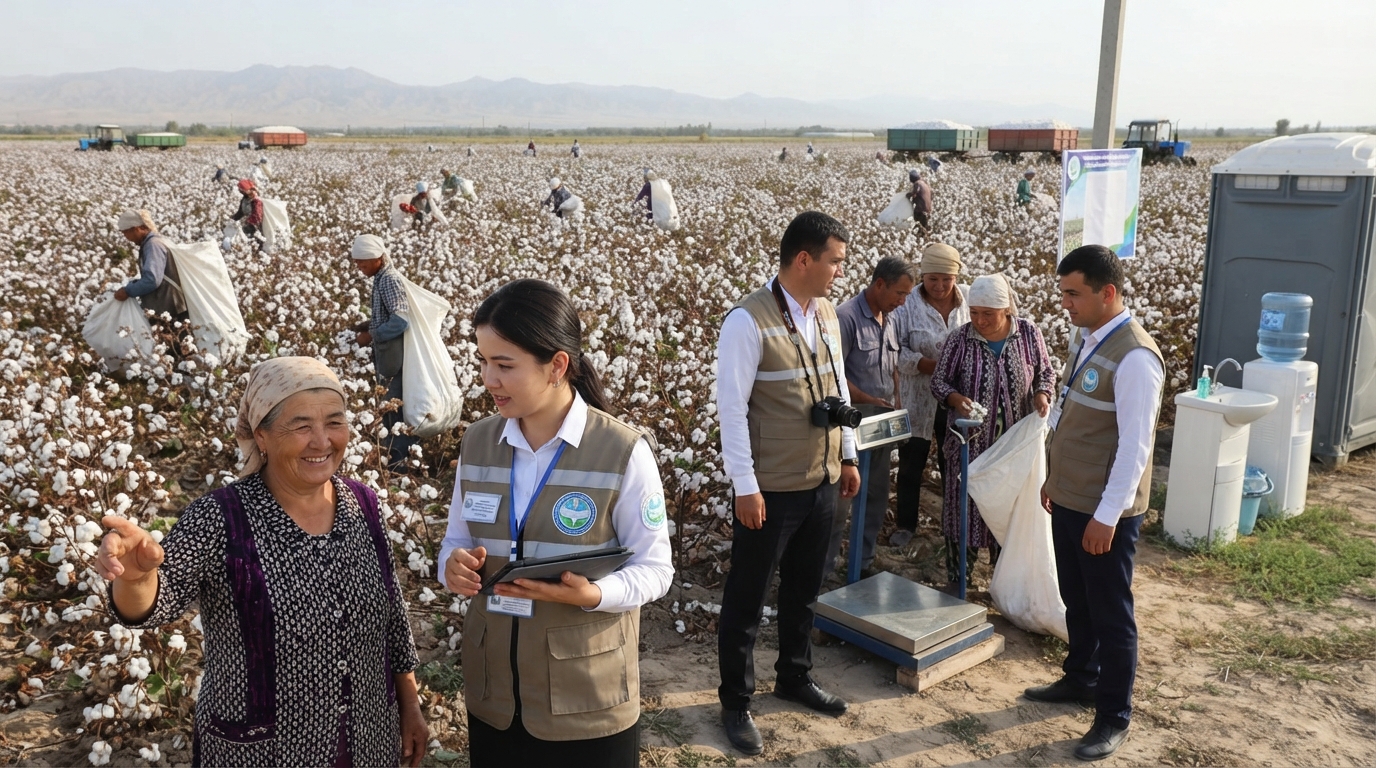
In Uzbekistan, monitoring of cotton pickers' working conditions starts on September 25. How it is organized
National monitoring of the working conditions of cotton pickers in the 2026 season will take place from September 25 to October 31. Its task is to prevent child and forced labor in the fields. The start of the monitoring was announced on September 18 at a briefing of the Federation of Trade Unions of Uzbekistan.
The monitoring group includes 65 specialists — five people in each region. Among them are representatives of sectoral trade unions, labor inspectors of the Federation, as well as members of the Chamber of Commerce and Industry and the National Association of Non-Governmental Non-Profit Organizations.
On Mondays and Saturdays at 7:00 AM, group leaders are sent random GPS coordinates of up to three locations in the region, and by 9:00 AM they already set out for inspection. Data and photo reports are transmitted to the federation daily.
Since September 15, round-the-clock duty has been organized at the federation and its branches for the entire season.
Across Uzbekistan, 200 banners have already been placed, another 10,000 posters are being prepared, and 200,000 leaflets with this information will be distributed to pickers.
"The current situation cannot be compared even with 2020, let alone the indicators of a decade ago. Previously, there was no liability for forced labor — neither administrative nor criminal. Now the administrative code has been tightened, and a separate article has been introduced into the Criminal Code," said Bakhtiyor Makhmadaliev, Deputy Chairman of the Federation of Trade Unions.
According to him, during the monitoring of recent years, the Federation of Trade Unions has not recorded cases of child and forced labor. Among the identified problems, payment delays, work without contracts, and inadequate working conditions still remain. The inspections continue, among other reasons, because international organizations place more trust in results obtained by non-governmental structures.
Katerina Gorbunova, representative of the Better Cotton Initiative program in Uzbekistan, added that the need for such monitoring will disappear only with the arrival of mechanization. The organization certifies more than 20% of the world's cotton and has been conducting its own monitoring of working conditions in Uzbekistan since 2022.
"Take large farms in the US or Brazil: three people work on a 10,000-hectare farm there, and monitoring there simply makes no sense. But when there are 5,000 temporary workers for the same 10,000 hectares, that is a completely different story," the specialist explained.
According to Gorbunova, the cotton season involves a significant part of the population in manual picking. Just three to four years ago, about 2 million people were mobilized annually for cotton picking, and most of them were employed informally.
The informality of labor relations is a common feature of agriculture worldwide, not just in Uzbekistan: this sector inherently carries more risks from a labor law perspective than any other. Therefore, Gorbunova calls monitoring not a punitive tool, but a form of support for workers and a kind of education for farmers. As employers, they usually have a minimal level of knowledge of labor legislation, and through monitoring, they gradually master the norms.
The results of last season's monitoring show what violations pickers face. The Federation of Trade Unions did not identify any cases of child or forced labor in 2025. At the same time, inspectors recorded:
All identified wage arrears were fully paid off, Bakhtiyor Makhmadaliev noted, answering a question from "Gazeta" about the mechanism for resolving such disputes.
"On the issue of labor remuneration, it was established that 8,752 pickers did not receive their money on time. Our inspectors, together with the heads of farms, took care of this, and the debt was 100% eliminated. If a violation is not resolved on the spot, the materials are transferred to the State Labor Inspectorate for the imposition of fines. If this also yields no result, the case is sent to the Prosecutor's Office, which supervises compliance with legislation," said the Deputy Chairman of the Federation of Trade Unions.
Minimum standards for working conditions are approved annually in August by the Republican Tripartite Commission on Social and Labor Issues, which includes representatives of the government, trade unions, and employers. According to these standards, a toilet, shower, hot meals, and clean drinking water are mandatory at field camps.
The State Labor Inspectorate of the Ministry of Employment and Poverty Reduction conducted its own inspections last season. Inspectors visited 986 farms and fined 116 officials for non-payment of money for a total amount of 397.44 million soums. Through the 1176 hotline and the inspectorate's Telegram bot, 222 appeals regarding payment delays were received. As a result, 1.785 billion soums were returned to the pickers.
The overall results of the 2026 season monitoring will be presented in December.