

In Uzbekistan, a proposal has been made to introduce color labeling for sugary drinks. Manufacturers responded with criticism
The Ministry of Health has proposed introducing mandatory color-coded labeling for non-alcoholic beverages starting in 2027, based on their sugar content. The UzBev Association criticized the initiative due to additional costs, short implementation timelines, and the absence of similar requirements for other products.
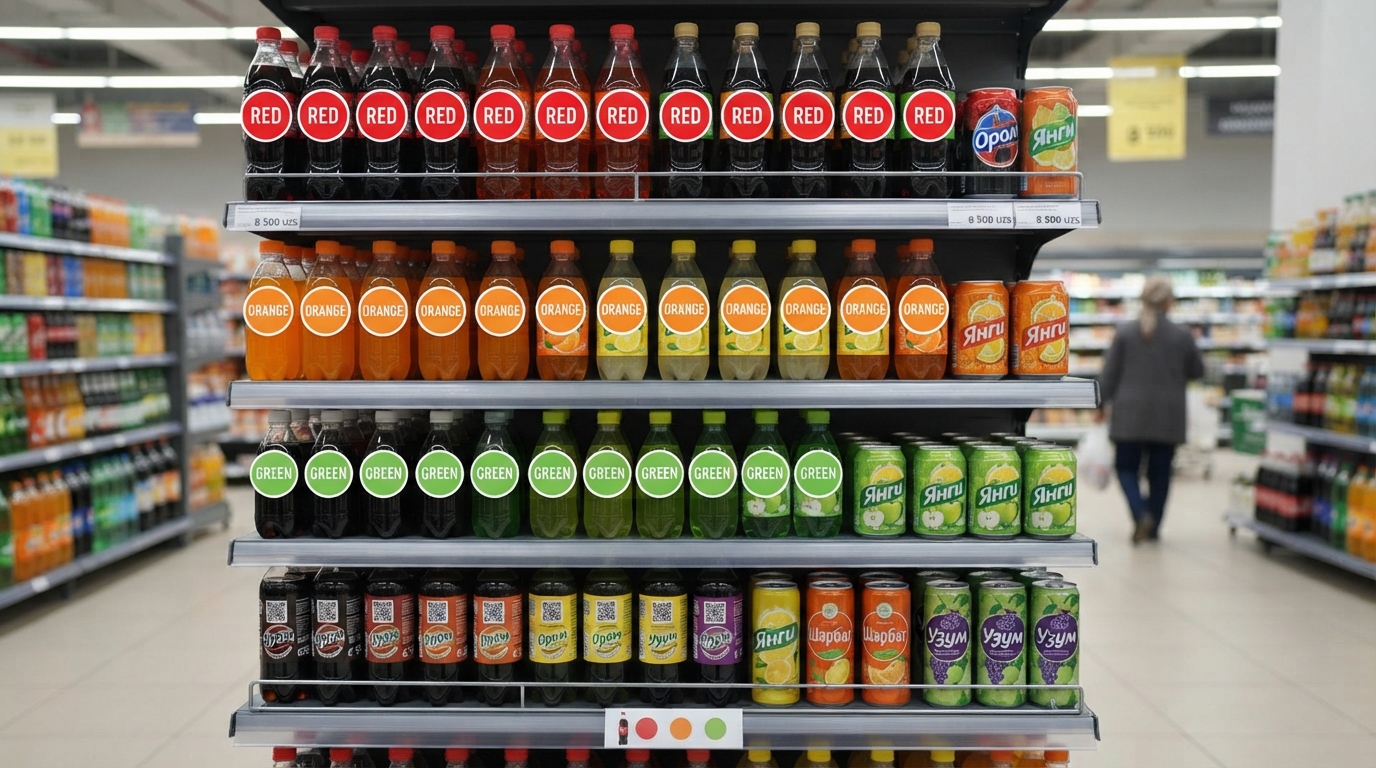
Uzbekistan proposes introducing color-coded labeling for sugary drinks. Manufacturers have criticized the initiative
Starting in 2027, Uzbekistan plans to make color-coded labeling of non-alcoholic beverages mandatory, depending on their sugar content. This proposal was made by the Ministry of Health, which published a draft government decree for public discussion.
According to the draft, starting January 1, 2027, mandatory warning labels based on sugar content per 100 ml of product are proposed for non-alcoholic beverages produced in Uzbekistan and imported into the country.
Three categories of labeling are provided:
The warnings must be placed on the front side of the package, occupy at least 15% of its total surface area, and be clearly visible to the buyer at first glance. The text must be rendered in contrasting colors.
In addition, it is proposed to place a QR code on the packaging containing information about the product's composition, its caloric content, and the recommended daily intake.
The draft also provides for the creation of a unified system of laboratory control over the sugar content in non-alcoholic beverages.
The Food Safety Committee is instructed to approve a unified laboratory analysis methodology by March 1, 2027, and to organize the determination of sugar content in accredited laboratories by September 1 of the same year.
The agency will also be required to maintain and publish quarterly on its official websites a register of non-alcoholic beverages in which the sugar content exceeds the figures established by the draft.
By December 1, 2027, it is proposed to develop and gradually launch a unified digital platform for monitoring high-sugar beverages.
The system is planned to account for the sugar (carbohydrate) content per 100 ml of each product, as well as the types of sweeteners used. The platform will be integrated with the information systems of the Tax Committee through the interagency integration platform of the "Digital Government".
The results of laboratory testing will be included in the system, taking risks into account to identify discrepancies between the declared and actual composition of the beverages.
The aggregated information is expected to be published in an open format. Compliance of the platform with the international GS1 Digital Link standard is also envisaged.
The development and further technical maintenance of the system will be funded from the state budget.
By January 1, 2028, the Customs Committee must implement an electronic declaration system for the sugar content in imported non-alcoholic beverages.
At the same time, it is proposed not to allow the import into Uzbekistan of products whose labeling does not comply with the new requirements.
In addition, from January 1, 2027, it is planned to phase out the sale of non-alcoholic beverages labeled in violation of the established requirements on the premises of educational institutions.
The Competition Promotion and Consumer Protection Committee is proposed to conduct test purchases of non-alcoholic beverages with high sugar content on an ongoing basis.
The agency will be required to publish information on identified violations in the media.
The Association of Producers of Non-Alcoholic Beverages and Juices of Uzbekistan (UzBev) expressed concern over the Ministry of Health's proposal to introduce mandatory warning labeling. In a comment to Gazeta.uz, the organization stated that the new requirements could lead to additional costs for businesses and should be adopted on the basis of scientific research.
The association emphasized that it supports consumers' right to receive reliable information about product ingredients, but considers the proposed approach insufficiently justified.
"The issue of informing the consumer is important in itself and deserves support. The consumer has the right to understand what they are buying and consuming. But that is precisely why any decisions must be balanced, scientifically grounded, and fair. Unfortunately, the proposed approach still raises serious doubts," UzBev's position states.
One of the association's main grievances is the application of the new requirements exclusively to non-alcoholic beverages.
UzBev noted that sugar is also contained in confectionery, baked goods, dairy desserts, ice cream, sauces, and other products. Moreover, healthy nutrition issues are associated not only with the consumption of sugar, but also salt, saturated and trans fats, total caloric intake, and physical activity.
"When warning labels appear only on beverages, the consumer may mistakenly conclude that other products without similar warnings are automatically healthier. And that is no longer informing, but potentially misleading," the association believes.
Manufacturers also drew attention to the implementation timeline of the new requirements. According to the draft, mandatory labeling is set to appear from January 1, 2027, whereas the unified methodology for laboratory determination of sugar content is planned to be approved only by March 1.
"A paradoxical situation arises: business must fulfill requirements whose criteria have not yet been approved," UzBev stated.
The association questions how manufacturers are supposed to determine sugar content before the official methodology is approved, which laboratory test results will be recognized as reliable, and how disputed situations will be resolved.
Furthermore, according to UzBev, the technical regulations on food product labeling have not yet been finalized.
A separate issue is the need to change product packaging. According to the association's estimate, preparing a new label alone takes at least three months on average. Meanwhile, packaging materials, including labels and aluminum cans, are often purchased in advance with a stock for up to one year.
Introducing requirements without an adequate transition period, manufacturers believe, could force companies to destroy already manufactured packaging materials or incur additional expenses for urgent design changes.
UzBev also recalled the expenses incurred by enterprises for the implementation of digital labeling and repeated changes to the tax burden on sugary beverages. According to the association, the new initiative increases uncertainty for manufacturers.
UzBev believes that the establishment of mandatory warnings should be preceded by a large-scale study of the dietary structure of Uzbekistan's population.
In particular, it is proposed to identify the main sources of consumption of sugar, salt, and other dietary components that affect health.
The association claims that there are no state studies in the country that would allow isolating sugary beverages as the main source of excess calorie intake.
According to manufacturers, without relevant data, it is impossible to objectively evaluate how effective the proposed measures will be in improving public health.
In addition, UzBev proposes testing the new labeling among consumers to determine how understandable it is, whether it helps compare products, and whether it creates misconception about their properties.
The association called for first completing the food product labeling reform, conducting studies on the population's diet, developing a scientifically grounded product evaluation model, and discussing the extension of warnings to other food categories.
"Consumers need objective information. Businesses need predictable rules. The state needs effective measures to improve public health. Achieving all three goals simultaneously is possible. But only on the condition that decisions are made on the basis of science, dialogue, and equal treatment of all participants in the food market," UzBev declared.
As a reminder, Uzbekistan wants to extend mandatory digital labeling to vegetable oil. This may happen from January 1. Currently, labeling covers tobacco products, alcoholic and non-alcoholic beverages, medicines, and household appliances.