

In the morning I spread my buttered bread…
In Uzbekistan, an inexhaustible material resource has been found in the form of personal vehicle owners and members of their families
In the morning I spread a sandwich…
"I returned to Uzbekistan six months after my father's death to enter into the inheritance, specifically to re-register a locally produced subcompact car, for which they don't offer more than 35 million sums ($3000) at the auto market today. Imagine my surprise when I was billed a total of over 10 million sums (including the services of two notaries, Russian and Uzbek). That is practically five monthly pensions that my father received in the last months of his life. Isn't that a bit much? The mildest and only censorable reaction to this from fellow sufferers like me is: when will they finally get their fill?" (From an appeal to the website)
Such a reaction is quite predictable and understandable. The problem indeed exists, and it is actively, yet fruitlessly, discussed on social networks, which only highlights people's clear dissatisfaction with the current situation. Meanwhile, official figures prefer to remain silent.
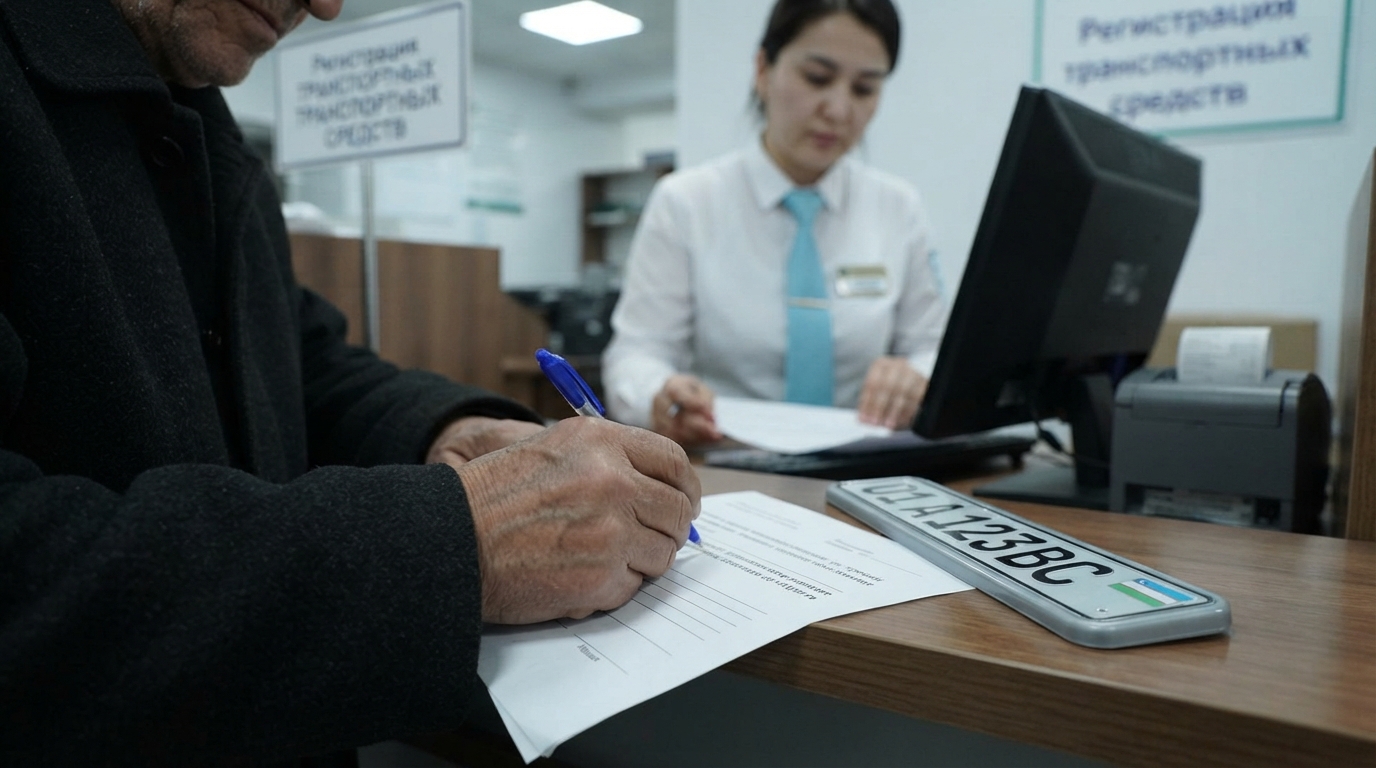
It seems that an inexhaustible source of income has been discovered in Uzbekistan — owners of personal cars and members of their families. As of April 1, the population had 4.55 million passenger cars. Someday, every single one of them will be sold, gifted to a son, or left to a widow. And each time, the new owner will come to the SBDD (State Traffic Safety Inspectorate) with a wallet.
In December 2025, registering a personal car with an internal combustion engine cost 4,589,680 sums. From October 1, 2026, it is already 8,289,600 sums, or 700 dollars at the Central Bank exchange rate. In ten months, the price has doubled.
A used car together with a notary already costs 9,785,600 sums, that is, 826 dollars.
### Where the $700 goes
| Payment | BAV | Sums | Dollars |
|---|---:|---:|---:|
| License plate | 10.5 | 4,620,000 | 390 |
| Registration | 6.84 | 3,009,600 | 254 |
| Vehicle passport | 1.4 | 616,000 | 52 |
| Application | 0.1 | 44,000 | 4 |
| Total at SBDD | 18.84 | 8,289,600 | 700 |
| Notary for a used car | | 1,496,000 | 126 |
| Total with notary | | 9,785,600 | 826 |
SBDD tariffs are taken from the service on my.gov.uz, BAV is 440,000 sums as of September 1, notary is according to the Ministry of Justice calculation. More than half of the amount falls on the license plate. This is an aluminum plate with film, printed directly at the SBDD in 30 minutes. Half an hour of work — and 390 dollars.
At the same time, the car does not become newer or safer. Only the last name in the vehicle passport changes. A father passes the car to his son, a widow registers her husband's car, and both pay $826 each for a new line in the database where this car has been listed for a long time.
### How registration grew more expensive in 2026
From November 2023 to the end of 2025, the plate cost 3.5 BAV. The tariff was not changed for two years. Then they began raising it almost every month. Coincidence or not, the tariff increase started precisely when the production of license plates was handed over to a separate entity, which sets the prices itself.
| Month | Registration | Vehicle passport | License plate | Application | Total at SBDD | Growth |
|---|---:|---:|---:|---:|---:|---:|
| December 2025 | 2,818,080 | 288,400 | 1,442,000 | 41,200 | 4,589,680 | = |
| April 2026 | 2,818,080 | 288,400 | 2,266,000 | 41,200 | 5,413,680 | +824,000 |
| June 2026 | 2,818,080 | 288,400 | 2,884,000 | 41,200 | 6,031,680 | +618,000 |
| July 2026 | 2,818,080 | 288,400 | 3,296,000 | 41,200 | 6,443,680 | +412,000 |
| August 2026 | 2,818,080 | 576,800 | 3,708,000 | 41,200 | 7,144,080 | +700,400 |
| September 2026 | 3,009,600 | 616,000 | 4,180,000 | 44,000 | 7,849,600 | +705,520 |
| October 2026 | 3,009,600 | 616,000 | 4,620,000 | 44,000 | 8,289,600 | +440,000 |
In one year, the license plate rose in price 3.2 times. In August, the vehicle passport price was simply doubled: it was 0.7 BAV, it became 1.4. The exact same piece of paper, only a different price. No announcements or press releases. The driver learns about the new cost at the moment of payment — from the receipt.
### How about the neighbors
In Kazakhstan, putting a new car on the register costs 41 dollars. Here, a vehicle passport alone costs 52 dollars.
In Russia — 53 dollars.
In Kyrgyzstan, re-registering a used car with new plates costs 45 dollars, and a notary is not needed there.
### Who determines the price
How did it happen that the tariff for a mandatory public service grows almost every month and nobody announces it? It's simple: the government no longer approves the price. Since January 20, by resolution of the Cabinet of Ministers, the amount of all payments for plates, vehicle passports, and driver's licenses is set by the very enterprise that issues them (isn't that strange?). It is called Uzavtomotoservis (until January it was Uzavtomotobelgi).
Since late April, in an order of the Ministry of Internal Affairs, Uzavtomotoservis is already listed as a limited liability company. Who its participants are is not stated in the resolutions. A firm with that name was not found in the EGRPO register either.
It turns out that the one who sells is the one who sets the price. And the buyer cannot refuse: without a plate, the car will not be registered; without registration, you cannot drive it. An electronic payment remains a payment if you cannot opt out of it.
The Ministry of Internal Affairs has instructed that employee salaries at the enterprise be paid "based on the financial capabilities" of the enterprise itself. The more expensive the plate, the broader those capabilities.
### What was promised in return
From January 1, 2026, the enterprise was allowed to sell personalized plates with up to six letters and numbers via auction. The auction procedure was supposed to be approved by the Ministry of Internal Affairs before the new year. There are no personalized plates. There are ordinary ones, but three times as expensive.
The same resolution specifies that a plate for an electric vehicle should cost less. There is no separate price for an electric vehicle plate on my.gov.uz.
And the preamble of the resolution states that the reform is needed to "prevent an excessive financial burden on the population." The burden has indeed changed: before it was excessive, now it is astronomical and monthly.
### Where the money goes
How much of the 8,289,600 sums goes to the budget and how much remains with the enterprise is not specified in the resolutions on license plates. Only the payment for retaining an old license plate is itemized: half to the budget, 35% to the "Safe Road and Safe Pedestrian" fund, 15% to the special fund of the Ministry of Internal Affairs, including employee bonuses.
How this worked before was analyzed by economist Otabek Bakirov. License plate production was transferred to the company Gid License Plate by a closed decision. According to him, after that, both plates and registration rose sharply in price, and scooter owners were also obligated to buy plates and register.
From every plate sold at auction, the company received a fixed 3.5 BAV, about 1.3 million sums. Of the remainder, 80% went to the budget, 20% to the special fund of the Ministry of Internal Affairs.
In the first quarter of 2024, Gid License Plate was eighth among the country's largest taxpayers, transferring 102 billion sums to the budget. For the entirety of 2024, it paid 845.9 billion sums and became the third largest private taxpayer.
Then the company disappeared from the list of largest taxpayers. Along with it, infographics for February-December 2024 featuring the company vanished from the Tax Committee's Telegram channel "Fiscal Analysis". Bakirov raised the question of whether it received hidden tax breaks and whether the business was handed over to a new "private partner." There is no answer.
According to the resolution, a license plate is not the property of the car owner. The item does not belong to you, but you cannot use it without paying. This is no longer a public service, but rent for the right to drive your own car.
A state that thinks about the citizen asks: how to make the procedure cheaper? A state that thinks about someone's personal income asks another question: how much more can we take?
Judging by the receipts, the answer to the second question changes every month.
"In the morning I spread a sandwich —
Right away a thought: how are the people doing?
And the caviar won't go down my throat,
And the stewed fruit won't pour into my mouth!…"