

Life has become more expensive: services, food, and transport are driving up inflation in Uzbekistan
Inflation in Uzbekistan for the first seven months of 2026 stood at 3.2%. At first glance, the figure looks relatively moderate. However, behind this number lies a noticeable increase in the cost of a whole range of everyday expenses — primarily services, non-food goods, utility bills, and transport. According to the National Statistics Committee, the main sources of consumer price growth in January–July were three major blocks: […]
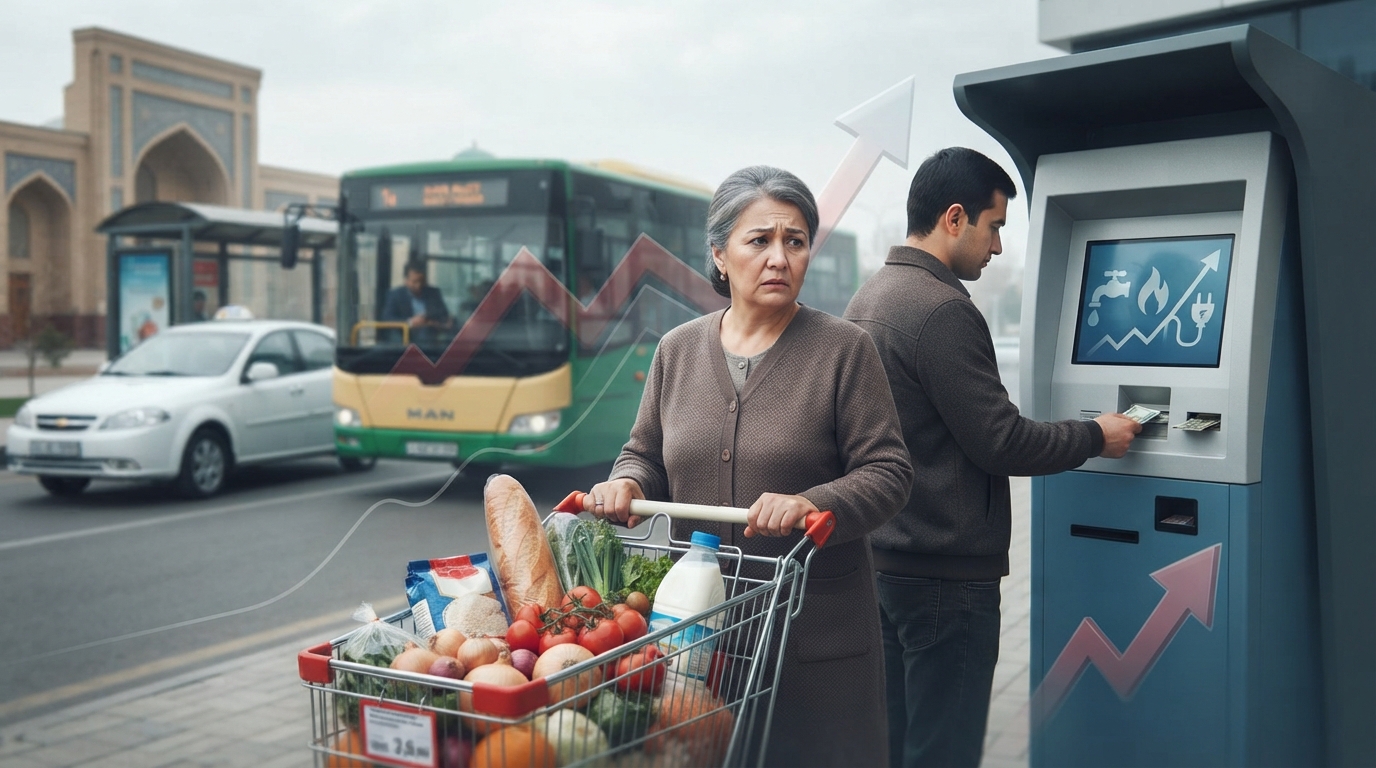
Life Has Become More Expensive: Services, Food, and Transport Accelerate Inflation in Uzbekistan
Inflation in Uzbekistan reached 3.2% in the first seven months of 2026. At first glance, this figure looks relatively moderate. However, behind it lies a tangible increase in the cost of a whole range of everyday expenses — primarily services, non-food goods, utility bills, and transport.
According to the National Statistics Committee, the main sources of consumer price growth in January–July were three major blocks: housing services, water, electricity, gas, and other fuels; food and non-alcoholic beverages; and transport.
Together, they contributed 2.12 percentage points to the overall price growth, or a 67.1% contribution to the increase in the composite consumer price index. The remaining categories accounted for another 1.04 percentage points, or 32.9%.
In other words, about two-thirds of the inflationary pressure was generated by expenses that are almost impossible for most families to avoid: housing and utilities, food, and transport.
The structure of price growth looks particularly noteworthy.
Usually, food is considered the most sensitive category for the population. However, in January–July 2026, food prices rose noticeably slower than those of services and non-food goods.
The structure of inflation shows that the rising cost of living in Uzbekistan can no longer be explained solely by more expensive food.
Of the total price growth of 3.2%, food accounted for 0.61 percentage points. Meanwhile, services contributed 1.20 percentage points, and non-food goods added another 1.35 percentage points.
Thus, food accounted for less than a fifth of the total price increase, while the main contribution came from non-food goods and services.
Moreover, services are becoming one of the most prominent sources of inflationary pressure. This is particularly important for family budgets: it is not just about purchases that can be postponed or replaced with cheaper alternatives, but about expenses that are regular and often mandatory.
Consequently, inflation in Uzbekistan in 2026 is increasingly taking on a "non-food" character.
Food continues to become more expensive, but the main source of consumer price growth is the expenses that accompany a person practically every day: housing, utilities, transport, and a wide range of services.
For the consumer, this means that the actual perception of the rising cost of living may be stronger than the overall inflation figure itself suggests. After all, a significant portion of the price increases falls precisely on those budget items that are difficult to exclude from the family budget.