

In the EU, one in three students failed to reach the basic level in mathematics
According to the PISA–2025 results, 33.9 percent of 15-year-old students in the European Union failed to reach the basic level in mathematics. In 2018, this figure stood at 22.9 percent.
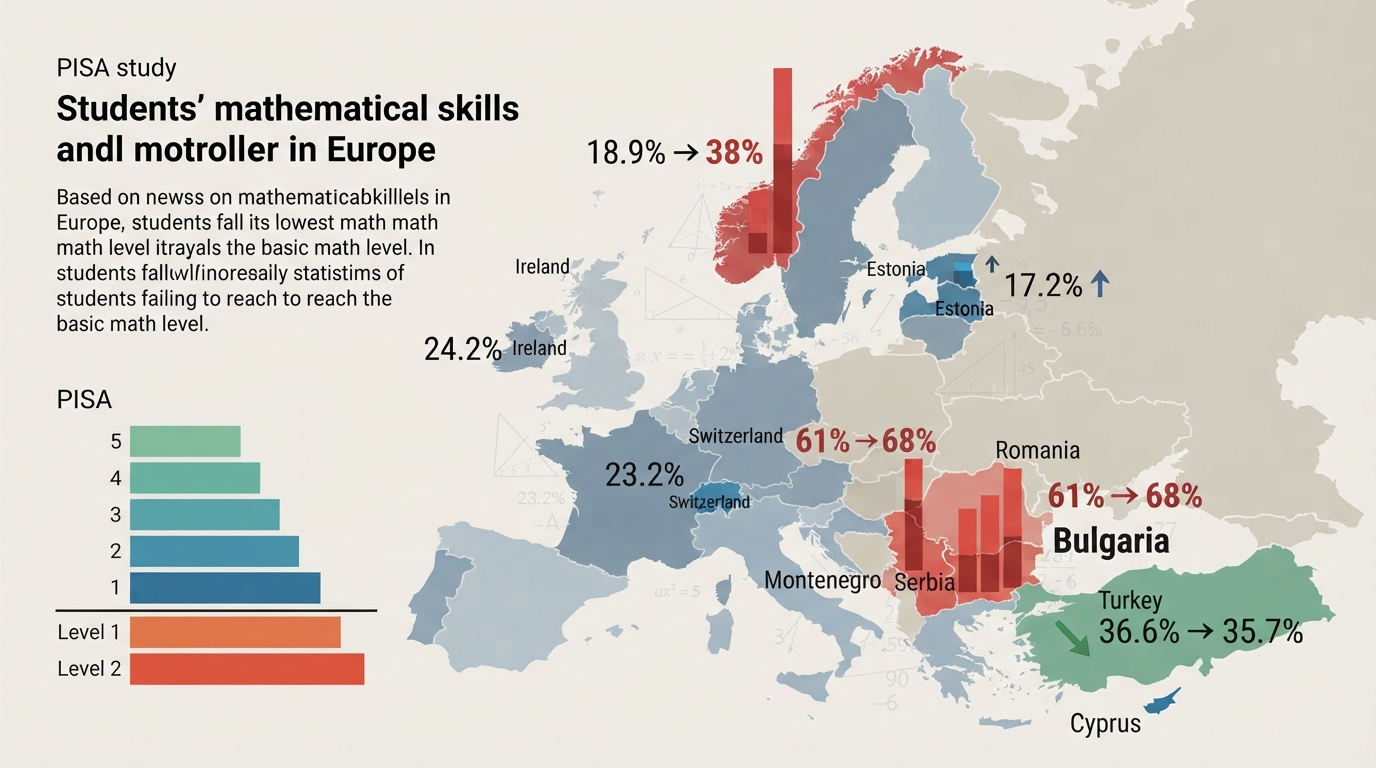
One in three students in the EU failed to reach the basic level in mathematics
The PISA international assessment program tests not only students' mathematical knowledge, but also their ability to apply it in practical situations.
According to the publication Naked Science, citing Eurostat data, compared to 2018, the proportion of students showing low results in mathematics has increased in almost all European countries.
In particular, in North Macedonia, the share of those who did not reach the basic level rose from 61 percent to 68 percent. In Bulgaria, Cyprus, Montenegro, Serbia, and Romania, more than half of the students also failed to achieve this level.
In the presented comparison, the best result was recorded in Estonia: the proportion of students with mathematical literacy below the basic level was 17.2 percent. However, the situation deteriorated in this country as well — in 2018, this figure was 10.2 percent.
In Switzerland, the share of students who did not reach the basic level was 23.2 percent, and in Ireland, it was 24.2 percent.
Turkey was the only state among the compared countries where this indicator improved slightly. There, the share of low-performing students dropped from 36.6 percent in 2018 to 35.7 percent in 2025.
The most severe decline was observed in Norway. The share of those who did not reach the basic level in mathematics in the country nearly doubled, rising from 18.9 percent to 38 percent. Significant declines were also recorded in Cyprus, Slovenia, and Iceland.
PISA evaluates mathematical literacy across six main levels. The second level is considered basic: a student who reaches it is deemed to possess the minimum mathematical skills necessary to live and work in modern society.
Failing to reach the basic level does not mean that the student does not know mathematics at all. It means that their ability to apply their knowledge to solve practical problems has not met the established minimum standard.