

Which countries' students know the natural sciences better?
In the PISA-2025 study, based on the results of 15-year-old students in science, the Chinese regions of Beijing, Shanghai, Jiangsu, and Zhejiang, along with Singapore, took the lead. Macau, Taiwan, and Japan also secured places in the top five.
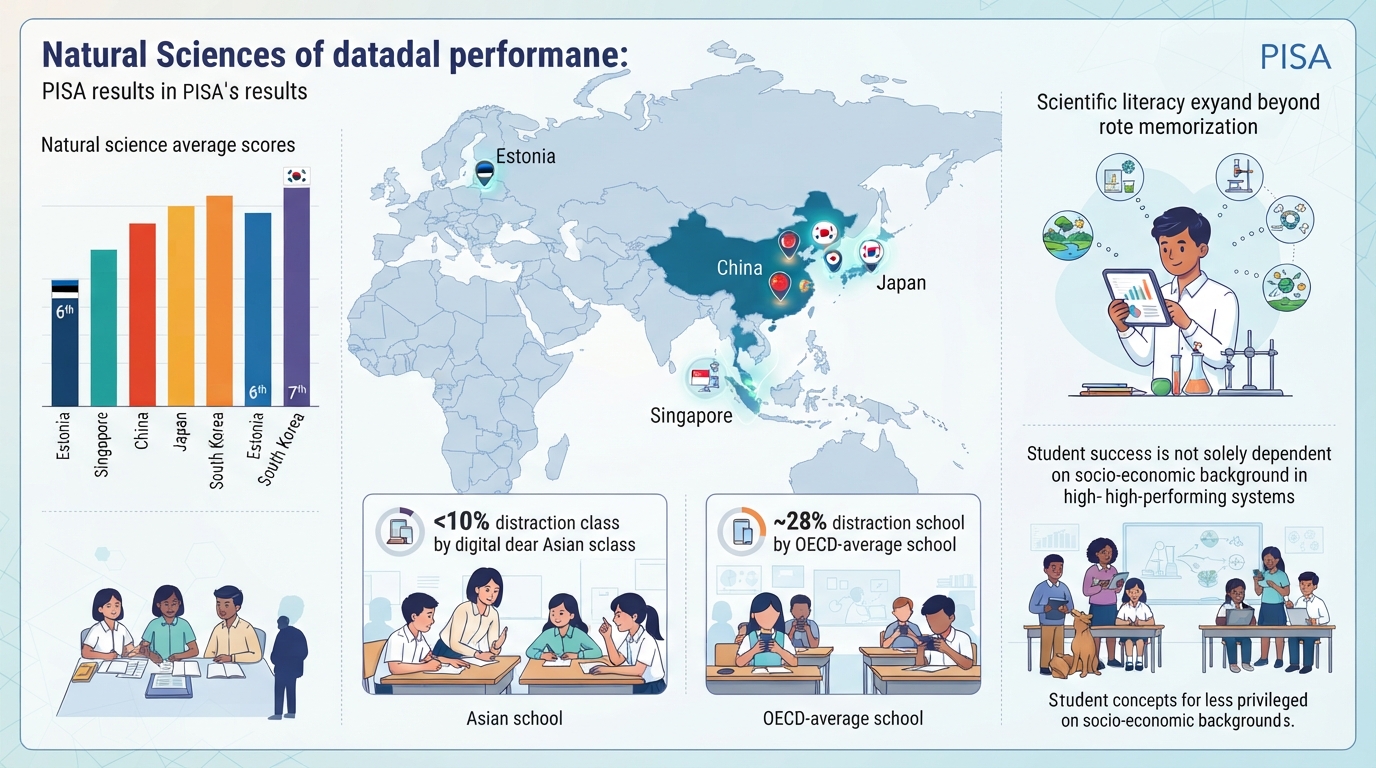
Which countries' students know science better?
In the material based on the Visual Capitalist infographic, countries and territories are compared through the average scores of students in science. China's results reflect not the entire country, but the four regions that participated in the study.
Estonia took sixth place with 527 points, becoming the only European country to enter the top seven. South Korea was recorded in seventh place.
More than 760,000 students from 91 countries and economies participated in the PISA-2025 study. They represent nearly 33 million 15-year-old teenagers in the world. The initial results of the study were published in September 2026.
The PISA program, conducted by the Organisation for Economic Co-operation and Development, assesses students' knowledge and skills in mathematics, reading, and science.
The scientific literacy test is not limited to testing the ability to recall facts from memory. It also determines students' ability to explain scientific phenomena, evaluate research and evidence, as well as analyze scientific information to make decisions.
The material notes that in some successful education systems in Asia, high academic demands are combined with a learning environment that helps achieve sustainable results. The participating regions of China, Singapore, Japan, and South Korea showed high results in mathematics and reading along with science.
The low level of distractions in class is cited as one of the possible reasons. In the participating regions of China, Japan, and South Korea, less than 10 percent of students reported that their classmates get distracted by digital devices in most or every science class. In the Organisation for Economic Co-operation and Development countries, this figure averaged 28 percent.
In some high-performing Asian education systems, students' performance in science was less dependent on their socio-economic background. This may show that success cannot be explained solely by the achievements of children from well-off families.