

**Lagging Behind**
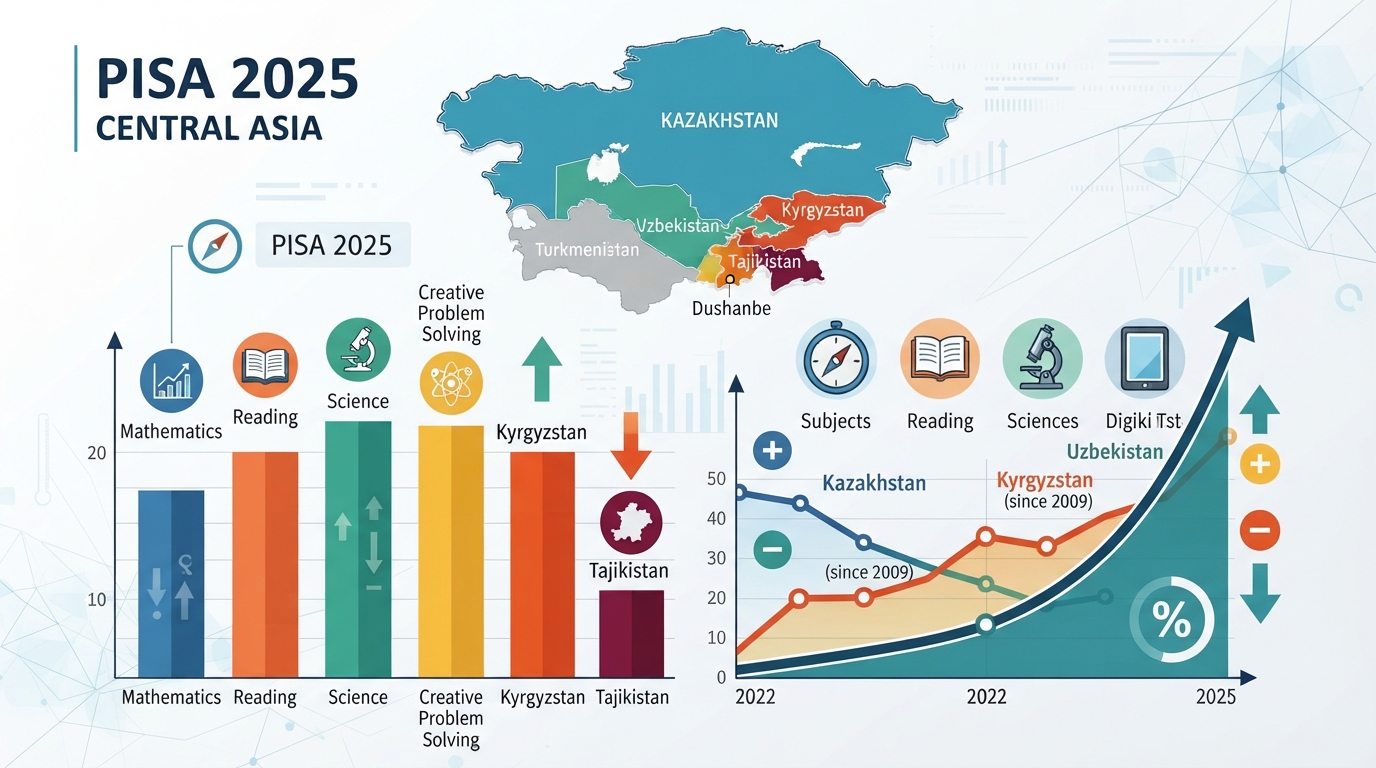
The results of the international PISA-2025 study showed that all Central Asian republics are falling behind their state development goals. For the first time in history, the state and society have a rare opportunity to compare two indicators: what the state planned to achieve and what the educational system ultimately delivered. International student assessment scores help governments identify the areas in which students are strong, where they are falling behind, and track changes in learning outcomes over time.
The Programme for International Student Assessment (PISA) measures how well 15-year-olds can apply their knowledge in science, mathematics, and reading to solve real-world problems. The study is conducted by the Organisation for Economic Co-operation and Development (OECD) and is designed to identify weaknesses and track whether learning is improving over time.
The results published on September 8 show growth in some areas, decline in others, and notable gaps in regional statistics. PISA 2025 placed a special emphasis on science and introduced a new assessment of computational thinking skills, which is part of a broader effort on learning in the digital environment.
At the national level, Kazakhstan, Kyrgyzstan, and Uzbekistan participated in the study. Tajikistan was represented by Dushanbe rather than a national sample, and Turkmenistan did not participate.
The highest published regional results in mathematics, reading, and computational thinking were shown by Kazakhstan, and in science by Uzbekistan. At the same time, Uzbekistan's results in mathematics and reading were not published, making a full comparison across the three core subjects impossible.
Central Asia's performance remained below the OECD average, but Kazakhstan and Uzbekistan outperformed some EU member states in several areas.
Across OECD countries, average scores in mathematics and reading fell to the lowest levels in PISA history. In science, the situation remained relatively stable.
Recent results and long-term trends do not always align. Kazakhstan and Uzbekistan participated in PISA in 2022, whereas Kyrgyzstan last took part in the study in 2009.
Compared to 2022, Kazakhstan's mathematics score decreased by about 12 points, which is a statistically significant drop for the country. A more moderate decline in science and reading was not statistically significant.
In Kyrgyzstan, by contrast, progress was recorded in mathematics, reading, and science compared to its previous participation. These gains span 16 years, rather than a single PISA cycle.
Uzbekistan showed the most notable growth among the regional results. Its science score increased from 355 in 2022 to 438 in 2025, an increase of 83 points. This was also the largest gain in science among educational systems with comparable results worldwide, more than doubling the next largest increase of 38 points.
Other international assessments provide a better understanding of the scale of the changes that have occurred.
Kazakhstan and Uzbekistan were the only Central Asian countries to participate in the 2023 Trends in International Mathematics and Science Study (TIMSS). This study assesses lower secondary school students and uses a different methodology than PISA.
Among eighth-grade students, Kazakhstan scored 443 in science, while Uzbekistan scored 396. Two years later, PISA recorded science scores of 420 for Kazakhstan and 438 for Uzbekistan. Because different students were assessed and different testing methods were used, these results cannot be directly compared.
In other countries of the region, there is less comparable data, which complicates a consistent assessment of changes across all five countries.
Uzbekistan's results in mathematics and reading in PISA 2025 were not published. The OECD reported that it identified inconsistencies in responses in some schools and regions, making these results unsuitable for comparison. However, the results for science and digital learning were published.
The sixteen-year gap between assessments in Kyrgyzstan makes it difficult to identify recent trends. Dushanbe's results cannot be considered a nationwide indicator for Tajikistan, and the absence of Turkmenistan leaves no benchmark for PISA.
Thus, Central Asia still lacks a fully comparable set of results covering all five countries.
Regular and reliable testing provides governments with data to identify weaknesses, track the outcomes of reforms, and determine areas where additional resources may be needed.
PISA 2025 sets a new benchmark for Central Asia. The next stage will show whether the trends observed in 2025 will persist.