

In the Andijan region, the efficiency of enterprises will be evaluated based on the yield from each square meter
In the Andijan region, the efficiency of enterprises will be evaluated based on the yield from each square meter
In the Andijan region, there are plans to evaluate industrial sites not only by the volume of attracted investments but also by the economic return from the utilized territory. In particular, the amount of value added created on each square meter will be taken into account.
This became known at a meeting chaired by President Shavkat Mirziyoyev, dedicated to the socio-economic development of the Andijan region, supporting entrepreneurship, and increasing public income.
In the first half of the year, the region's economy grew by 8.8%, industry by 9.2%, services by 16.1%, and investments by 8.9%.
It was emphasized that Andijan has limited land and natural resources. At the same time, its advantages were identified as an active population, entrepreneurial spirit, a large number of young people, an industrial school, and a large market.
Over the past ten years, 20 trillion soums have been directed to the region from the republican budget, and banks have allocated 90 trillion soums to support entrepreneurship. This year alone, 6 trillion soums have been directed towards improving the well-being of the population. In this regard, it was noted that the granted powers and financial opportunities must yield corresponding results.
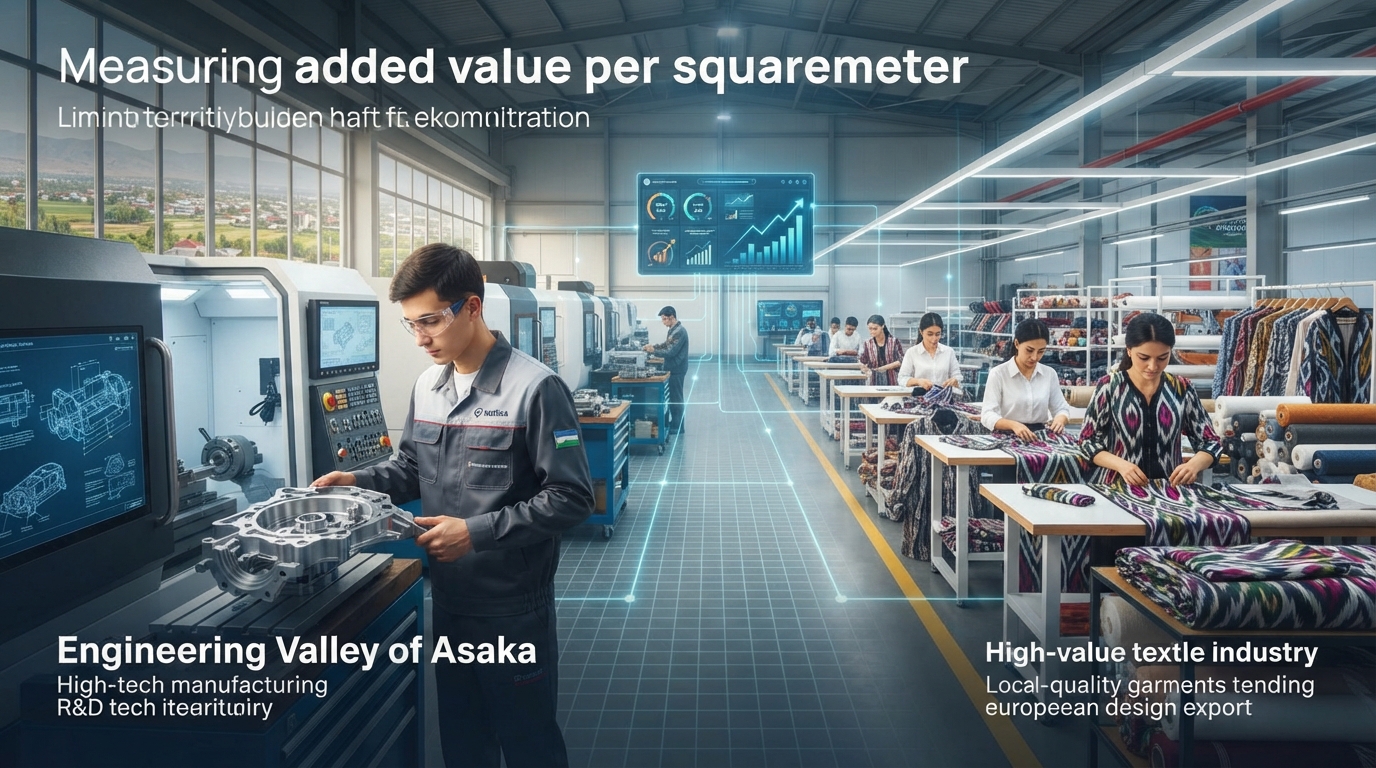
One of the development directions will be Asaka. Here, the task has been set to use 30 years of experience in automotive manufacturing and mechanical engineering to create proprietary technologies. It is planned to establish the "Asaka Engineering Valley" and develop the production of software products, electronics, electromechanics, and engineering services.
Currently, 10,000 students in the region are studying in the fields of engineering, energy, industry, and information technology. To turn their ideas into finished products, it was proposed to develop research and development centers.
Additional potential is also seen in the textile industry. Attracting European designers, constructors, and brands, as noted at the meeting, will allow for more efficient use of existing capacities, a transition to the production of high-value-added products, and an increase in the industry's exports by more than 1.5 billion dollars.
Against this background, a new criterion for evaluating investment efficiency will be applied in the region — the volume of value added created on each square meter.