

In Tashkent, the shortage of student places reached 141 thousand in the 2025-2026 academic year
By 2030, it is planned to create 48 thousand new student places at the expense of the republic budget and 78 thousand at the expense of the local budget. As a result, the capacity utilization rate of schools is expected to decrease from the current coefficient of 1.4 to 1.2 in 2030.
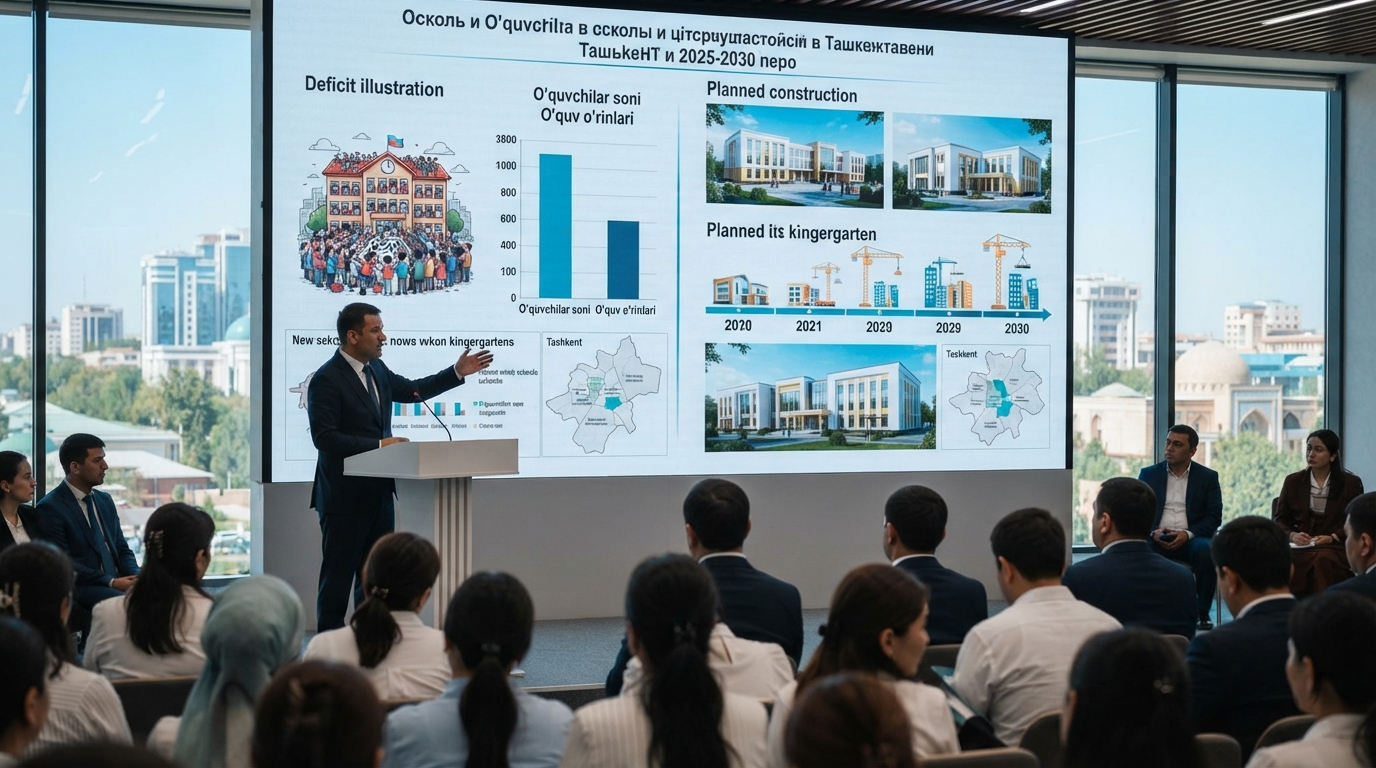
Shortage of student places in Tashkent reached 141 thousand in the 2025-2026 academic year
In the city of Tashkent, the shortage of school student places reached 141 thousand in the 2025–2026 academic year. This was reported at a presentation of projects aimed at beautifying neighborhoods, constructing new schools and kindergartens, and developing the urban environment in the capital.
Over the next five years, due to an increase in the number of students by 71 thousand, or 14 percent, the shortage may reach 212 thousand by the 2030-2031 academic year. For this reason, it is planned to create 48 thousand new student places at the expense of the republican budget and 78 thousand at the expense of the local budget by 2030. As a result, the load factor of schools will decrease from the current 1.4 to 1.2 in 2030, the presentation states.
Additionally, projects for 24 new schools with a total capacity of 38 thousand places have been prepared for the 2026–2027 academic year. Their total area is 64.6 thousand square meters.
The number of children aged 3-7 in the city is 253 thousand. Their coverage with preschool education stands at 79.2 percent, while the shortage of places in kindergartens is 65 thousand. Therefore, it is planned to create 8 thousand additional kindergarten places at the expense of the republican budget and 32 thousand at the expense of the local budget by 2030. As a result, coverage will be brought to 92 percent in 2030. For the 2026-2027 academic year, five types of projects for 28 new kindergartens with a total area of 32 thousand square meters and a total capacity of 16 thousand places have been prepared.