

If the population is halved, will the pressure on nature decrease?
Scientists studied a scenario based on the world population decreasing to approximately 4 billion or less by the year 2200, along with a reduction in each person's impact on nature. The calculation shows one of the possible ways to achieve ecological sustainability. However, this is not a UN demographic forecast or a strict limit set for humanity.
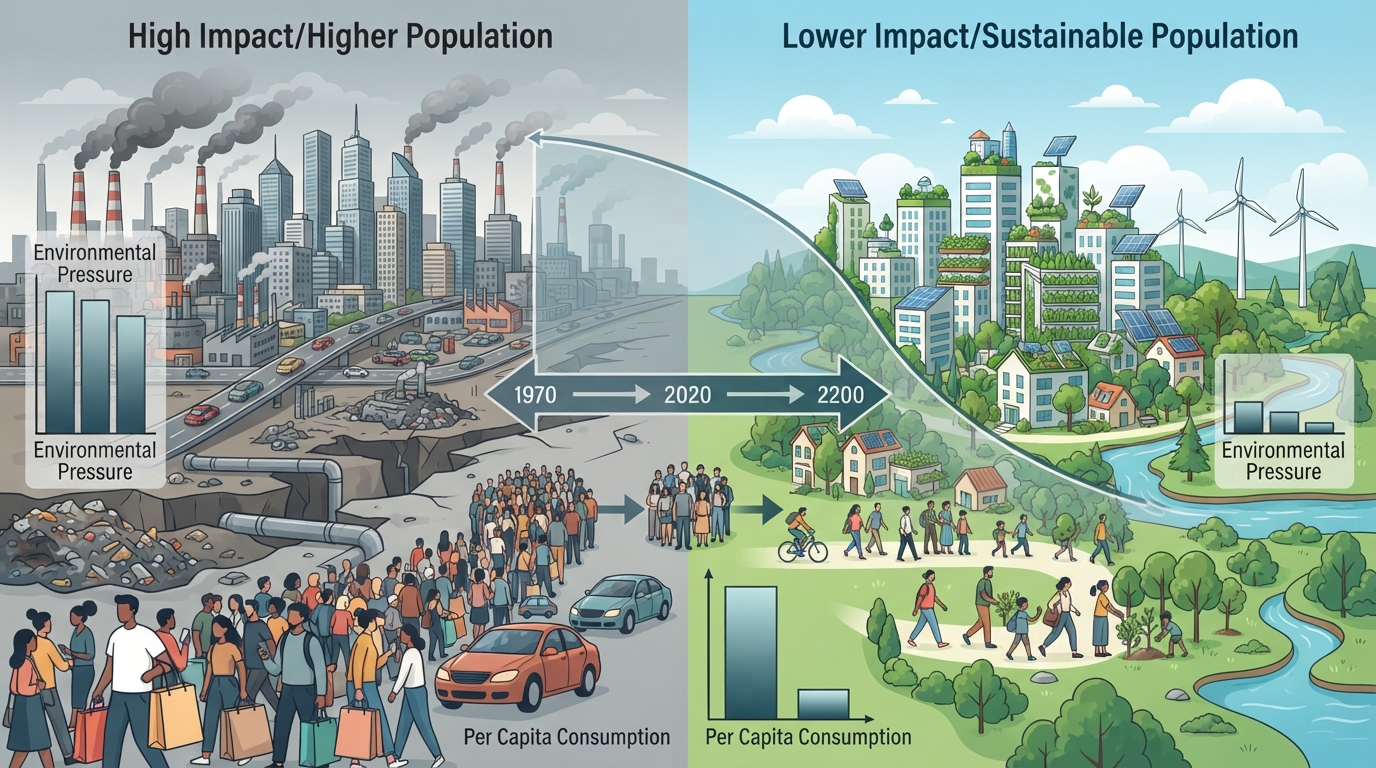
If the population is halved, will the pressure on nature also decrease?
A study published in the journal Sustainable Development analyzes the impact of population size and per capita consumption on natural systems.
Mark Keegan and his co-authors compared data from 1970–2020 across eight indicators related to environmental pressure. These include carbon dioxide emissions, energy and water use, plastic production, material consumption, and indicators reflecting the state of wildlife.
The researchers then calculated what the outcomes would be under scenarios where the population size changed in different directions.
According to the main idea of the model, the overall impact on nature depends both on the number of people and on the environmental pressure per person. That is, along with the population size, how energy is produced, how much resources are saved, and consumption habits are also important.
The authors considered a scenario where the population would be approximately 4 billion or less by the year 2200, combined with a reduction in the environmental impact per capita. Therefore, it is incorrect to reduce the study to the conclusion that "nature can only be saved by halving the population."
This calculation should also not be confused with the UN population projection. The UN's World Population Prospects 2024 report estimated the world population at approximately 8.2 billion in 2024. In the medium scenario, the population is expected to peak at nearly 10.3 billion in the mid-2080s and be around 10.2 billion by 2100.
The purpose of the two calculations is different: the UN estimates how the population size might change, while this study explores a long-term environmental scenario.
For a long-term period like the year 2200, the results are highly dependent on assumptions about fertility rates and life expectancy. Even a small difference in the number of children per woman can lead to a large difference in population size over several generations. Therefore, the figure of "4 billion" cannot be accepted as the Earth's fixed carrying capacity.
Furthermore, human impact on nature is not uniform. An equal reduction in population size in a high-consumption society and a low-resource-use society will yield different environmental results. Meanwhile, changes in energy can reduce emissions but may have less of an impact on the consumption of other resources.