

"I will confess to all your charges, just leave my father alone, please. His only fault is that he educated me." Report from the play "Qo'rqma" ("Do Not Fear")
The play "Qo‘rqma" (Do Not Fear) is being staged at the "Millat" theater. Dedicated to the tragedy of the Turkestan youth who were sent to study in Germany in the 1920s and subsequently fell victim to repression, this sound drama attempts to approach a painful topic of history in a new way through various symbols and metaphors.
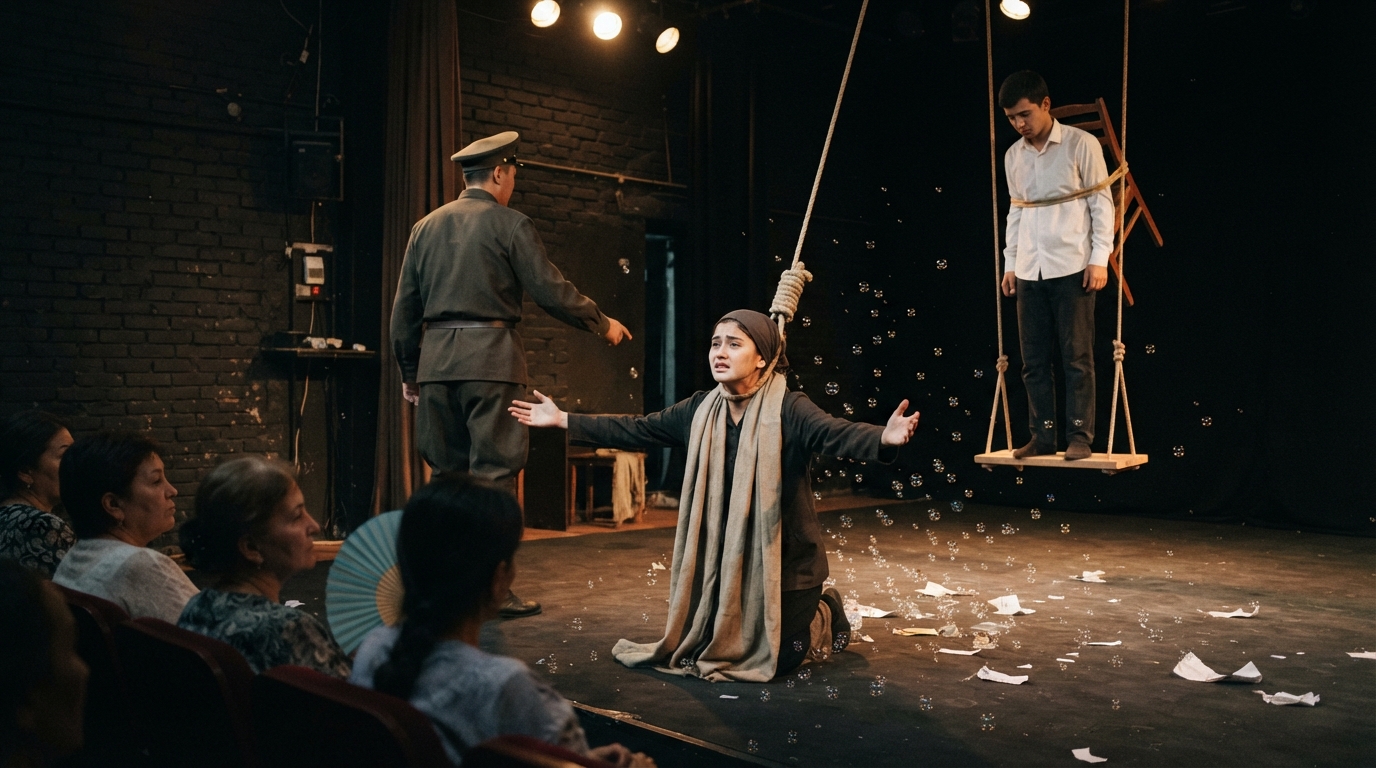
"I confess to all your charges, just leave my father alone, please. His only crime is that he educated me." Report from the play "Qo'rqma" (Do Not Fear)
On September 13, the staging of the play "Qo'rqma" began at the "Millat" theater, located on Qatortol Street in Tashkent.
In 1922, representatives of the Jadidist movement sent more than 70 Turkestani youths to study in Germany. Since not all of the students came from wealthy families, the Jadids themselves and wealthy individuals back home sent them financial aid. In addition, the Soviet government also allocated a small stipend.
In 1924, the Soviet government, viewing the education of Turkestani young men and women in Germany as a major threat, wanted to bring them back. When they did not agree to this, the government began to deprive them of support. In 1928, they were completely deprived of their stipends. Exhausted by the pressure, a group of students returned to their homeland and fell victim to the "repression machine" of 1938, being shot to death.
In 2020, writer Javlon Jovliyev's novel "Qo'rqma", which covers these tragic events, was published. For several years, the book caused various, even contradictory debates within the literary environment and among readers. At the same time, it was deemed worthy of the "Tahsin" and "Oltin Qalam" (Golden Pen) national awards.
The play is staged precisely based on this novel. It does not cover the entire novel, but mainly shows the tragedy of oppression, betrayal, and repression against the youth.
From beginning to end, the play is performed entirely live, without microphones.
More than 60 spectators took their seats on tiny benches. On the stage spread across the width of the theater, the actors were already prepared to perform. The play begins with the plea of a girl saying: "I confess to all your charges, just leave my father alone, please. His only crime is that he educated me."
On the stage, the lives of today's modern youth and the students sent to Germany come to life in a parallel manner.
The actors try to convey painful, tragic scenes that torment the nation through light humor and satire. "The historical event itself crushes a person. We made such a decision so that the idea would reach the audience more easily," says the artistic director of the play, O'lmas Temur.
Initially, the dialogues about money and loans remind the audience of their own everyday lives. When one student, expecting a lot of money to be collected if a play is staged at the theater, is told by another: "People have no money, many live in rented places, every person sitting here has two loans and a world of worries."
In a scene where the crowd is trampling each other crying "free food," Fitrat watches them silently with a sad gaze. In this, a question seems to be hidden: is there any room left among today's everyday worries to think about enlightenment, history, and the future?
Before sending the students to Germany, they are taken to Samarkand to take an oath in front of the Amir Temur mausoleum. Along with their heartfelt expressions, the youth also express their inner sorrow towards Samarkand: "O, Samarkand! The city that rocked the cradle of the world. O, Samarkand — the land that was a mother to the world! How majestic Samarkand is, and at the same time, how humiliated."
It is in this very scene that the shooting of Fitrat is shown, yet he continues to perform his role until the end of the play. This seems to hint at what kind of fate awaits the youth heading to Germany.
In the next scene, the characters of "woodlice" appear. These insects, which feed on plant remains and waste, are compared to a certain category of people in society. "I see them a lot, they live only at the expense of others. They crawl in areas from university departments to parliament buildings. They strut around in ministries with their bellies and mustaches. They interfere with others, thinking of how to quickly kill a conscientious working person by causing a heart attack."
Through the call "The remedy is action, your salvation lies in fighting for the future," it is hinted that vices can only be overcome through action.
The Soviet government looks for a spy among the students studying in Germany to keep abreast of their inner thoughts. For this, someone had to commit betrayal.
Calling the girl playing the role of Khayriniso Majidkhonova, an official offers cooperation in exchange for money to monitor the students' internal mood. When the girl objects, the representative threatens to throw her into prison.
When the girl does not yield even after torture and suffering, he threatens her by bringing up her father. "Your father sent you abroad intending to make you a special agent, while he himself prepared for a coup d'état," he accuses her under several articles.
In the end, unable to endure, the girl confesses to all of it, pleading to leave her father alone, saying his only crime was educating his daughter. However, the response from the representative comes: "Your father has already been liquidated."
In general, several sharp metaphors are used in this scene. The curtain wrapped around the character's neck hints at a noose, and the kicking away of the chair while standing on a swing hints at the execution process. The holes in the clothes indicate that the students were shot, imprisoned, and exiled, while the main visual tool, the color red, serves as a symbol of blood, the Soviet regime, and repression.
On stage, Khayriniso Majidkhonova's appeal to Uzbek girls and mothers resounds. "Giving birth to a coward is not motherhood. Only the mother of educated, brave men is a true mother. We once had plenty of such women," she says.
To this comes a bitter confession on behalf of the young men. "I am a coward. I am afraid of working and suffering. I betray my homeland, and my love for the sake of my lust. I bite without working, I enter the institute without studying. I love without being worthy of love. I take a wife without knowing how to raise a child, and I die without being worthy of death."
Another character on stage, pointing to the developing technology in the world, regrets why his own country could not achieve such progress.
In the next scene of the play, Khayriniso communicates with her children who are not yet born. The unborn children begin to set conditions for their future mother on behalf of the future generation. The conditions also strike like a slap to our present day and our current problems.
— Won't you sell me?
— No, I will feed you with my blood. If my blood runs out, with my soul.
— Won't you throw it in my face that you gave birth to me and fed me?
— Giving birth to you and feeding you is boundless happiness and love.
— Won't you raise me by frightening me from childhood that you will marry me off early?
— No, I will raise you free and honest. I will help you get an education so that you can make your own choices.
— Will you teach me to cry?
— No, mothers only teach children to laugh. I will teach you how to laugh when it is necessary to cry.
At the end of the conversation, the child asks the mother if her blood is clean, and if a traitor has ever passed through her lineage. The mother says there is an old rumor that his grandfather was a traitor, but that this might also be a lie. In response to this, the child's scream resounds: "Do not go near my father, I do not want to be born of you!"
Before even being born, the child is afraid of being the descendant of a traitor.
Whether due to the heat in the theater or the live performance, sweat began to appear on the foreheads of the audience. Some began to fan themselves with their fans.
Then, the sound of a train resounds, hinting at the students' return from Berlin to Tashkent. But the stage welcomes this return not as a joyful meeting, but as a heavy tragedy. The youth writhe with red chairs placed on their heads. Khayriniso Majidkhonova, Naim Polat, Ahmad Shukuriy, Abdurauf Fitrat, Sattor Jabbor, Maryam Sultonmurodova, Abduvahob Murodiy — the names are read one after another, and a symbolic shot is fired after each.
Death and painful scenes, the departure of the soul from the body, are expressed delicately not by a conventional pistol shot or a loud gunshot sound, but through soap bubbles, which are children's toys.
The stage work does not narrate historical events in a consistent chronological sequence. The audience must logically piece together the change of time and space through dialogues in different languages, songs, screams, and announcements. This might be a bit difficult and incomprehensible for a person who is unaware of the events of the 1920s.
"The writing style of the novel 'Qo'rqma' does not obey traditional rules. Javlon Jovliyev's artistic style is also unusual, and the plot does not run smoothly. The same approach was taken in staging the work. Unlike classical stage works, an introduction, rising action, climax, falling action, resolution, and conclusion were not provided. The events are fragmented and not logically connected to each other.
This is an experimental play of an independent experimental theater.
That is, it is not characteristic of traditional theaters," says O'lmas Temur, explaining this.
The abundance of musical solutions distinguishes the play from other works about the Jadids. However, this very uniqueness might make it a bit difficult for some viewers to grasp the content.
"We are often used to seeing the Jadids in turbans, chapans, and mustaches, lost in thought. We deliberately did not weigh down the play with the monologues of the Jadids. Our goal was not to make the audience cry once again. The 'Millat' theater sees the Gen Z generation as its main audience. Among them, there is a segment that understands theater as yawning for two hours in a boring, dark, and cold hall. We want to show that theater is not like that and has not died for thousands of years, in a form close to the youth themselves and their lifestyle," says O'lmas Temur.
In the play, along with the Uzbek language, English, German, and Russian languages are also used. "Today's youth are interested in learning languages and communicate in other languages along with their mother tongue in daily life. We took this path to make it understandable to them, and to arouse interest and wonder," notes the founder of the theater.
Placing the youth precisely at the center, the play raises the question of why today's students are studying. Seven creative team members and ten young actors worked for two months on the stage work, which lasts for one hour. While 11 sessions were planned for September, the tickets were completely sold out shortly after being posted online. The last performance will take place on September 27.
"In May 2026, an open competition was announced by the Ministry of Culture for private theater-studios for state orders. In it, more than 20 private theaters and studios presented their stage works and documents. Among them, our play 'Qo'rqma' was declared the winner, and 220 million soums were allocated by the ministry as a state order," says O'lmas Temur.
In the future, it is planned to present the work to university students in cooperation with the Ministry of Higher Education and to organize sessions in regional centers.
During the president's meeting with youth on February 14, 2025, O'lmas Temur put forward a proposal to establish a new theater. On March 26, 2025, a presidential decree was signed to establish the Youth Experimental Theater-Studio within three months, and its execution was entrusted to the Ministry of Culture and the Tashkent City Khokimiyat.
"When I went to the ministry and the khokimiyat regarding the execution of the decree, they said they had no opportunity to allocate a budget. Disappointed, I registered myself as an individual entrepreneur and opened the 'Millat' theater on March 27, 2026, International Theater Day," says O'lmas Temur.
The new theater operated for three months and was forced to temporarily suspend its work, unable to pay the rent.
"Later we found out that, telling us 'we have no opportunity,' they repaired a small space of the State Youth Theater, declared 'the theater is opened,' and closed the execution of the decree. When I reached out to Minister Ozodbek Nazarbekov, he inquired about the situation and said they could give us space from the renovated theater. But the theater management did not allow us to adapt the allocated part to our needs, and we left that place of our own free will. Then we took this place in Qatortol and restarted our activities. The Central Bank paid our rent for the months of September-December," says O'lmas Temur.
To date, the theater has staged the one-act tragicomedy "Julietta sotdi" (Juliet Sold) based on the work "Kulgi akademiyasi" (Academy of Laughter), the poetic play "Hakkala, dukkala, cho'kala", and the work "Osmonning oxiri" (The End of the Sky) written by Muhammad Yusuf. The sound drama "Qo'rqma" became the team's fourth stage work.