

“Made Chingiz Aitmatov cry through her role.” Actress Yodgora Ziyamuhamedova — in the memory of her colleagues
The newspaper asked the colleagues of the late Honored Artist of Uzbekistan, Yodgora Ziyamuhamedova — Farida Umarova, Bahodir Nishonov, and Shuhrat Ibragimov — to share their memories. "One of her big dreams was to see a theater that would become a true world of miracles for children," they said.
“Made Chingiz Aitmatov cry through her role.” Actress Yodgora Ziyamuhamedova — in the memory of her colleagues
On September 17, Honored Artist of Uzbekistan, theater, cinema, and dubbing actress Yodgora Ziyamuhamedova passed away at the age of 74.
For more than 52 years, she worked productively at the Uzbekistan State Theater of Young Spectators, creating nearly 100 different characters on stage. She also hosted the children's show “Oqshom ertaklari” (Evening Tales) for 25 years.
**Parizod Ahrorova, Honored Artist of Uzbekistan:**
I had known Yodgora opa since my institute days. When I was admitted in 1973, she was in her graduating year. She and her classmates had staged a graduation play titled “Kechikkan sevgi” (Delayed Love). That was when I saw Yodgora opa for the first time. From 1987, we started working in the same theater. She also closely helped me blend into the team quickly.
We created art on the same stage for many years. We performed roles together in television novels such as “Otalar so‘zi” (Words of the Fathers), “Taqdirlar” (Destinies), and “Iqror” (Confession). In addition, we often went to recreation areas and cotton fields, as well as various creative meetings organized by the Ministry of Culture. We visited almost all regions of our country together. We were always sent together, and we often stayed in the same room.
Humanity, kindness, and generosity were extremely strong in her. She never judged people by their profession or status. Whether they were representatives of art or of another profession — she treated everyone the same, and even listened to the pain of strangers. She would converse warmly with street sweepers and ask about their well-being. Even when we went to the market, she would not bargain with the sellers. She would say, “Don't give it to me cheap, I will buy it like everyone else.” She loved children very much, pampering them like her own grandchildren and showing them affection.
Yodgora opa went through many hardships in her life. When her husband, the leading actor of our theater Shuhrat Ziyamuhamedov, died at the age of 38, her children Fotima and Zuhra, and her son Tohir, were very young. In such difficult conditions, she raised and educated her children through her own hard work. She sent her twin daughters to the “Bulbulcha” children's ensemble, sparking their interest in art. I even know that Fotima and Zuhra prepared and sold moshxo‘rda and mastava to help their mother. The family went through such difficulties.
She was always passionate about the theater. She never asked for anything for herself. She was not a person who would go around asking for help by using her family difficulties as an excuse, saying, “Provide conditions for me.” On the contrary, she dedicated her entire life to theater art. Her salary at the theater was around 4 million soums. Despite this, she was content, saying, “The theater salary has a blessing.” Recently, she was very happy to hear that her category had increased at our theater. She said, “We have been patient for so many years, hopefully it will increase from January.” Unfortunately, she did not live to see those days.
One of Yodgora opa's biggest dreams was to see a theater that had become a true world of wonders for the children of Uzbekistan. She often said, “If only there were a theater where children's eyes would light up with joy when they arrive, with a large foyer, good dressing rooms for actors, revolving stages, fly bars that go up and down, and curtains that open and close beautifully. If only there were flowers, birds, and wonders that would dazzle children when they enter, making them gasp in amazement and feel proud, saying, ‘Here is our theater!’” She would repeat this dream wherever she went, saying, “I don't know if this dream will come true or remain an unfulfilled wish.” This dream was also among her last words.
Lately, she also had some complaints regarding her health. She would say, “Pari, my heart feels strange for some reason, it is fluttering and racing, as if it is about to jump out of its chest.” Sometimes she would cough. When I asked, “Why are you coughing?”, she would say, “It must be an allergy, I don't know, maybe from dust... When this cough starts, my throat itches and it doesn't stop. Once it stops, it stops.” But she was not in a state of being seriously ill and bedridden. These events happened within three days. May her soul rest in peace!
**Bahodir Nishonov, Honored Artist of Uzbekistan:**
I had known Yodgora since the 70s, from our student days at the institute. We worked together in the same theater for 52 years. She was a very wonderful and upright person, a strong actress with character.
Yodgora saw many hardships during her life: she experienced orphanhood, hunger, and scarcity. Her father died early, and just like her mother, she raised and educated her three children on her own. For this reason, she always envied people who had parents. We also lived as neighbors for a while. Back then, she would say, “Bahodir aka, what happy people you are. You have parents, I have never seen my father, I have never said ‘dada’ (father) even once.” Yodgora often emphasized that she lived with the regret of never being able to say the word “father” her whole life.
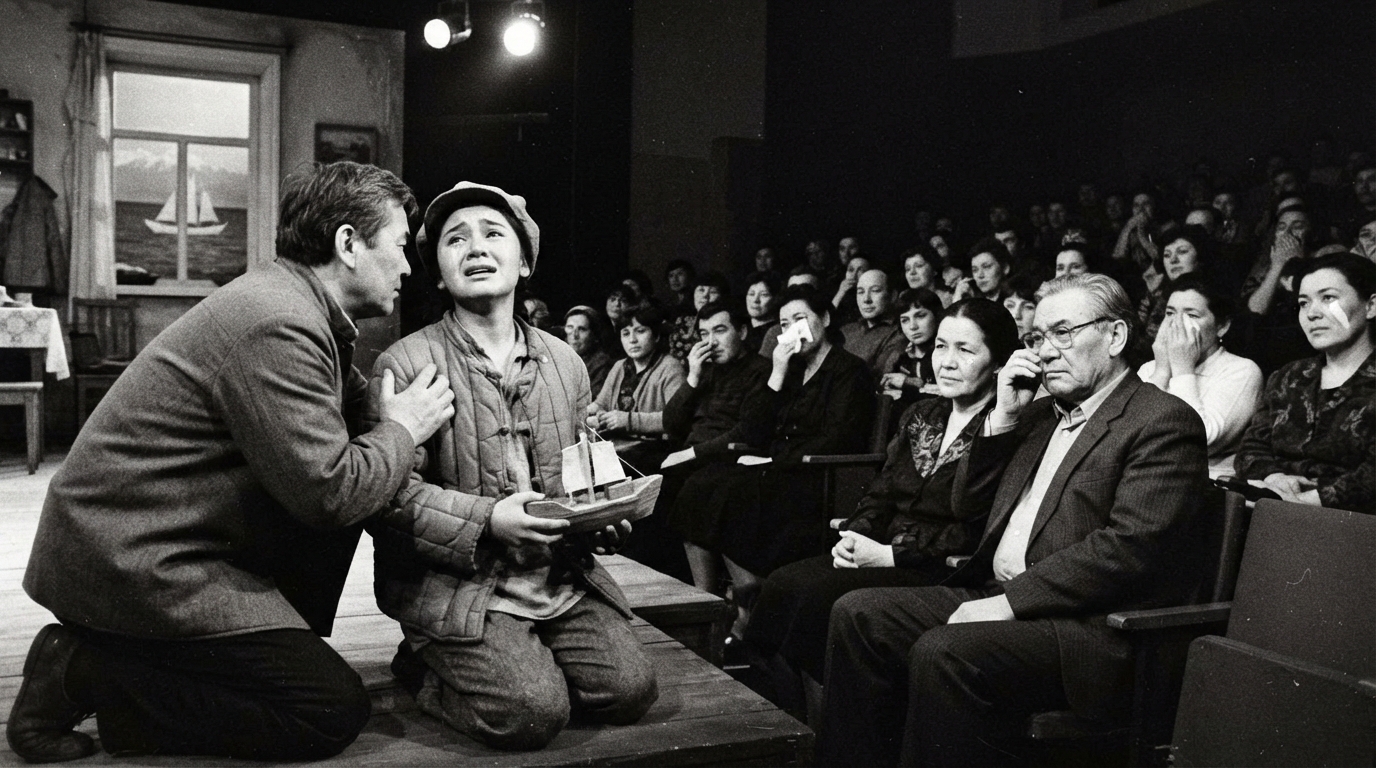
Even though she grew up in hardship, she remained an upright person. She did not choose roles in the theater either: regardless of whether it was a major or minor character, she played the assigned role well. We played together in plays like “Qizil shapkacha” (Little Red Riding Hood) and “Chiranchoq quyoncha” (The Boastful Bunny). But, in my view, her strongest and most memorable role was the character of Nurgazi in Chingiz Aitmatov's play “The White Ship”. I also played the role of Kulbek in that play.
I remember, in 1982, Chingiz Aitmatov himself came with his wife to the premiere of “The White Ship”. The premiere was scheduled for 14:00, but because the plane did not fly on time, the play started at 19:00 in the evening. We waited for almost five hours. The most interesting thing was that not a single spectator left; everyone sat waiting for Chingiz Aitmatov. That day, representatives of the ministry, writers, poets, critics — many famous people also attended.
After the play, Chingiz Aitmatov expressed very good opinions. He said warm words like, “Uzbeks, we are blood brothers, neighbors. I am very glad that Uzbeks staged my work.” He also mentioned that he was very moved during the play, and even cried. In particular, he specifically mentioned Yodgora's portrayal of Nurgazi. He said, “Our sister played the role of Nurgazi very movingly, I even cried.” Indeed, she performed Nurgazi excellently.
One of Yodgora's biggest dreams was to see the centenary celebration of our theater. She would often say, “Bahodir aka, may we be destined to reach the 100th anniversary, may our unity not be lost.” It was also very important for her that the representatives of the older generation in the theater, such as myself, Shamsiqamar Mansurova, Yodgora, Farida Umarova, Hakima Otaxonova, and Venera Safyanova, were united. In three years, that is, in 2028, the 100th anniversary of our theater will be celebrated. Yodgora wanted to see those days very much. Unfortunately, she could not reach this dream.
**Shuhrat Mirzayev, actor:**
Like many children, I also grew up watching Yodgora opa hosting “Oqshom ertaklari” since my childhood. Years later, I was destined to create art with her in the same theater. We worked together for more than ten years. During this time, we became like mother and son. She would call me “my child,” and I would address her as “my mother.”
During the past period, we worked together in several plays such as “Jadidlar. So‘nggi kunlar” (The Jadids. The Last Days), “Barhayot chinor” (The Everlasting Plane Tree), and “Qizil qalpoqcha” (Little Red Riding Hood). She performed unique characters to perfection in every play. She played a very good role in “Qizil qalpoqcha” in particular.
There was never any disagreement in the process of working with Yodgora opa. She always supported me and said good words. She would encourage me, saying, “Good luck, good luck, my child.” Her attitude towards me was very sincere and special.
But I regret not talking to her enough lately. The last time we met was on September 13 or 14. Sometimes a person fails to notice what state the person next to them is in, or that they lack something. This has become one of my biggest regrets.
No matter who a person communicates with, they should talk to them as if they are speaking for the last time.
Every communication should be approached this way.
The more than ten years I spent with Yodgora opa are very precious to me. I saw her as my mother, and she loved and respected me like her own child.