

Black Sun of the Desert. The Ilkhom Theatre Premieres a Play About a Bukhara That Is No Longer Remembered
"Ilkhom" opened its 51st season with the premiere of the play "When the Desert Grows Old, It Will Remember Bukhara." "Gazeta" columnist Dmitry Povarov discusses whether director Aleksandr Plotnikov managed to find a connection between personal memory and grand history in our shared past in his new work.
Black Sun of the Desert. "Ilkhom" Premieres a Play About a Bukhara That Is Not Remembered
Created by Mark Weil, "Ilkhom" has always been a theater open to new names and creative ideas. Russian director Alexander Plotnikov, who graduated from Kama Ginkas's directing course at the Konstantin Raikin School of Performing Arts and also studied screenwriting at VGIK, has already become almost one of Ilkhom's own. Here, he has staged two works of significance for our theatrical life: "The Sergey Parajanov Free Auction" and "Twenty Days Without War," which launched the landmark 50th season last year.
Plotnikov's new play, "When the Desert Grows Old, It Will Remember Bukhara," named after a line from a work of Persian poetry, is structured as an autofiction play. The director takes the stage to play himself—a man who, in our time, is trying to reconstruct the fate of his great-grandmother. She was forcibly taken from Bukhara to the Urals by his great-grandfather, a Red Army officer who participated in the 1920 storming of what was then still the capital of the Emirate of Bukhara.
Plotnikov, who simultaneously acts as author, director, and actor, does not so much recount his family's past as place himself inside a history where one of his ancestors ended up on the side of the victors, while his great-grandmother was among the vanquished. Because of this, the search becomes not only historical or documentary, but also painfully personal. The director attempts to understand not just what happened to his great-grandmother, but what exactly of this past has been passed down to him.
His great-grandmother lived in the Urals for about 20 years without ever learning to speak Russian—judging by everything, there was no one to talk to and no reason to. Then she vanished into the family past, leaving behind neither letters nor photographs. It is this very void that becomes the main document of the play.
In contemporary new drama and documentary theater, a particularly important thread is one where a historical event is shown not through "great figures," but through a diary, a letter, an interview, a family story, a private archive. Plotnikov has none of this—"the more questions, the louder the silence." However, the play's synopsis emphasizes that his goal "is not to retell a family tragedy—but rather to trace how whimsically and inevitably the losers and the victors, personal memory and grand history, turn out to be bound together in our shared past."
Regarding "grand history," the direction of all these searches becomes clear immediately. A quote by the Uzbek poet Shamshad Abdullaev, who passed away two years ago, appears on the screen installed on the upstage wall: "We know everything about the future because we won't be there; we know nothing about the past because we were there."
The paradox of this phrase sets the structure of the hour-and-a-half-long performance.
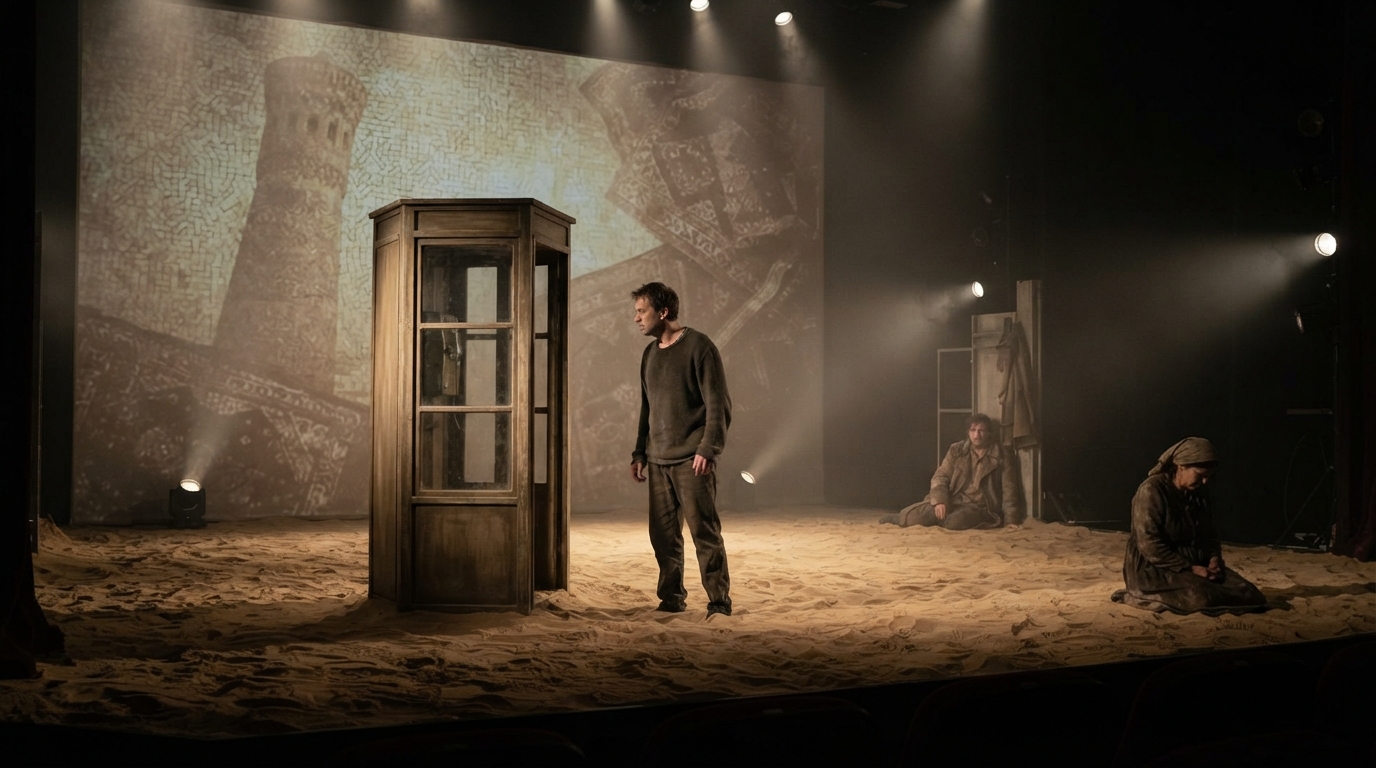
Plotnikov clashes the past, present, and future on stage, but does so without the usual array of theatrical spectacles. There are almost no external effects here that would ease the audience's journey through complex historical material. The set consists of—naturally—sand covering the floor, and a few spotlights.
The backdrop screen at times resembles a half-erased mosaic on the wall of a minaret destroyed during a bombardment, and at other times a worn Persian carpet. From time to time, cameras project action onto it from one of the theater's dressing rooms, where the play's characters periodically retreat from the stage. A large booth, resembling a telephone booth, becomes a kind of communicator for contact between the living and the departed.
The entire stage space seems electrified; the tension gradually builds. At the same time, words do not always break into screams, but transition into a silence that becomes chilling.
The facts appearing on the screen hit particularly hard. Sparse information about the capture of Bukhara, the killings, and the violence appears with almost no commentary. The paradox is that the sources are, to a large extent, Soviet bibliography. The history that is commonly considered to be "written by the victors" has itself preserved the evidence of its own violence. One only had to learn how to read it.
In Plotnikov's text, Russian speech coexists with Uzbek and Farsi. Filth, horror, murder, and death coexist with a romantic, almost poetic form. The device, of course, is not new, but importantly, the director manages to avoid its main danger—pathos. The high style does not negate the horror of what is happening, nor does it make it beautiful.
The director helped the two other actors find the precise intonation to reflect their characters' states. Kamila Yakubova, in the role of the great-grandmother, does not attempt to play her character as a finished psychological portrait. Mafruza, Mahshid, Mahsa—each new variation of her name seems to push her even further away from the woman she once was. We do not know her, and likely never will, but we feel both the bitterness of her broken life, the pain of separation from her homeland, and the terrifying degree of her loneliness.
In the words written for the Red Army officer, Plotnikov confidently signs off on his "anti-Sovietism." Boris Gafurov appears in his new role not as the benign Comrade Sukhov from the legendary "White Sun of the Desert," but as a bewildered man with heavy breathing: he is dying from a bullet that lodged near his heart back during the storming of Bukhara. The past remains inside a person—even if they know nothing about it or prefer not to know. At some point, closer to the finale of the play, Gafurov's character suddenly offers the audience an alternative version of history with a happy ending, but the viewer is unlikely to believe it—they have been too heavily "crushed" by what they have seen and heard before.
Undoubtedly, Plotnikov's new work is a risky production. It does not strive to please, does not offer the viewer the usual consolation, and is hardly designed for mass theatrical success. But "Ilkhom" has always remained a place where one can pose a question to which there is no comfortable answer. And if the theater enters its 51st season with such a play, it is not so much a risk as a reminder of its original purpose.