

"Soon I will die, my child..." - About the work written under the influence of a lifetime of passion by Otkir Khashimov
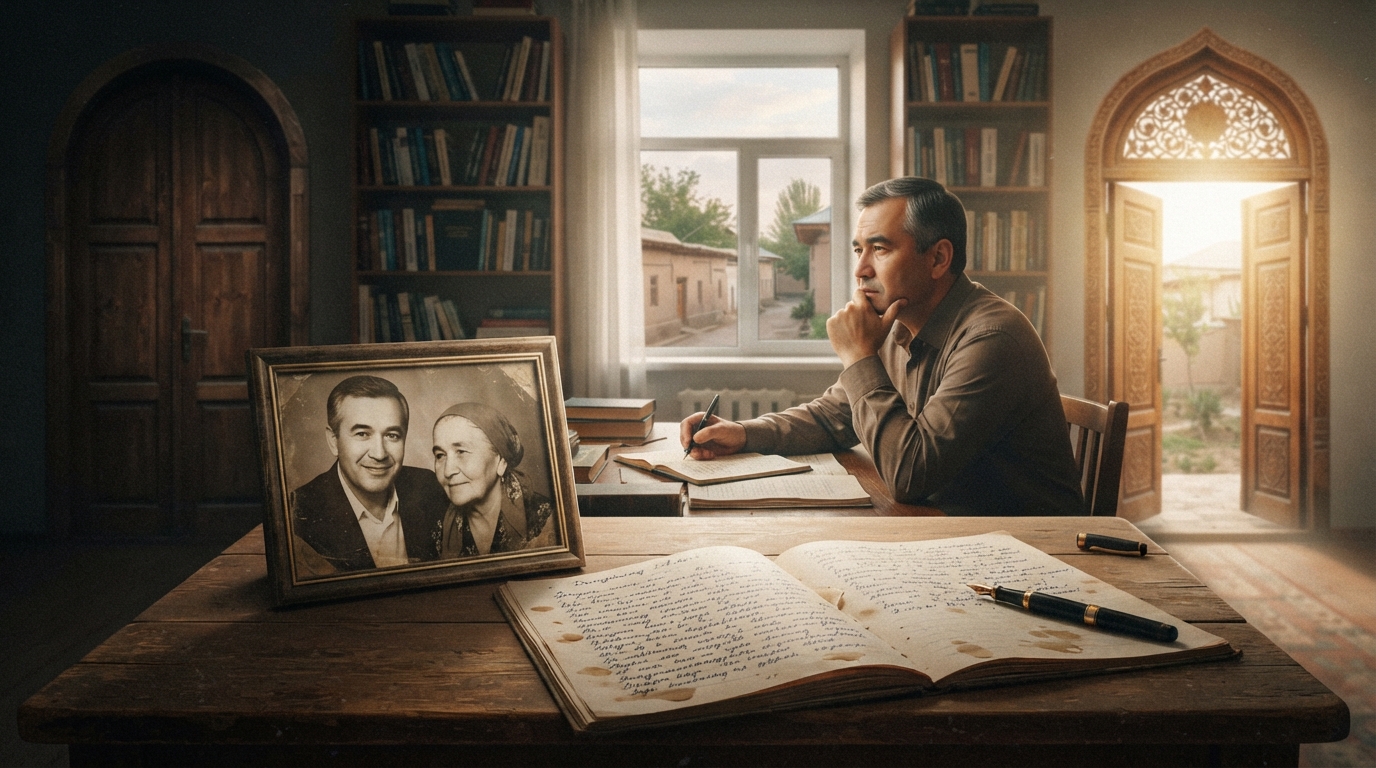
**“Soon I will die, my son...” — About the work written under the influence of Otkir Khashimov’s lifelong passion**
“— Don’t rush, my son... There is a story.
— Mom, I am in a hurry, I have to go to work. I need to get a pension...
— Son, let’s take a picture.
— For a picture? Why, mom?
— I will die soon, my son ...”
The son smiled lightly upon hearing these words. His mother spoke calmly, as if she were visiting a neighbor. “Don’t say that,” the young man said, hurrying out into the street. Time was running out, there was so much to do. How could he have known? Exactly one week later, his mother’s calm prediction would come true, plunging the young man into a lifetime of remorse and eternal suffering from which he would never be able to ask for forgiveness?
That hasty young man, the young man who, due to the arrogance of youth, greeted his mother's last request with laughter, was the people's writer of Uzbekistan, Otkir Hoshimov, whose works were published in more than two million copies, who in the future was able to force the entire Uzbek people to remember their debt to their mother.
We often imagine writers as perfect people who teach the people from high pulpits, capable of solving all the riddles of life. But a true Man of the Word, first of all, grows out of his own endless wounds, belated regrets, and hidden tears. He pours out the pain of others on paper and goes to the grave with his own pain.
In this article, we will talk about the fate of Otkir Hoshimov, a master of the art of making people laugh and cry while entering Uzbek prose, who left the bloody and glorious history of his people, the most tender and pure feelings between two doors, and who entered Uzbek prose with a word that could be whispered but not shouted.
**Dumbirabad dust**
August 5, 1941. At a time when the Second World War was pouring blood on the world and the value of a human being was equal to a handful of bran, a baby was born in the village of Dumbirabad in Tashkent. In his veins flowed not the blood of an ordinary peasant, but the blood of Abulkasimkhan Eshon (the founder of the famous Abulkasim Madrasah), who at the end of the 19th century, when the colonial army was about to massacre the Old City, entered the Governor-General's office and stopped the massacre.
His father, Ataullah Aka, was an extremely kind, honest, and taciturn man. His mother, Hakima Aya, was a simple, hardworking woman who was revered by the entire neighborhood as “Poshsho Oyi,” a living treasure of folk tales. Otkir was formed precisely between these two poles — his father’s uncompromising truthfulness and his mother’s boundless compassion.
He grew up experiencing the hardships of war and poverty from childhood. Although he studied with excellent grades, due to family circumstances, he was forced to work hard. He studied in absentia at the Faculty of Journalism of Tashkent State University and worked as a laborer, letter carrier, and proofreader in newspapers such as “Temiryulchi,” “Tashkent Haqiqati,” and “Kizil Uzbekiston.” Labor and sweat became his first teachers.
**Qahhor's gaze and the mountain that fell on his shoulders**
At the age of twenty-one (1962), the young man, obsessed with creativity, published a collection of essays called "Steel Riders". But the event that brought him into the field of real writers was the story "Four Letters" written in 1963 and the story "Desert Air" based on it.
In those years, there was such a pole in the field of Uzbek literature that one word of his either took the young creator to the sky or forced him to throw away his pen for life. This was Abdulla Qahhor, who bought words by the ton and sold them by the gram. The great writer, who read the young student's first work, sent him a letter:
"The future of creativity that suddenly began with a flame will be bright... May this flame never fade, may your creativity never catch fire!"
This was a great happiness, but also a great burden. Otkir Hashimov lived his whole life feeling that no matter what he wrote, Qahhor was staring at him from behind, asking, “Well, mullah, how are you doing?” This responsibility saved him from writing premature works. At the same time, by the 1970s, the works “Bahor kaytaym”, “Qalbingga kulak sol”, “Nur borki, soya bor” took root not like mushrooms after the rain, but like centuries-old maple trees.
He knew how to show mistakes through the characters of his works, and was “cruel” towards them. The image of Alimardon in the story “Bahor kaytaym” is a vivid example of this. When readers and critics asked why he sentenced Alimardon to death, the writer would coolly reply:
“He killed him, not me. He has both selfishness and courage. He would rather die than live defeated by someone.”
**Editorial quirks: 40-centimeter ears and blind people**
It would be a big mistake to think of the writer as only a singer of sorrows and terrible tragedies. Otkir Hoshimov was a cheerful and talkative person with an extraordinary sense of humor. During the years when he headed the literature and art department of the Tashkent Okshomi newspaper (1966-1982), he shared his good mood with his colleagues in a nerve-wracking, constantly hectic journalistic environment.
One day he decides to call his dear friend and colleague Tolqin Rasulov. The writer, who is an excellent voice changer on the phone, picks up the phone, introduces himself as an employee of the TashMI (Medical Institute), and begins to speak in a deliberately muffled, authoritative voice:
— Is this “Okshom”? We are talking about TashMI. Do you need information?
Tolqin, who is sitting in a daze every day, unable to fulfill his “information” norm, finds peace in his soul:
— I need it! Now I will get some paper... Tell me.
Otkir Hoshimov, in a completely serious tone, begins to “dictate” a story about a unique operation that has never been seen before in history: the age of the patient Boqibayev, who was brought in a serious condition from the 8th brigade of the “Avangard” collective farm in the Buka district, his family, his achievements in work, about a dozen professors and associate professors who participated in the operation... He even lists the student who fainted from fear during the operation. Having written all this down on paper, Tolqin, whose face was dry, finally asks:
— What did they operate on?
Then Otkir Hoshimov answers in the same completely serious tone:
— What could have happened! Patient Boqibayev’s right ear was like a building, and his left ear was stretching by itself. It grew and grew to 40 centimeters in a week. The surgeons cut off 33 centimeters of it, leaving 8 centimeters...
Tolqin Rasulov hears the laughter that erupted in the room on the phone and understands everything. As soon as the buzzing stops, he enters the room and says, laughing and cursing at the same time: “What kind of person are you? My hand hurts from writing!”
Adib’s “mistakes” were not the only ones. Another time, one of the newspaper employees accidentally and somewhat inappropriately used the proverb “The blind finds the blind in the dark” in his article. After reading this, Otkir Hoshimov immediately calls Tolqin Rasulov and Salih Yakubov to him and devises a new joke plan. The author of the article is summoned to the room by phone. Adib looks at him and says with a very serious and worried look:
— Brother, what have you done? A delegation from the Society of the Blind is sitting in the editor-in-chief's reception. "At a time when our government is so concerned about the blind, let's take a look at the journalist who dared to insult us," they said. One of them knew me. "He's a good guy, he wrote without knowing it, we'll reprimand him ourselves," we said, and we sent him back, just like your brothers.
Hearing these words, the employee's face turns pale with fear. He repeatedly thanks the writer and his colleagues and promises not to make such a mistake again. He even prepares a special table for these "saviors" after work and throws a party.
These incidents clearly show that the writer can not only put people in the mood with his words, but also how sensitive he is to human psychology, their fears and passions.
**Divine “contact” and tears**
Otkir Hoshimov considered creativity not just a profession, but a divine process. He compared writing a work to the flight of a spaceship:
“There is a strange rule in aeronautics and astronautics. Its name is contact... If the ship’s engine does not start roaring at that moment, the flight is canceled. It must not be a second before or a second after!”
Works lived inside him for months and years, but at the very moment when the “contact” button was pressed, he would forget about the world and be alone with paper and pen. At such times, absolute silence would descend on the house. It was enough for his wife Olmaskhan Aya to say to her children: “Your father is working,” - there would be such peace that you could hear a fly flying in the yard.
The writer’s works were written not only with thought, but also with blood and tears. In 1980, his angelic mother died. He endured this loss so hard that his literary friends took him to Sijjak to relax and distract him from his pain. Their advice, “Put your suffering on paper, you have talent,” gave rise to one of the most widely read works in Uzbek literature, “The Works of the World” (1982).
The writer’s wife, Olmaskhan Aya, recalled that she had seen her husband cry three times in his life. Once, when his mother died, and the second time, when he finished writing the story “White Marble, Black Marble” from this work.
When talking about Otkir Hoshimov, we cannot fail to mention his novel “Between Two Doors,” written in 1986. The work was a new and high phenomenon in terms of composition and philosophy. As the writer himself said:
“A person enters through one door when he is born, and leaves through another when he dies. All disputes take place between these two doors.”
While writing this novel, he experienced the suffering of the characters in the work. One day, his wife entered the studio, and the writer was sitting at the table with his head bowed. Tears dripped onto the papers. He looked at his wife and said:
“I killed Munavvar!” and went out into the yard. In short, Hoshimov proved in his own experience that a work written with genuine suffering is a pleasure to read. Umar writes characters like Zakonchi and Rano so skillfully that the reader, while feeling complete hatred and shame for them, shows that they also have a logic of existence, their own opposite truths.
**Mankurts, “Uzbek ishi” and fearless editorial staff**
The late 80s and early 90s. A time when the authoritarian regime was vomiting blood, but not yet completely dead. Otkir Hoshimov was appointed editor-in-chief of the “Star of the East” magazine in 1985-1995. This was not an ordinary position, but a political and spiritual arena. It was under his leadership that in 1990 the magazine began to publish an Uzbek translation of the Holy Quran (translated by Alauddin Mansur). No matter how much secular organizations such as the “House of Atheism” tried to close the magazine and stop the translation, calling it discrimination, Hoshimov and his team did not back down.
The writer spent years collecting materials, talking to disabled people from the Afghan war and victims of the "Uzbek affair" to capture the tragedies of the end of the last century, but the work would not begin. One day he fell seriously ill and was hospitalized. Doctors demanded immediate surgery, but he refused. A gloomy late autumn evening. While he was smoking a cigarette on the third-floor balcony, the wind tore a leaf from a tree and threw it under his feet. The writer stepped on the leaf... the crippled leaf crumbled into pieces. That moment played the role of "contact"! The writer, who immediately returned to his studio, wrote the famous first sentence that defined the spirit of the novel: “Autumn is like a patient lying on his deathbed. Underfoot, sick corpses groan…”
In particular, through the image of the Commissioner in the work, the writer revealed the true face of the regime. The Commissioner was not just a negative character, he was a very dangerous, intelligent maniac, a slave of the system who was ready to give up even his mother. But what punishment did Kashimov give him? Prison? Death? No. The writer condemned him to rot alive, to be isolated from everyone and become a solitary leper. Because of his actions, he turned his wife into a dead man, hated by his sons, and a living corpse who would come out at night. Through this work, the writer exposed the great crime of the Soviet regime against humanity.
**Looking at the second door...**
He did not put down his pen until the last years of his life. He compiled the conclusions he had been writing down for almost 40 years and created the work "Notebook Border Notes". When I think about this book, I remember his words about the market economy:
If an atheist who could not call the letter alif a stick yesterday gathers a thousand people and "instructs" them today, and his teacher, who gave him a bad name, carries tea, I cannot help but be amazed! If the same teacher skips school the next day and goes to the "Ippadrom" to sell cigarettes, I cannot help but be amazed!
If a scientist who made great inventions yesterday stands at the station, and a student who entered the university with a "contract" throws mud at him on his "foreign" bus... If a Chalasavod "hofiz" is sprinkled with "blue" for "hanging" for an hour...
If a poet sitting in a corner of the circle bows his head in disappointment that his ghazals written with his heart's blood have turned to dust... Let such a market catch fire and its flames reach the sky!
Otkir Hoshimov likened publishers and writers who use literature as a source of income, and who publish books for money without talent, to chickens: "They lay eggs like walnuts, but they destroy the world by cackling!"
Years later, our writer received the orders "Mehnat Shuhrati", "Buyuk Khizmatlari Uchun", the title of "People's Writer of Uzbekistan", and became an honored writer of the entire nation. However, time, as always, began to speak, and the disease took its toll not on the pen, but on the collar.
May 24, 2013. At a time when clouds were spreading in the sky of Tashkent, and the sun was warming the ground... Otkir Hoshimov quietly left that "second door" that he described.