

"The Fields Left by My Grandmother" (Essay)
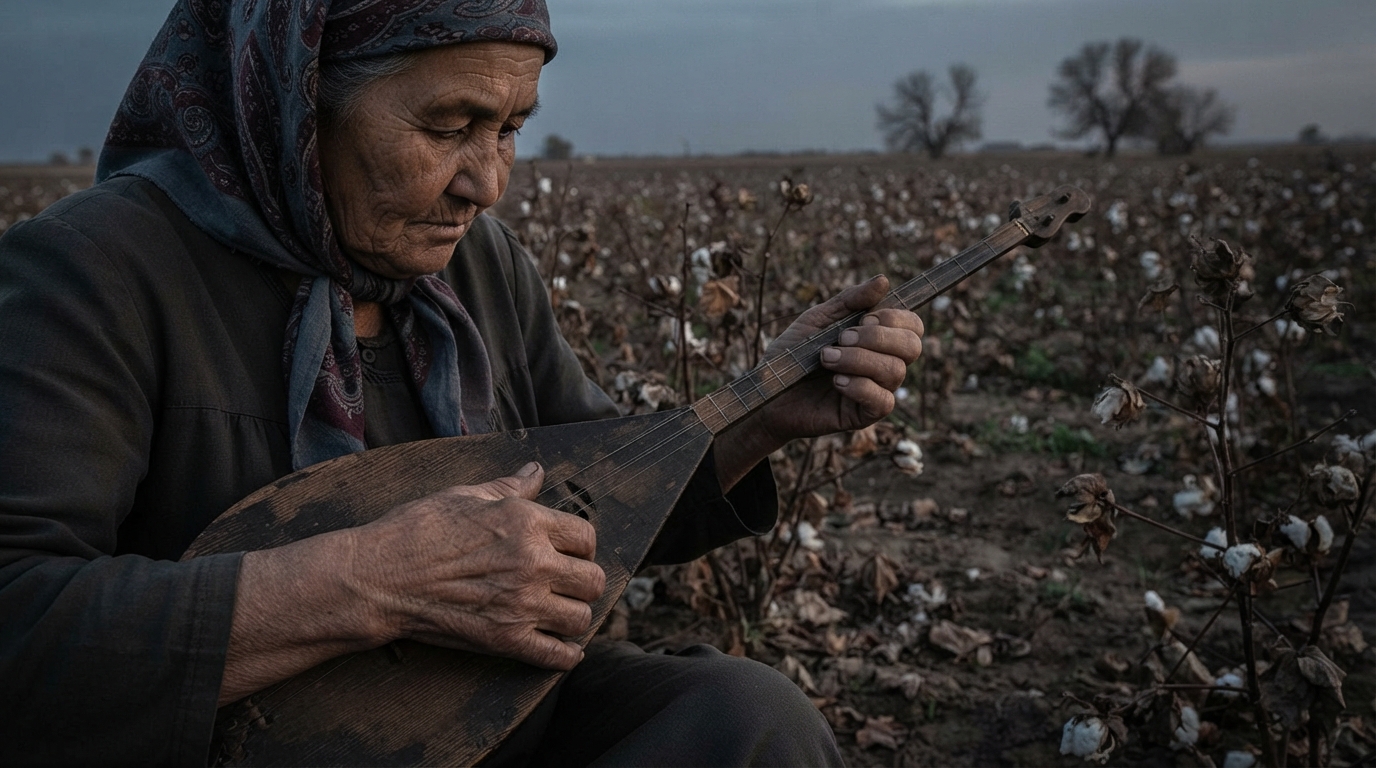
Her slender figure, her thick, golden hair flowing under her scarf, was reminiscing about her beautiful youth in the cotton fields.
**"The Fields Left Over by My Mother" (Essay)**
I picked up my drum again!
I picked up a pile of coals, not a book.
A hundred years ago, I wondered, "What kind of book is this? Was it written by a poet or a writer? If you look at it from one side, it's a story, if you look at it from another, it's a poem writhing like a bitter intestine, if you look at it from another side, it looks like a song that is sung without breathing?" – I picked up that old book.
Do you think I had a drum, or do you think it's a rule?!
I picked up my grandmother's old, mute drum, which had been hanging on the wall for centuries, and which had been silent for centuries, and which had been used to recite "Alpomish", "Kuntug'mish", "Ravshanxon", "Avazxon" and other Uzbek folk poems in the past.
Do you think I knew how to play the drum?
Do you think I used to sing a poem or two?
How could a poor, incompetent person, who could not speak a word, who thought he would be a singer when he grew up, and then trembled in front of a crowd, and instead of singing, made a sound like a goat's bleating, be able to recite a poem?
You say, you say, you say right!
Tell me, believe it or not, this singing book made me sing!
It taught me to beat the drum!
It taught me to cry...
I beat the drum while crying.
I beat the drum, burning like thousands of Uzbek women during the Red Massacre.
I beat the drum, sliding against trees, trying to hit the walls,
I beat the drum, crunching, crunching, gurgling.
I beat the drum, gurgling I'll play "The Fields Left by Our Father" by Togay Murod, who spoke of the people's suffering in the vernacular, and who went among the people, among the peasants, and worked hard with them, and wrote a paper on paper, playing my drum!
I'll play "The Fields Left by Our Mother" to the tune of my grandmother, who has passed away, and my mother has told me!
I'll play it chirpingly, chirpingly, and slappingly!
I'll play it, and even the mute drum that fell into my hands couldn't stand it anymore and started to sing...
To be honest, I rarely reread books. If I reread a book, it means that this work has taken a place in my heart. As a person, he lifted my pains, and as a creator, after reading the work, he exclaimed, "Your pen, bless your creativity!" - as you can see, "The fields left by my father" is lying in my "Golden List", and in the end, Togay Murad, who put his drum in my hand, made me sing, play, play, cry, and finally write.
I gave my drum to my mother: they say that my great-grandmother (my mother's mothers) lived through the Red Soviet invasion and the hardships that our people suffered, during the era of generalization, perhaps even enslavement. My grandmother experienced the Red invasion, the massacres of the war front, and the years of famine that wiped out the human race, she experienced it all. With a fair face, a tall, slender figure, and two braids of dark hair as long as her wrists, the grandmother was as beautiful in spirit and, of course, in nature as she was in appearance. Her slender figure, her thick, golden hair flowing under a scarf, spent her beautiful youth beating the drum in the cotton fields. Her home was in the fields, her wedding, her bed, and her cradle were also in the fields. She bathed in a saltpeter ditch and was perfumed with a perfume called butifos. Her babies grew up on mulberry branches like sparrows, and when they could walk, they were chained to the mulberry tree (with a rope tied around their legs or waist) and ate from the soil of the fields, and when they regained consciousness, they would go straight to her grandmother's fields. In those fields, our Dehkankul fathers and Dehkankulova mothers grew up. Their bones were solid, their souls were hardened in cotton. They spoke of cotton, they woke up with cotton, they slept with cotton...
My grandmother, who was approaching 40 years old, could no longer go to her fields due to illness. After that, she opened a kindergarten from her home and began to babysit the Dehkankulovas' children under the age of three, that is, future Dehkankulovas. Their places of residence were "Karl Marx", "Chkalov", "Kuybyshev", "Lenin", "Kalinin", etc., in short, places like this, fields around the country, cotton around the country, poison around the country (allambala poison drugs), around the country... This is how my grandmother opened her eyes in her fields and died in her fields, spitting blood in her fields! My mother was left in her place and of course she continued the tradition. "When I opened my eyes, I saw cotton, and I picked cotton," says my mother. "I picked up to 250 kilograms of cotton a day," says my mother! She doesn't say anything else. She often lies down; she doesn't say, "Oh my soul!" or "Oh my liver!" She is silent...
When I came to this place, I stood there, as if I were standing in a flooded cotton field in late autumn, in a muddy field that had fallen on my head. So, why did you stop again without writing down?! After all, where will I find the people who sing the Uzbek people's songs about the cotton harvest, about hard work, about happiness, about the joy of the harvest What I need most is to get into the tractor trailer and sing the song, which is like a Bakhshi song:
I am a helper girl, I have come to pick.
I will not return home until the plan is fulfilled.
May my plan be fulfilled, my Uzbekistan!
May my Uzbekistan exceed the plan!
Oh, the helper girls, who were not able to pick cotton or raise their skirts at first (they were children, after all), cried and cried, and sang and sang, and in the dusty fields, filled with poisonous drugs, they swallowed poison and poison, and plucked the cotton that was called cotton. When do you think the gang of Dehkankuls and Dehkankulovas returned home and went to school? Of course, as they said in their own song, they were not allowed to die until the cotton was covered with snow and the skin was no longer able to be peeled. They would pick the snow with sticks, their hands and feet frozen like ice. Now they could no longer keep quiet, they would tell my mother to sing: "Let the council die, let the cotton dry up! Look, my hands and feet are swollen, my clothes are torn, this cotton has spilled out my insides!" - he says. "My child, whom God has protected, what men and women, your children have died quietly. My mother, she took my sisters and brothers too soon!" - he says with tears in her eyes.
- You live in safe, safe times, don't be ungrateful! – she says,
– Thank you! – my mother says. She takes a deep breath, hands me her trusty drum, her mother's drum, and falls silent again. Even a tambourine that doesn't tell its pain will burst, and she opens her mouth to me...
I stare at my children singing along to the cheerful song while going for a walk in the mountains, and then at the fields left by my mother, which I pass by through the car window. If I don't see them now and then, I can hardly see the cotton fields. Fruit trees, vineyards, and melon fields standing tall and swaying like soldiers guarding their homeland come into view. As if they are lying there, humming as they know how, no human being is visible. Ehehehe, "The fields left by my mother! The fields left by my mothers, why are you silent, why aren't you singing!?" – I want to shout. The fields are so small.
The fields fall silent. I fall silent too. But this silence is no longer a pain, but a comfort. Even if I remain silent until we reach the place we are looking for, I will wander, perhaps I will wander between my conflicting feelings. I feel it, but still, in one corner of my heart, my mother sits with tears flowing from her eyes. Every time I visit her, my mother still smiles silently.
– Give me our drum, the fields left by my mother! – I say.
– Let's sing a song without being silent! – I say. My mother's fields, which have also attracted her, fall silent.
However, the traveler who plays the drum cannot remain silent. "Woah!" says my drum, "Take your pain away!" says my drum.
I'll take my drum back in my hands...
Mastura Aburahim kizi
R/S: The song "Teriim" was recorded from an oral conversation with a picker who participated in the cotton harvest in the 1960s-1970s.