

"I want to turn this place into the Canary Islands." The story of 63-year-old Botir Valiev, who established a banana plantation in Chilanzor
House manager Botir Valiyev has transformed the courtyard of his apartment building on the 6th floor of Chilanzor into an urban jungle with about 200 banana trees. Farming helped him get back on his feet after a serious illness, and his example has inspired neighbors to green their areas. The newspaper tells his story.
**"I want to turn this place into the Canary Islands": The story of 63-year-old Botir Valiyev, who planted a banana plantation in Chilanzor**
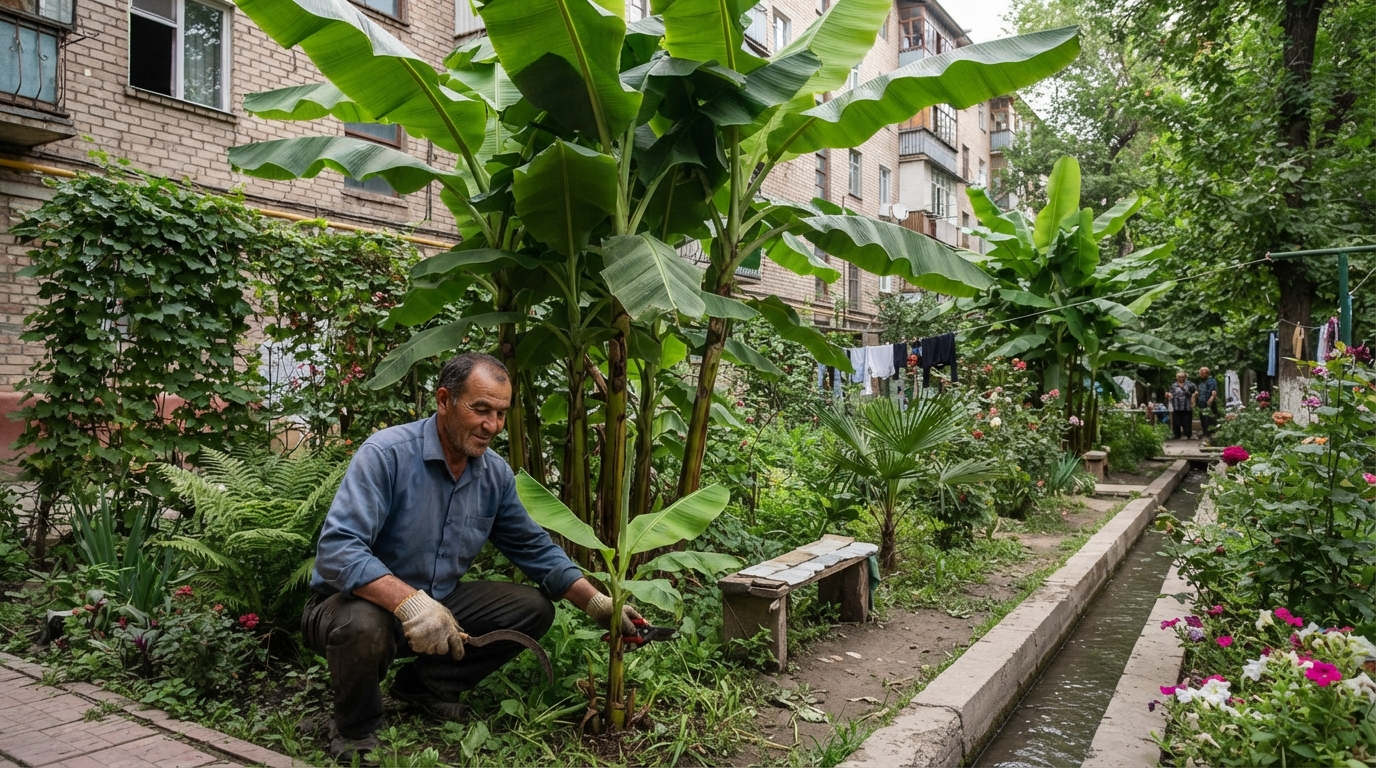
Life goes on as usual in the courtyard of house 48/49 on the 6th floor of Chilanzor: narrow paths pass through flower beds and bushes, clothes hang on clotheslines, children play in the shade of trees, and neighbors sit and chat. A distinctive feature of this place is the excessive greenery, the courtyard is reminiscent of a tropical forest. Bananas growing in clumps along the paths reach the windows of the third floor, creating a thick shadow with their wide leaves.
The initiator of this landscaping work is 63-year-old Botir Valiyev. He is visible among the banana plantations, wearing work gloves, holding a sickle in one hand and a pair of garden shears in the other. He is the house manager who transformed this once neglected area into one of the most greened courtyards in the country.
Botir Valiyev, a native of Navoi, is an electrician by profession. First, he worked at a car depot in Uzbekistan, then in South Korea, he provided technical support for factory equipment. He returned to Tashkent in 2014.
"One day, in a severe cold, I fell asleep on the street and caught a bad cold. I was treated for a long time, but my condition did not improve. After that, I had to return to my homeland. I could not leave the house for almost a year. I only started going out at the end of 2015. That's when I noticed how deserted and lifeless our courtyard had become," recalls Botir.
A single mulberry tree grew alone in the grass-covered empty space under the windows. The yard was littered with garbage, there were no benches or other facilities for recreation. A large part of the square was a chaotic parking lot. Cars were parked in rows along the house, sometimes even under the windows.
"I asked the neighbors: "Are you moving soon?" They said that they had lived here for several decades and had no intention of moving anywhere. Hearing this, I was surprised: how can you live in one place for so many years and not change anything around you? At first I thought that people probably did not consider this yard theirs. Then I realized that they had gotten used to the existing situation. But you can't live like this," Valiev recalls.
Valiev began landscaping work in the area in front of his apartment building. He installed barriers on the side of the road so that cars would not come close to the house. Then he cleared the area of garbage, mowed the grass, and loosened the hard ground. According to Batyr, it was physical labor that helped him regain his health.
"At first, I would go out into the yard little by little, and later I started working every day. It was like physical exercise for me. Instead of going to the gym, I would plow the land, plant crops, and spend a lot of time in the fresh air. The more I worked, the better I felt. Therefore, I can say that the shovel and hoe saved my life," he says.
As the appearance of the yard changed, the attitude of the residents of the house to the common area also changed. At first, Batyr worked alone, but over time, his neighbors began to support his initiative. They began to clean up, helped with watering and planting seedlings, and took turns sweeping the sidewalks and beautifying the recreation areas.
In 2018, the residents offered Valiev the opportunity to manage the house. Together with his neighbors, Batyr aka raised the necessary funds and gradually put the old house and its territory in order. He made benches with his own hands, installed motion-sensor lights on the sidewalks, bought a pump for irrigation, and gradually began to turn the area freed from cars into a garden.
The first plants in the yard appeared almost by accident in 2016. One of the neighbors brought Batyr aka a bunch of lilies, and he planted the flowers around his porch. Later, rose bushes, lilacs, violets, and clematis appeared around the house. However, passers-by often plucked the flowers.
"Sometimes children, sometimes adults, would pluck the flowers. I would explain to them that the flowers were planted for everyone. 'Look, you've seen this beauty, but the next person who comes after you has the right to enjoy it too,' I would say. But it's impossible to follow everyone and plant each one. Then, when I saw the banana, I decided to plant it in the yard. It's lush, it looks beautiful, and most importantly, no one touches it," says Batyr aka.
Batyr aka bought his first banana seedling in 2022 from a familiar gardener. The plant took root, and soon young shoots began to grow from its base. Batyr aka learned to separate them and transplant them to other parts of the yard, gradually increasing the number of bananas.
The most important thing in banana care is abundant watering. Water is taken from a ditch near the house and is supplied to all plants using a pump. According to the house manager, adult plants have already adapted to the Tashkent heat and, if watered sufficiently, do not need additional protection from the sun.
Last year, the plants first bloomed and began to bear fruit. However, the short warm season was not enough for the bananas to ripen.
"The bananas grew to about 5-6 cm, but they still did not have time to ripen before the cold. For me, the main thing is not the yield, but that the bananas grow quickly, produce a lot of leaves and provide shade. The fruits themselves can be purchased at a nearby store," says the house manager.
As the weather cools, the above-ground part of the bananas dries out. After the first frosts, the leaves turn black and fall off. Then Valiev cuts the banana stems, leaving about 40-50 cm above the ground, and buries the bottom of the plants in a thick layer of mulch. He does not use film or other artificial materials for heating.
"The fallen leaves alone are enough to protect the plants from the cold. If the winter is warm, bananas can start growing as early as January or February, but usually new shoots sprout in March," he explains.
The fallen mulch also acts as fertilizer. Valiev puts it in a pit about 70 cm wide and 50 cm deep, along with plant clippings and kitchen waste. Within a year, the organic matter turns into dark, soft humus (compost). Every fall, it is dug out, and the empty pit is filled with new leaves. This way, the residents of the house do not have to pay to buy fertilizer or remove the garbage.
"Garbage is not waste. Waste is plastic and non-decomposable things. And garbage becomes an excellent food for plants after a year," Valiyev emphasizes.
In four years, dozens of new ones have appeared from one stunted plant. Today, the "plantation" in Chilanzor has about 200 large banana trees and young branches. During the season, the largest of them grow almost seven meters - up to the windows of the third floor, while the smaller branches reach one and a half to two meters by autumn.
Bananas are not the only exotic plant in the yard. Valiyev, wanting to enrich his collection, began to look for rare plants that could thrive in the local climate. Thus, bamboo, ferns and date palms appeared here.
Batyr aka is not going to stop at what he has achieved. The residents are asking him to continue planting bananas on the other side of the house. He plans to transplant young shoots there so that over time the entire area around the building will become green.
In addition to bananas, Valiev also wants to expand the planting of bamboo, palms, centipedes and lianas. He plans to stretch ropes between the posts so that the creepers can climb up and form a canopy. According to Batyr aka, this ordinary courtyard will eventually turn into a jungle.
The house manager also intends to change the ditch that runs through the courtyard. He plans to turn the ditch into a small canal that will bypass the trees and flower beds. He also plans to build ponds with water lilies and scenic rocks over which water will flow. To avoid wasting water, Batyr aka suggests installing motion sensors: the pump will only turn on when someone approaches the pool.
"My dream is to turn the yard into the Canary Islands. I tell my neighbors: 'You don't have to go anywhere to relax. You just leave the house, sit on a bench, and relax in the lap of greenery and water.' Even in the summer heat, the thick vegetation keeps it cool here," says Valiev, thinking about the future of the yard.
It's not easy to implement these ideas. Valiev has no transport or special equipment - he only has gardening tools and a small cart. Neighbors help bring soil, fertilizer, and large seedlings. But difficulties cannot stop this man - almost everything that grows around the house today began with a small cleared plot of land and a few plants.
"People are used to waiting for someone to come and do everything for them. But if we don't take care of our yard ourselves, who will? We live here ourselves. You need to look for opportunities, not excuses such as lack of money, water or tools. You need to do the cleaning work not under compulsion, but of your own free will and with good intentions. Only then can you achieve some results," concludes Batyr aka.