

"I want to create a Canary Island here." The story of 63-year-old Batyr Valiyev, who grew a banana jungle on Chilanzar.
Residential yard manager Batyr Valiyev transformed the courtyard of a multi-story building in Chilanzar's 6th block into an urban jungle, home to nearly 200 banana plants. Working with the land helped him recover from a serious illness, and his example inspired his neighbors to green their plots. Gazeta tells his story.
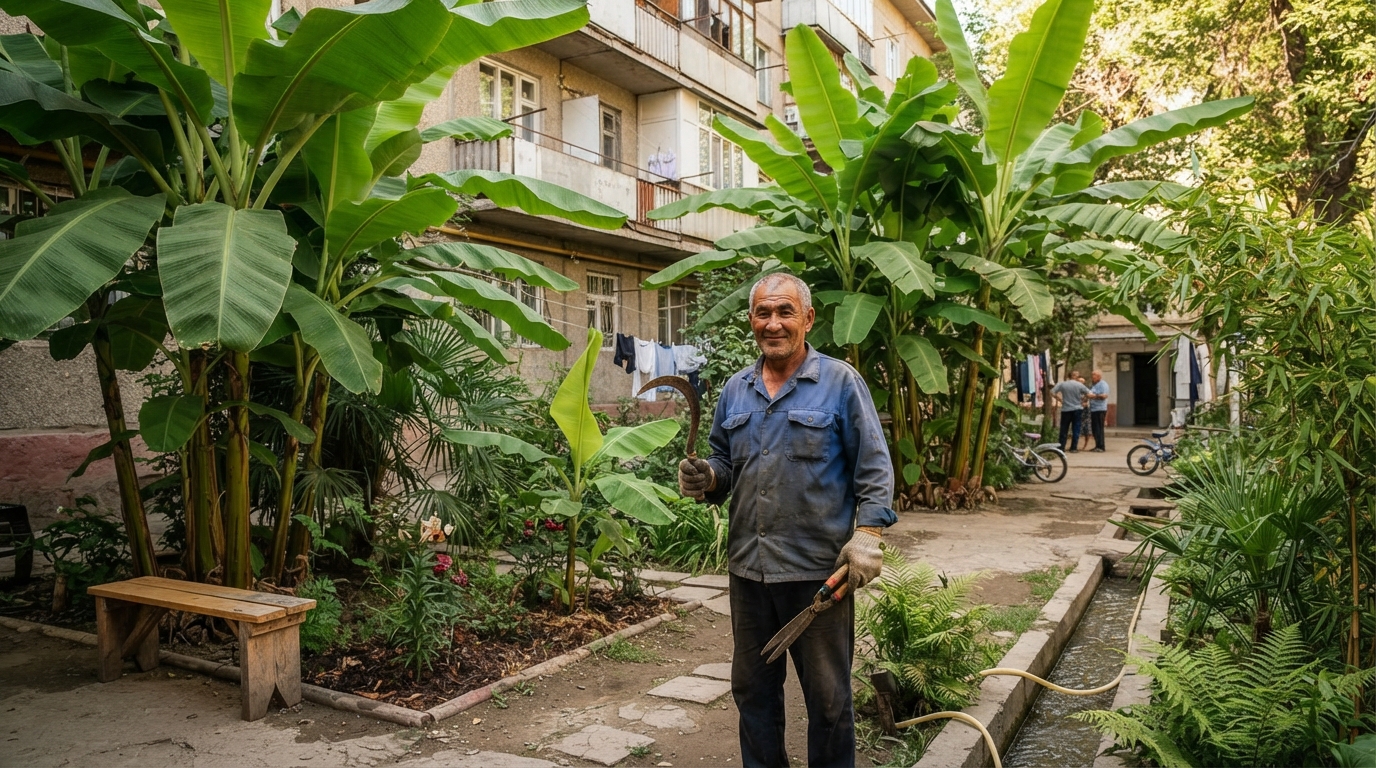
"I want to create a Canary Island here." The story of 63-year-old Batyr Valiyev, who grew a banana jungle in Chilanzar
The courtyard of building No. 48/49 in the sixth block of Chilanzar looks ordinary: narrow paths wind between flowerbeds and shrubs, laundry hangs out to dry, children play in the shade of the trees, and neighbors enjoy leisurely conversations. The only thing that makes this place special is the abundance of greenery, transforming the courtyard into a veritable forest. A tropical one at that: clusters of banana trees grow along the entrances, their stems reaching up to the third floor, and their broad, bright green leaves create a dense canopy.
The head gardener is easy to find. A man wearing work gloves emerges from the banana thicket, holding a sickle in one hand and garden shears in the other. This is 63-year-old Batyr Valiyev, the house committee member, thanks to whom this once-abandoned area has been transformed into one of the greenest courtyards in the neighborhood.
Batyr Valiyev is originally from Navoi and is an electrician by profession. He worked at a motor depot in Uzbekistan, then went to South Korea, where he serviced factory equipment. In 2014, he returned to Tashkent.
“One day, I fell asleep outside in the bitter cold and caught a terrible cold. I spent a long time receiving treatment, but it didn’t get any better, so I had to come back. I practically didn’t leave the house for the entire year. Only towards the end of 2015 did I start going outside a little. That’s when I noticed how empty and lifeless our courtyard was,” recalls Batyr-aka.
A lone mulberry tree stood in a grassy vacant lot under the windows. The courtyard was littered with trash, there were no benches or designated rest areas, and a significant portion of the space was taken up by makeshift parking. Cars were parked alongside the building in several rows, sometimes right under the windows.
"I asked the neighbors, 'Are you moving soon?' They replied that they'd lived here for decades and had no plans to leave. Hearing this, I was surprised: how could someone live in the same place for so many years and not change anything around them? At first, I thought people simply didn't consider this courtyard their own. Then I realized they'd gotten used to the way things were. But you can't live like this," says Valiyev.
Valiyev began his improvements with the area around his own entrance. To prevent cars from driving too close to the house, he installed curbs. Then he removed the trash, mowed the grass, and dug up the hardened soil. According to Batyr-ak, it was this physical labor that helped him recover.
"At first, I only went out into the courtyard a little at a time, then I started working every day. It was like exercise for me. Instead of going to the gym, I dug the earth, planted plants, and spent a lot of time outdoors. The more I moved, the better I felt. So, you could say that a shovel and a hoe saved my life," he shares.
As the courtyard's appearance changed, so did the residents' attitudes toward the shared space. While Batyr-aka initially worked alone, over time, his initiative was supported by his neighbors. They began cleaning, helping with watering and planting, taking turns sweeping the entryways, and creating recreation areas.
In 2018, the residents suggested Valiyev take over the building's management. Together with his neighbors, Batyr-aka raised the necessary funds and gradually restored the old building and its grounds. He built benches with his own hands, installed motion-sensor lights in the entryways, purchased a watering pump, and gradually began transforming the space freed up by cars into a garden.
The first plants appeared in the yard in 2016, almost by accident. One of his neighbors brought Batyr-aka a bag of lilies, and he planted them around his entryway. Later, rose bushes, lilacs, violets, and night-flowering flowers appeared along the side of the building. However, the flowers were often picked by passersby.
“The flowers were constantly picked—by both children and adults. I explained: they were planted for everyone. You've already seen this beauty, but someone else is coming after you, who also has the right to admire it. However, it's impossible to monitor everyone and criticize everyone. Then I saw a banana tree and decided to plant it in the yard. It produces a lot of greenery, looks beautiful, and no one bothers it,” says Batyr-aka.
Batyr-aka purchased his first banana seedling from a gardener he knew in 2022. The plant took root, and soon new shoots began to appear at its base. The house committee learned to separate them and transplant them to other spots in the yard, gradually increasing the number of bananas.
The key to caring for bananas is ample watering. Water is taken from a ditch near the house and pumped to all the plants. According to the house committee, the mature plants have already adapted to the Tashkent heat and, with adequate watering, do not require additional protection from the sun.
Last year, the plants bloomed and began to bear fruit for the first time, but the short warm season was not enough for the bananas to ripen.
"The bananas grew to about 5-6 cm, but they still didn't have time to ripen before the cold weather. For me, the most important thing is not the harvest, but that the bananas grow quickly, produce a lot of greenery, and create shade. The fruits themselves can be purchased at a nearby store," says the house committee.
With the onset of cold weather, the above-ground portion of the banana plants dies. After the first frost, the leaves darken and fall off. Valiev then cuts the stems, leaving about 40-50 cm above ground, and covers the base of the plants with a thick layer of fallen leaves. He doesn't use plastic or other artificial insulation.
"Fallen leaves are enough to protect the plants from frost. If the winter is mild, bananas can begin growing as early as January or February, but new shoots usually appear in March," he explains.
Fallen leaves also serve as fertilizer. Valiev places them, along with plant cuttings and kitchen scraps, in a pit about 70 cm wide and 50 cm deep. Over the course of a year, the organic matter turns into dark, loose compost. Each fall, this compost is spread throughout the plot, and the emptied pit is refilled with fresh leaves. This way, residents don't have to buy fertilizer or pay for leaf removal.
"Leaves aren't trash. Trash is plastic and anything that doesn't decompose. And after a year, leaves turn into excellent plant food," notes Valiyev.
In four years, dozens of new plants have emerged from a single established plant. Today, the Chilanzar "plantation" contains around 200 mature banana trees and young shoots. Over the course of a season, the largest of them grow to approximately seven meters—the height of the third floor—while smaller shoots reach one and a half to two meters by autumn.
Bananas aren't the only exotic plants in the courtyard. Wanting to diversify his collection, Valiyev began searching for unusual plants that would thrive in the local climate. This is how bamboo, ferns, and date palms appeared.
Batyr-aka doesn't plan to stop there. Residents are already asking him to continue planting bananas on the other side of the building. He plans to transplant young shoots there, so that over time, greenery will appear around the entire building.
In addition to bananas, Valiev plans to expand the plantings with bamboo, palms, ferns, and vines. He plans to string ropes between the supports for the climbing plants, allowing them to climb and form a canopy. Over time, Batyr-aka envisions, the ordinary courtyard will resemble a jungle.
The house committee also wants to transform the irrigation ditch that runs through the courtyard. He plans to turn it into a small canal, winding around the trees and flowerbeds. Nearby, he plans to install lotus ponds and decorative rocks over which water will flow. To avoid constant water consumption, Batyr-aka suggests installing motion sensors: the pump will only turn on when someone approaches the pond.
"My dream is to transform the courtyard into the Canary Islands. I tell my neighbors, 'You won't have to go anywhere for vacation. You can just walk out of the house, sit on a bench, and relax among the greenery and water.'" "Even in the summer heat, the dense vegetation will keep it cool here," Valiyev says of the yard's future.
Bringing his ideas to life isn't easy. Valiyev doesn't have any transportation or specialized equipment—only gardening tools and a small cart. Neighbors help deliver soil, fertilizer, and large seedlings. However, these difficulties don't deter him—almost everything growing near his house today once began with a cleared plot and a few plants.
"People here are used to expecting someone to come and do everything for them. But who, if not us, will take care of our yard? We live here. Lack of money, water, or tools shouldn't be an excuse—we need to find opportunities. Cleaning should be done not under duress, but of our own free will, with good intentions. Only then will something work," concludes Batyr-aka.