

'I live with a ghost': Japan's haunted homes attract bargain hunters
Properties where someone has died in tragic circumstances can have big reductions in price.
‘I live with a ghost’: Japan’s haunted homes draw bargain hunters
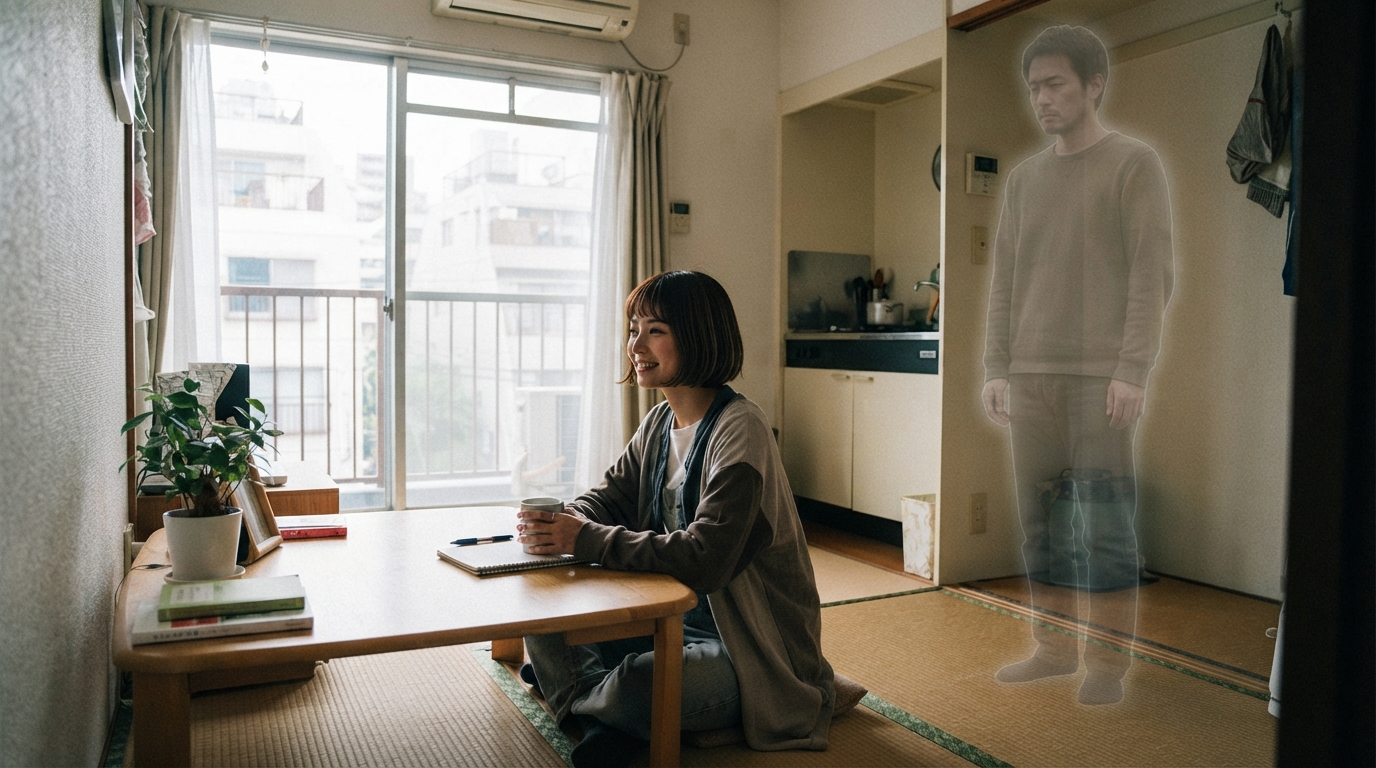
Ryua says she shares her Tokyo apartment with a ghost.
From the first time Ryua stepped into her rental flat in Tokyo, she was convinced it was haunted.
“When I visited the place for a viewing there was a man standing there, glaring at me,” she says.
“Since the estate agent couldn’t see him, I realised he must be a ghost.”
Someone less fearless might have left and never come back, but Ryua decided to move in anyway.
“I’m a bit of a contrarian, so I decided I wanted to become friends with this glaring male ghost,” says Ryua, who works as an aidoru, a young entertainer, and does not want to reveal her surname.
Four years on, and still living in the same apartment, she says paranormal events continue every day. She says she hears constant footsteps and the ghost speaking.
Although Japan has increasingly marked Halloween, the country has its own word, “yuurei”, meaning a lingering, troubled spirit.
These are the ghosts of people who died in violent or tragic circumstances — those who were murdered, killed themselves, or simply were lonely and died alone. If they died at home, the belief is that their yuurei will not leave.
For house hunters who are not superstitious or squeamish, that can mean major bargains. There is an entire category of homes known as jiko bukken, meaning “stigmatised” or “incident” properties.
Under government guidelines issued in 2021, Japanese estate agents must disclose suicide, murder, death by fire, and any death in which the body was not found for a long time.
For rental properties, this must be disclosed for three years, and for any property put up for sale it must be revealed indefinitely.
By contrast, there is no legal requirement in the UK.
And in the US, the rules vary from state to state.
For instance, in California you must disclose if someone has died in the property within the past three years, while in Arizona and Oregon you do not.
Ryua was told that a man had killed himself in her apartment. As a result, she gets an almost 30% discount on the rent for her tiny 25 sq m bedsit in the fashionable ward of Setagaya. She says she pays 45,000 yen ($285; £213) a month, rather than the 62,000 yen it should have cost.
A home where there had been a murder or suicide would likely be harder to sell or rent anywhere, but Tokyo estate agent Erik Oskamp says Japanese people are especially superstitious and wary of stigmatised properties.
“[Even] an apartment next to a cemetery will be difficult to rent out, especially if you can see the tombs from the kitchen,” Oskamp explains. “The worst thing is if a suicide has happened in the apartment. Even if somebody has jumped from the roof, many renters will move out. Other issues are a serious crime or a lonely death.”
That last issue, someone dying alone, would not usually affect a property’s value in, say, the UK or the US.
But in rural Kagoshima, in southwest Japan, it allowed Diane Tincher to buy a large three-bedroom house for about half the asking price.
The 79-year-old American has lived in Japan for nearly 40 years and works as a tour guide. She says the estate agent was upfront with her — there was a substantial discount because an elderly woman had died alone, which stigmatized the property.
Tincher paid 20m yen for the house, in an area where similar homes typically sell for as much as 45m yen.
“I don’t believe in ghosts. But I know that the Japanese are very superstitious,” she says. “If there is a ghost I’m thankful to her every day... to live in such a splendid and affordable home.”
While researching the house, Tincher found it on a website called Oshimaland, which lists jiko bukken properties and gives details of the incidents that took place there. It began in 2005, covering Tokyo, before expanding across Japan and then internationally in 2011.
The site is crowdsourced, meaning members of the public add the homes and their details.
Teru Oshima, who founded Oshimaland, says such properties used to be “not very attractive options” in Japan.
But as house prices have risen in recent years, along with a sharp increase in the wider cost of living, one 2025 survey found that more than half of Japanese people would now rent a jiko bukken if it were cheap.
Back in Setagaya, Ryua says she is content living with her ghostly flatmate. “I believe that ghosts were once living human beings, so they deserve our respect,” she says.