

How are the two poorest villages in the world getting rich?
An unexpected twist came later: the one who most loudly opposed the filming,
**How are villages on both sides of the world thriving?**
**Huskar, whose peace was disrupted by the cartoon**
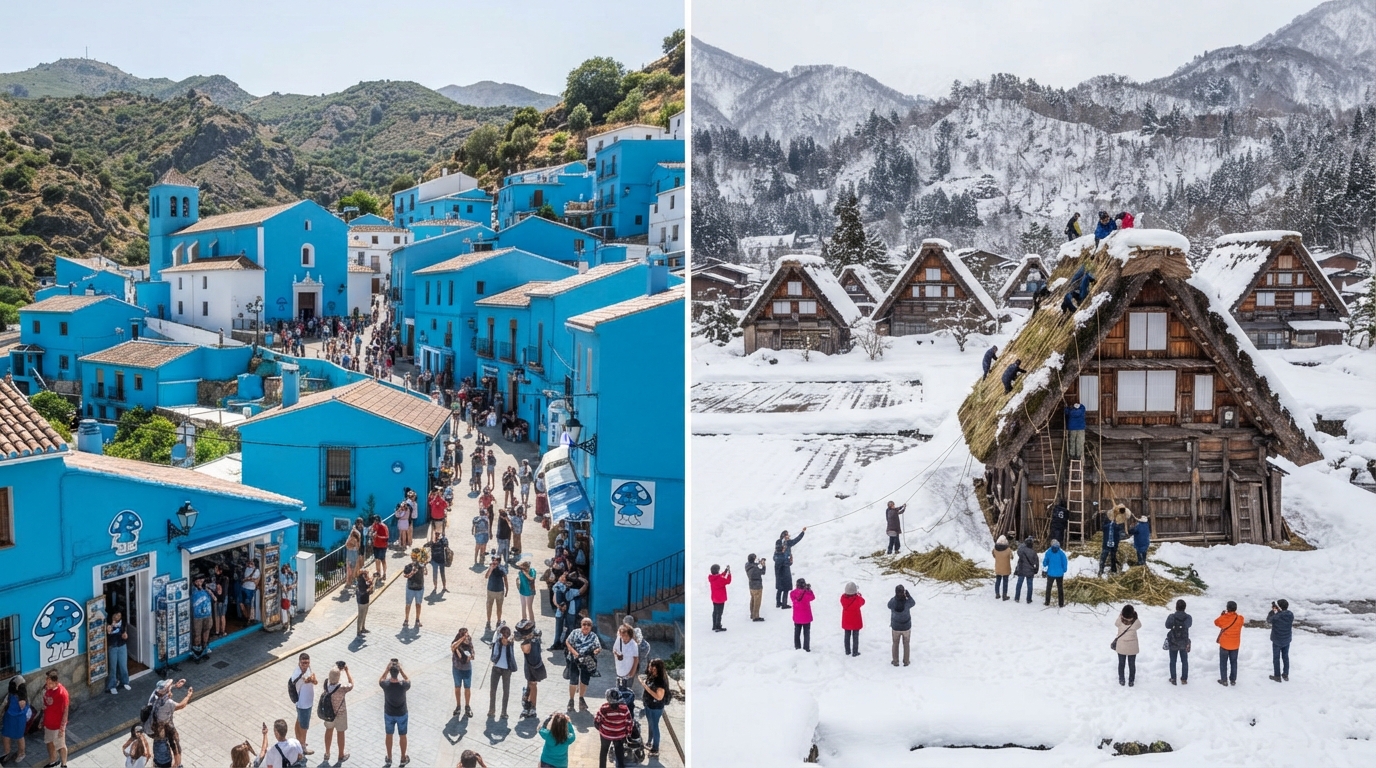
In the village of Huskar, located in the mountains of Andalusia, Spain, life had not changed for centuries. The main livelihood of the population was picking mushrooms in the mountains, raising goats and small-scale farming. In this quiet place, distinguished by its white-walled houses, the days were so peaceful that even tourists from the city did not stay here long.
But in 2011, this peaceful life changed radically. Representatives of the major Hollywood media corporation - Sony Pictures - visited the village. They came with an unexpected and unusual proposal for a global promotional campaign for the 3D cartoon "The Smurfs": to paint all the houses in the village, including the historic church and even the tombstones in the cemetery, bright blue.
This idea of Hollywood was not unanimously accepted by the local population. On the contrary, the village was divided into two poles. In particular, the application of blue paint to the walls of the centuries-old church and the cemetery where their ancestors found eternal rest was considered by many to be disrespectful to sacred sites and history.
When the workers began work with paints and brushes, some disgruntled homeowners tried to interfere with the work by repainting the walls of their houses with white paint. Protests were held in the center of the village with slogans such as “We are not Smurfs, we are farmers!” and “Return our peace!” Because the noise of the film crew, the huge statues of blue creatures that appeared on the streets, and the constant filming processes were getting on the nerves of people accustomed to a peaceful life.
But the filmmakers managed to convince a certain part of the population by promising to paint the houses white again after filming. More than 4,000 liters of paint were used to paint the village houses.
Finally, in July 2011, the cartoon was shown and a miracle happened. Previously, Huesca, which received only 300 tourists a year, has now attracted more than 80,000 people in just 6 months! The small streets between the mountains are filled with tourists. People began to stand in long lines to take pictures near the blue walls, buy Smurf mushrooms and eat at local cafes.
Families that previously barely managed to earn 50 euros a day are now earning thousands of euros a day. Hotels, souvenir shops and transport services have flourished. Unemployment in the village has almost disappeared.
Then came an unexpected twist: one of the former protesters, who was the loudest against the filming, who threw white paint on the walls, later opened the first Smurf Cafe and Souvenirs store in the village and became the biggest entrepreneur!
When the contract expired and Sony Pictures wanted to repaint the houses white, the residents gathered in the village center again. And 141 people voted to keep the houses blue, and 33 voted to return them to white.
But the village’s story did not end there. In 2017, Sony Pictures and the copyright holders began demanding a large percentage from the village for using the “Smurfs” brand. Due to disagreements, the village lost its name and official brand “Smurfs Village”.
Did the livelihood stop? No! The residents of Huskar immediately changed the name of the village to “Blue Village”. The brand name is gone, but its history and bright blue houses remain. Today, thousands of tourists continue to come here to witness the history of economic upheaval with their own eyes.
**Shirakawa-go, lost in the snow-capped mountains**
While the Spanish village of Huáscar was revived by Hollywood’s hype and a chance turn, the Japanese mountain village of Shirakawa-go has the opposite charm.
Shirakawa-go’s wealth lies in its unique social and economic system, built over centuries, based on discipline and collective responsibility.
Shirakawa-go is located at the foot of the sacred Mount Haku-san in the northwestern part of Japan’s Honshu island, surrounded by rice paddies and a mountain river. This peaceful and natural village is a UNESCO World Heritage Site and is famous for its 114 historic houses. Some of them are over 250 years old.
In winter, the snow here reaches several meters in thickness. For this reason, the locals have created a unique architectural style called “Gassho-zukuri” (palms joined for prayer) for centuries.
The roofs of the houses are built on a steep slope of 60 degrees, using only wood and ropes, and are covered with straw and thatch without a single nail. Such a structure withstands heavy snow pressure and shaking earthquakes.
The problem is that the thatch layer of such a roof needs to be completely renewed every 30-40 years. In the language of a modern market economy, renewing the roof of one house is a process that requires tens of thousands of dollars of labor and resources, which is beyond the means of an ordinary peasant family.
It is precisely this financial and physical difficulty that has formed a unique social system in Shirakawa-go - “Yui”. "Yui" means "hashar" in our language, but it is a strictly regulated social obligation in the village. When a day is set for the roof of one house to be replaced, the villagers gather together early in the morning. The work is planned so precisely and down to the minute that the entire roof replacement is completed in 1-2 days.
Most importantly, no one is paid a single yen for this service. If the whole village covers the roof of your house today, tomorrow you will go to another house and work. This system not only frees the local population from heavy financial expenses, but also maintains the cohesion of the community.
In 1995, Shirakawa-go was inscribed on the UNESCO World Heritage List. Since then, investors and large hotel chains have been pouring into the village. But the locals gathered and adopted three strict and uncompromising rules: no houses or land in the village will be sold to outsiders or foreign investors, and no houses will be rented out to outside businesses for commercial purposes. No modern buildings, plastic structures, or bright advertising banners that contradict the village’s historical image will be erected.
They have rejected mass, cheap tourism by excluding large hotels and noisy entertainment centers from the village. The residents of Shirakawa-go have not adapted to the modern world, but rather have subordinated the modern world to their own rules, creating a high-value ethno-tourism model.
Tourists do not stay in large hotels, but in the centuries-old thatched houses of the local population, together with their families. Thousands of people a year line up months in advance and pay high prices for this.
It sells rice, mountain vegetables and traditional Japanese dishes grown by local farmers, rather than imported food. Several historic houses in Shirakawa-go have been converted into museums, and the income from entrance fees goes entirely to supporting local infrastructure and the Yui system.
While the Spanish village of Huáscar shows us that adapting to the needs of the times, rapidly changing the model and bold marketing can help a struggling region recover, the Japanese village of Shirakawa-go proves that not sacrificing identity and values for commercialism is the most valuable capital.
One got rich thanks to a fast trend and cinematic hype, the other maintained its independence through centuries-old discipline and collective responsibility. But the results of both are encouraging. Most importantly, the villages did not disappear from the map, the population did not move to the city, but rather proved their existence to the whole world through tourists and became prosperous and prosperous villages.