

How to receive assistance from the "Iron Register" and the "Women's Register"?
To receive assistance from the "Iron Register" ("Temir daftar") and the "Women's Register" ("Ayollar daftari"), one must apply to the "Inson" social services center or the local neighborhood community (mahalla). The criteria for inclusion in the system, the application procedure, and the types of assistance differ from one another. In this article, we will look at the procedure for obtaining assistance from the "Iron Register" and the "Women's Register".
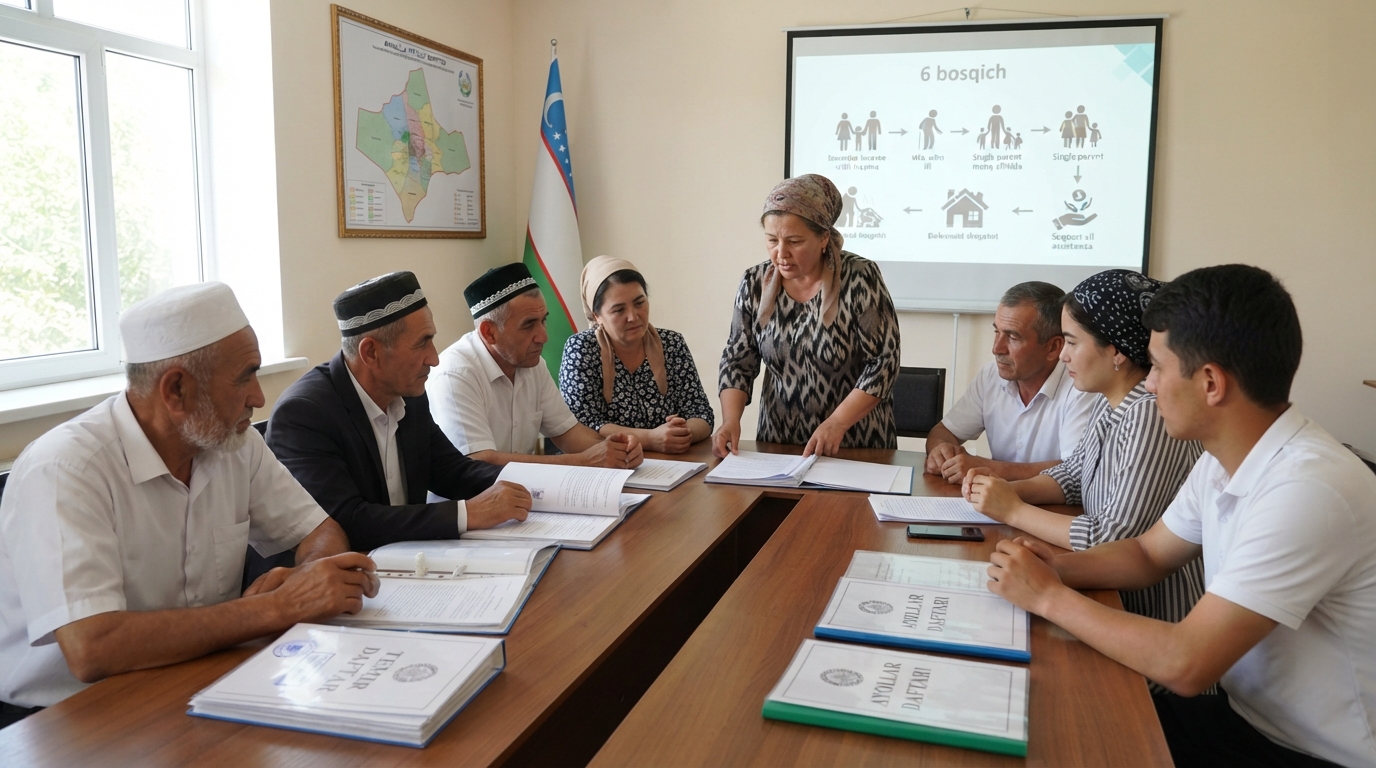
How to receive assistance through the "Temir daftar" (Iron Register) and "Ayollar daftari" (Women's Register)?
"Temir daftar" is a system aimed at registering families in difficult financial situations, identifying their problems, and delivering the necessary assistance. It is regulated by Government Resolution No. 313 of 2024.
"Ayollar daftari" is a list formed to support women in need of assistance, who are unemployed, or who wish to acquire a profession and create a source of income. This system operates on the basis of Regulation No. 145 of 2022.
"Temir daftar" is maintained to identify families whose financial and social situations have worsened, assess their problems, and provide targeted assistance. A social worker studies the family's conditions and prepares a recommendation, which is then reviewed by the "mahalla seven".
The process usually takes place in 6 stages:
- Absence of an able-bodied member or a member earning a stable income in the family;
- One of the family members having a severe illness, disability, or requiring constant care;
- Loss of the family breadwinner;
- A father or mother raising three or more children alone;
- Insufficient family income and difficult housing conditions;
- The family falling into a difficult situation as a result of fire, flood, earthquake, or other emergency situations.
No, meeting just one requirement is not enough. Under the "Temir daftar", a family's situation is assessed individually: its income, family composition, able-bodied members, health, housing conditions, dependency burden, and existing social risks are studied together. Therefore, a single fact such as "there is a person with a disability in the family" cannot serve as a basis for either automatic inclusion or rejection. For example, if a family has a child with a disability and a sole breadwinner, along with low income and housing unfit for living, this family's need for assistance may be assessed as higher.