

How are the economies of Central Asian countries changing?
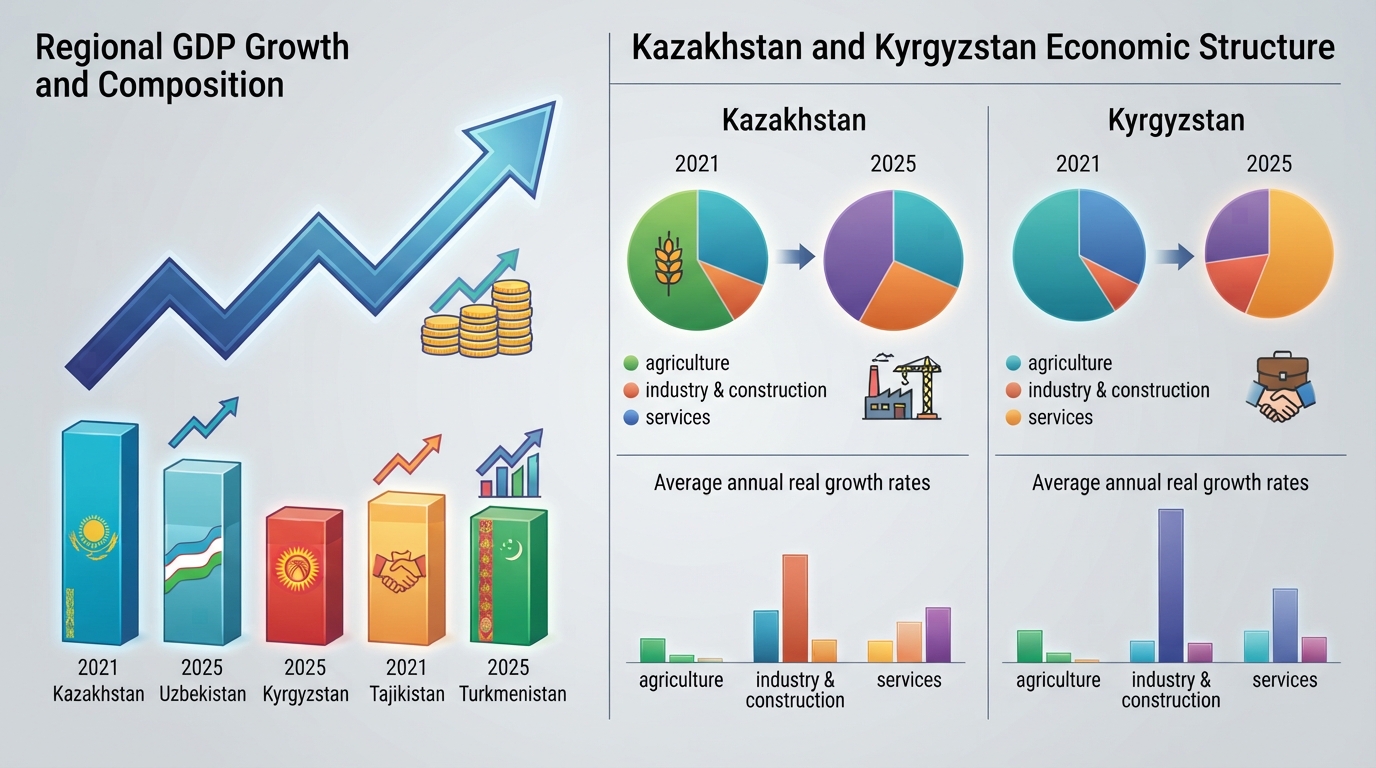
The economy of Central Asian countries has doubled in five years. Between 2021 and 2025, the best average real growth was observed in Kyrgyzstan at 9.2 percent. Kazakhstan continues to hold the largest share in the breakdown of the region's gross domestic product by country. However, over the last 5 years, this figure has decreased from 60 percent to 56 percent. In turn, Uzbekistan's share increased from 24 percent to 27 percent.
How are the economies of Central Asian countries changing?
In 2021–2025, the total gross domestic product of Central Asian countries rose from $285 billion to $543 billion, recording an almost twofold growth. Ruslan Abaturov, an expert at the Center for Economic Research and Reforms, analyzed the economic indicators of the region's countries based on World Bank data.
By the end of 2025, Kazakhstan retains the largest share in the breakdown of the region's GDP by country. However, during the reporting period, its total share fell from 60 percent to 56 percent. Conversely, Uzbekistan's share increased from 24.6 percent to 27.1 percent, Kyrgyzstan's from 2.9 percent to 4.2 percent, and Tajikistan's from 2.9 percent to 3.3 percent. Turkmenistan's share decreased from 9.6 percent to 9.2 percent.
Kazakhstan's economy reached $306 billion from $171 billion in 5 years. The average annual real growth was 4.8 percent, which was the lowest indicator among the countries of the region. For this reason, Kazakhstan's share in the region's economy decreased.
In the structure of Kazakhstan's gross domestic product, the share of agriculture decreased from 5.4 percent to 3.7 percent, and the share of industry and construction fell from 33.1 percent to 32.3 percent. At the same time, the share of the services sector increased from 56.1 percent to 57.7 percent. The average annual real growth of value added in agriculture was 3.5 percent, in industry and construction 5.5 percent, and in the services sector 4.4 percent.
Kyrgyzstan's gross domestic product rose from $8.3 billion to $22.6 billion. The average annual real growth was 9.2 percent, which was the highest indicator among the countries of the region. Economic growth accelerated after 2021: in 2022–2023, real GDP growth was about 9 percent per year, and in 2024–2025, it was more than 11 percent.
In the structure of Kyrgyzstan's economy, the share of agriculture decreased from 12.2 percent to 8 percent. The share of industry and construction remained almost unchanged, falling from 26.9 percent to 26.5 percent, while the share of the services sector increased from 50.7 percent to 51.2 percent. The average annual real growth of value added in agriculture was 2.3 percent, in industry and construction 10.5 percent, and in the services sector 8.5 percent.