

"Hell chicken" dinosaur adapted to eating fruit discovered
Paleontologists have identified a new species of dinosaur the size of a large turkey in the US. The unusual jaw structure of this creature, nicknamed the "chicken from hell," indicates that it was adapted to feeding on soft fruits. The find has provided new insights into the diet of dinosaurs and their connection to the ancient plant world.
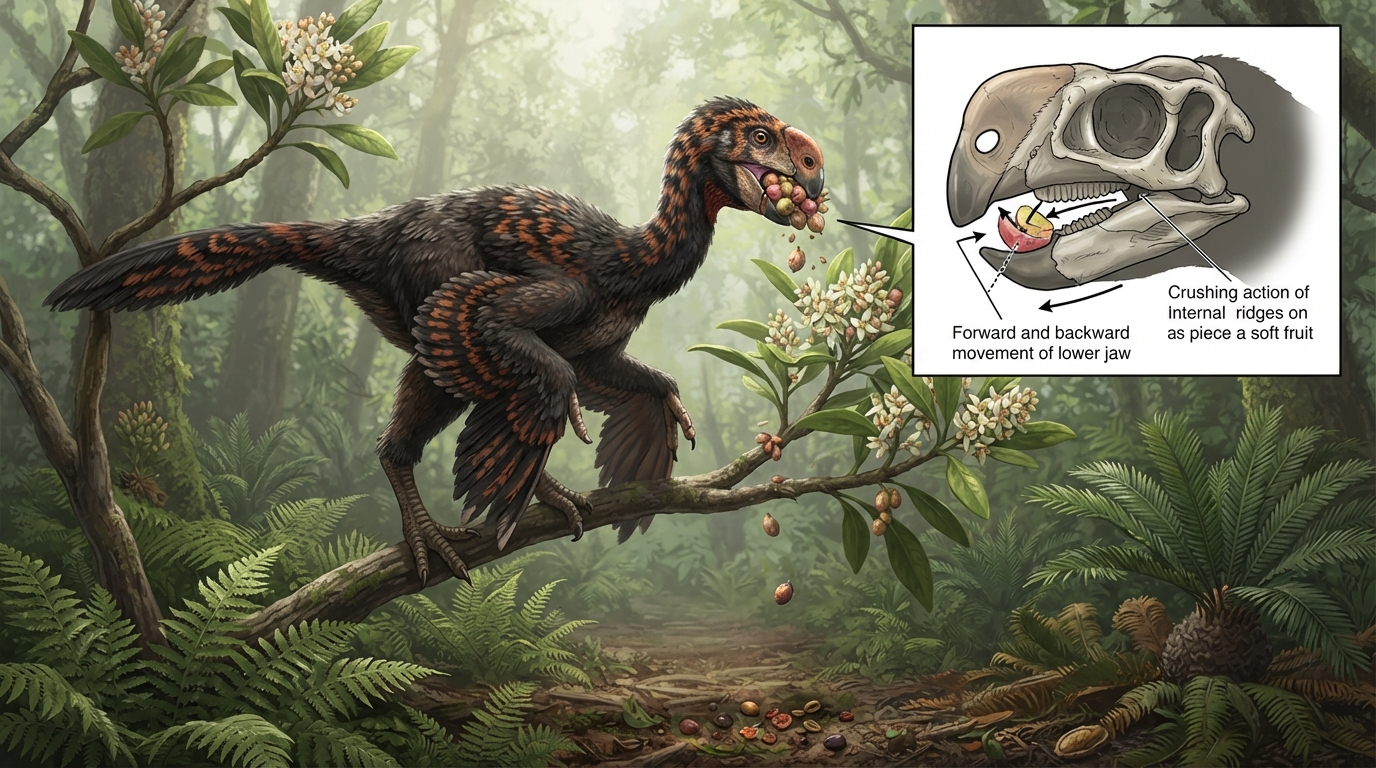
A "hell chicken" dinosaur adapted to eating fruit has been identified
The new species was named Infernogallus jamesi. This name means "James's hell chicken." Its well-preserved fossilized remains were found in the Hell Creek region in the western US, an area rich in paleontological discoveries.
Scientists from Stony Brook University in the US and the Royal Ontario Museum in Canada participated in the study. They examined the dinosaur's almost fully preserved skull and skeletal parts. The results were published in the journal Nature Communications.
This dinosaur lived at the end of the Cretaceous period, alongside famous large creatures such as Tyrannosaurus and Triceratops. However, unlike them, it was much smaller: its body resembled a large turkey, and it weighed approximately 12 kilograms.
Infernogallus jamesi belongs to the group of bird-like dinosaurs — oviraptorosaurs. Its toothless beak and the structure of its jaw bones served as key evidence in understanding its feeding method.
Scientists studied the internal and external structure of the skull in detail using computed tomography. By analyzing the places where bones and muscles attached, they reconstructed how the jaw apparatus worked. This method allowed them to evaluate how a creature that lived millions of years ago crushed food.
As a result, it was determined that the arrangement of the jaw muscles differed significantly from the norm. This structure allowed the lower jaw to move forward and backward. Matching ridges and grooves inside the mouth helped crush and grind soft food.
According to the researchers, such a mechanism was suitable for processing fleshy, soft fruits. On this basis, they concluded that the fruits of flowering plants might have made up a large part of the dinosaur's diet.
A similar feeding mechanism is also found in some modern frugivorous parrots. In them, too, the movement of the jaw serves to crush soft fruit pulp. This similarity between the ancient dinosaur and modern birds is of great importance in understanding the potential diet of the new species.
However, the conclusion drawn based on the jaw structure does not mean that every single food the dinosaur ate has been identified. Current evidence shows that it specialized in consuming soft plant food, particularly fruits.
The discovery has also raised new questions about the role of dinosaurs in ancient ecosystems. Fruit-eating animals often help disperse plant seeds. If the seeds they swallow are not digested and fall in another place, the plant gets the opportunity to grow in a new territory.