

A new feathered dinosaur has revealed an alternative evolutionary path for modern birds
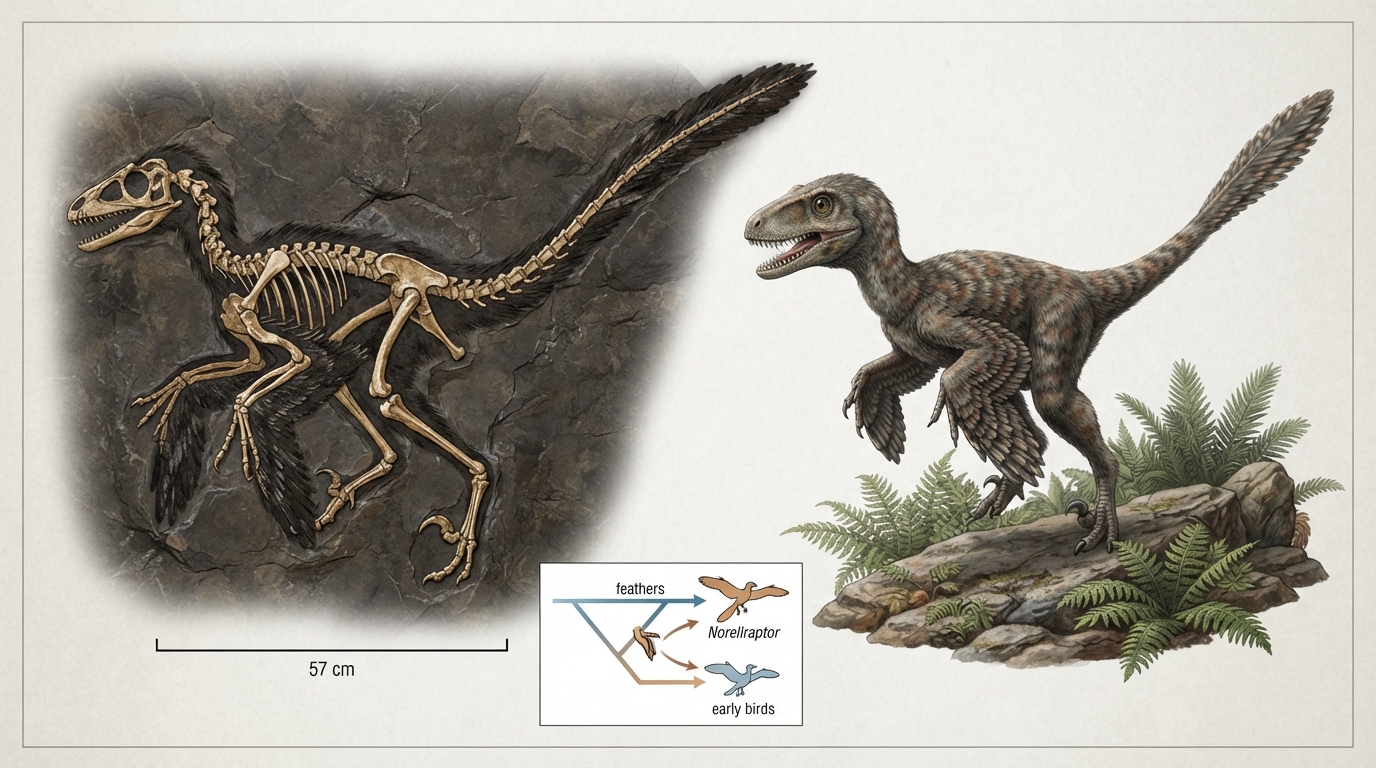
New feathered dinosaur points to alternative evolutionary path for modern birds
Scientists have described a new species of small feathered dinosaur, Norellraptor barsboldi, which lived in what is now China. The well-preserved skeleton of this animal has allowed researchers to re-evaluate how flight-related traits emerged in ancient creatures.
The dinosaur was approximately 57 centimeters long. The discovered skeleton preserved traces of feathers, including on the forelimbs and tail. Scientists classify this animal as belonging to a group of small predatory dinosaurs closely related to the ancestors of modern birds.
The main conclusion of the study is that similar features in these dinosaurs and ancient birds could have arisen independently of each other. In other words, different groups of animals could have arrived at adaptations for flight through different paths, rather than inheriting them from a single common ancestor.
The researchers compared a large number of structural features of these dinosaurs and ancient birds. About 30% of the traits that appeared in the studied group of dinosaurs also emerged in the lineage leading to birds. However, the scientists found no overlap in the sequence of their appearance.
This challenges the notion that similar body features in ancient relatives of birds necessarily formed according to the same scenario. Therefore, the authors of the study believe, the history of how the ability to fly emerged could have been much more complex than previously assumed.
The scientists obtained additional data by studying the bones of the discovered animal. Based on their structure, the researchers established that the dinosaur died while still young, although its body had already undergone a significant part of the growth process. The developmental features of its forelimbs also differed from what is characteristic of modern flying birds.
The specimen itself was found near the town of Lamadong in China's Liaoning Province. A local farmer handed the fossil over to the Hebei GEO University Museum in 2023. The researchers separately verified the preservation of the find and its original discovery site.
Earlier, fossilized remains of a dinosaur that lived approximately 75 million years ago were found in Karakalpakstan. The paleontological discovery was made in the Sultan Uvays Mountains during a joint expedition by scientists from Karakalpak State University and the State Geological Museum of Uzbekistan.