

A 538-million-year-old animal fossil with a mouth surrounded by spines was found in China
In China, the remains of a tiny worm-like creature with spines around its mouth that lived approximately 538 million years ago have been found. Its body was covered by a flexible coat composed of fibers, plates, and hollow spines. The exceptionally well-preserved fossil allowed scientists to study not only the ancient animal's appearance, but also the delicate structure of its coating.
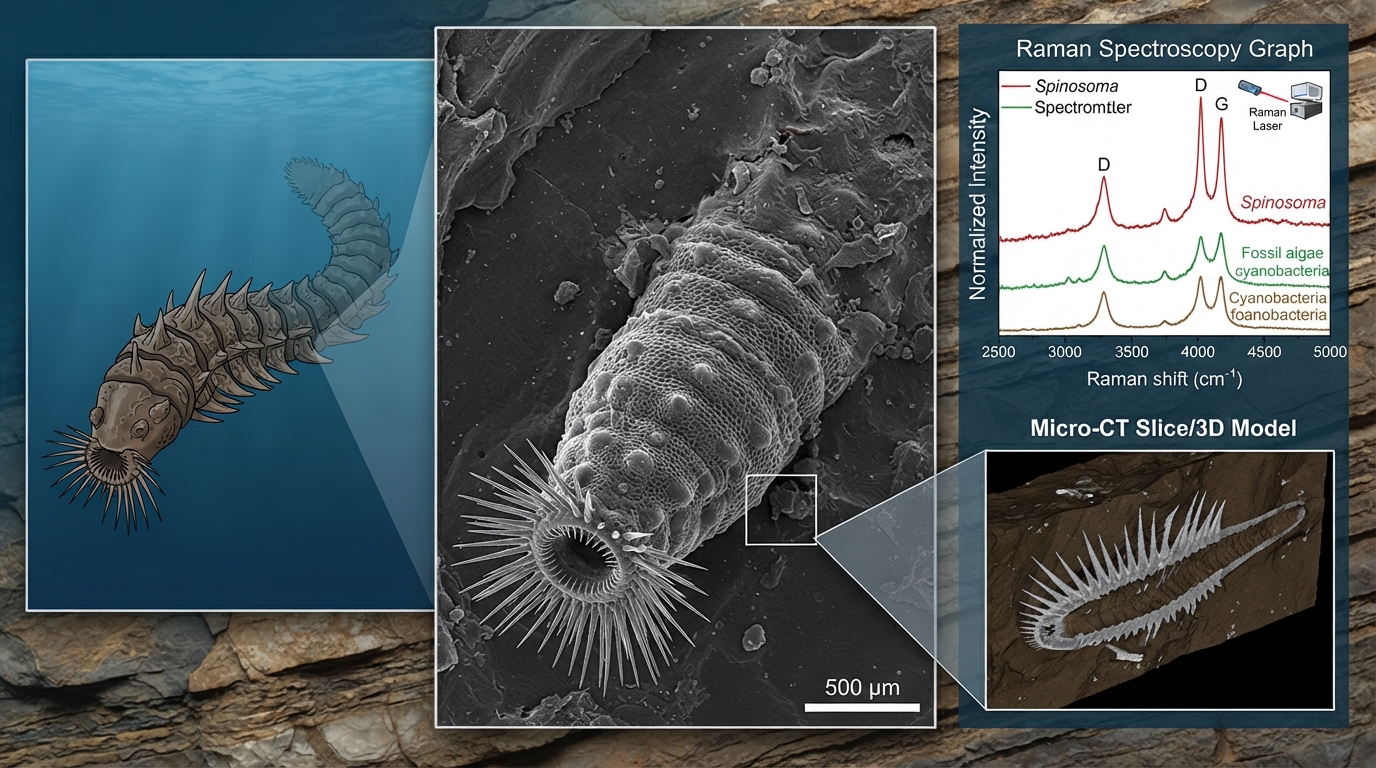
538-million-year-old animal fossil with a spine-encircled mouth discovered in China
Peking University paleontologists studied fossils found in silica-rich rocks in China and described a new species of ancient animal. It was named Spinosoma reticulatus. The results of the study were published in the journal Communications Biology.
As early as the beginning of the Cambrian period, animals with a complex outer covering lived in the seas. However, their soft tissues are rarely preserved to an extent that allows individual organs to be studied.
For this reason, our knowledge of the earliest animals depends largely on which tissues were preserved among which types of rock.
Such finds are particularly important for studying the origin of ecdysozoans (moulting animals). This huge evolutionary group includes today's arthropods, roundworms, and other animals. Their common feature is that they shed and renew their outer covering during the growth process.
Chinese scientists had previously studied certain organs of ancient worms and found evidence indicating that they moulted. However, the majority of such finds were associated with a shallow-water environment and were preserved due to phosphate minerals replacing the tissues.
In the new study, a different material was examined — fossils within silica-rich rocks. The age of the layers in which they were located was estimated to be approximately 538 million years. For this, the position of the layers in the geological section and the microscopic fossils found along with them were taken into account.
The best-preserved specimen is nearly 1.5 millimeters long. However, the rear part of its body is missing. This means that the animal was longer when it was alive.
In addition to this specimen, the scientists also analyzed many separate fragments of the outer covering.
The fossils were studied under a microscope, comparing their overall shape, the arrangement of their bumps, and the structure of the covering. Raman spectroscopy was used to examine the chemical properties of the preserved carbonaceous material.
Spectra obtained from the animal fossil were compared with those of fossilized algae and cyanobacteria found alongside it. This comparison helped distinguish initial biological differences from changes caused by the burial of the fossils and the heating of the rocks.