

A new species of light-avoiding, eyeless snail has been discovered in China
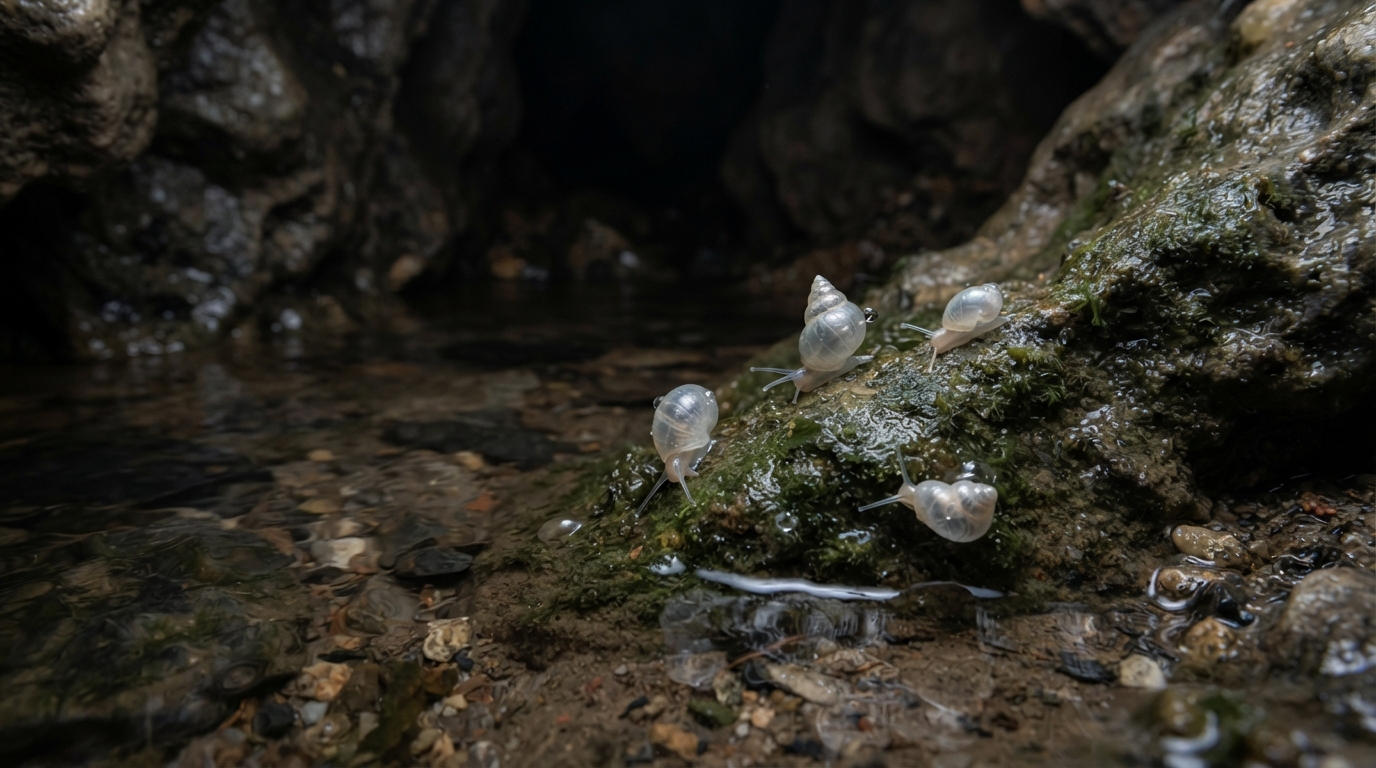
In a mountain cave in China's Yunnan province, a new species of snail with no eyes, a colorless body, and a semi-transparent shell has been discovered. Adapted to life in absolute darkness, this mollusk became the first cave-dwelling freshwater snail recorded in the country.
A new species of light-avoiding blind snail discovered in China
The new species was discovered by specialists from Yuxi Vocational and Technical College of Agriculture and Nanchang University during an exploration of a cave in Yunnan province. The results of the study were published in the scientific journal Subterranean Biology.
The mollusk was named Erhaia dijiang in honor of Di Jiang, the patron god of mountains in ancient Chinese mythology. In legends, Di Jiang is depicted as a faceless creature.
The snails were found at an altitude of 2,062 meters above sea level. This is the highest known habitat recorded so far for cave snails belonging to the family Erhaiidae. The find demonstrated that freshwater snails can live in cave systems at altitudes exceeding two kilometers.
The tiny mollusks are fully adapted to the underground environment. Their visual organs are completely gone, and there are no coloring pigments in their body. The shell is small, conical, thin, and translucent. Thin, sensitive tentacles on the soft body help them sense their surroundings.
Laboratory observations revealed that the snails avoid light. When illuminated, they attempted to hide in dark crevices under stones.
In their natural environment, these creatures live in shallow waters inside the cave, among gravel and small stones at the bottom of the water. In the places where they are found, the water depth does not reach one meter, and the temperature is around 20 degrees.
Increased water flow during the rainy season can carry some snails out of the cave. Researchers found specimens swept outside at distances up to two meters from the cave entrance. However, representatives of this species were not detected in open water streams near the cave.
In the laboratory, they fed on microscopic algae growing on the surfaces of stones. They also consumed regular fish food provided by the researchers.
The discovery is of great importance for exploring the little-studied underground fauna of East Asia. However, the status of the new species is causing serious concern among scientists.
Initial field studies yielded only three live adult snails and one empty shell. No young snails were encountered. Additional research is necessary to determine the total population and distribution area of the species.
For this reason, researchers are calling for the exploration of other cave systems in the region. They emphasized the need to develop special conservation measures to preserve these mollusks adapted to a fragile and limited environment.