

Half of the salary goes to rent: In which European countries is living more expensive?
Millions of Europeans spend a large portion of their income on housing costs. This includes rent or mortgage interest, utility bills, as well as taxes. Euronews examined how these expenses vary by country.
Half of the salary goes to rent: In which European countries is living more expensive?
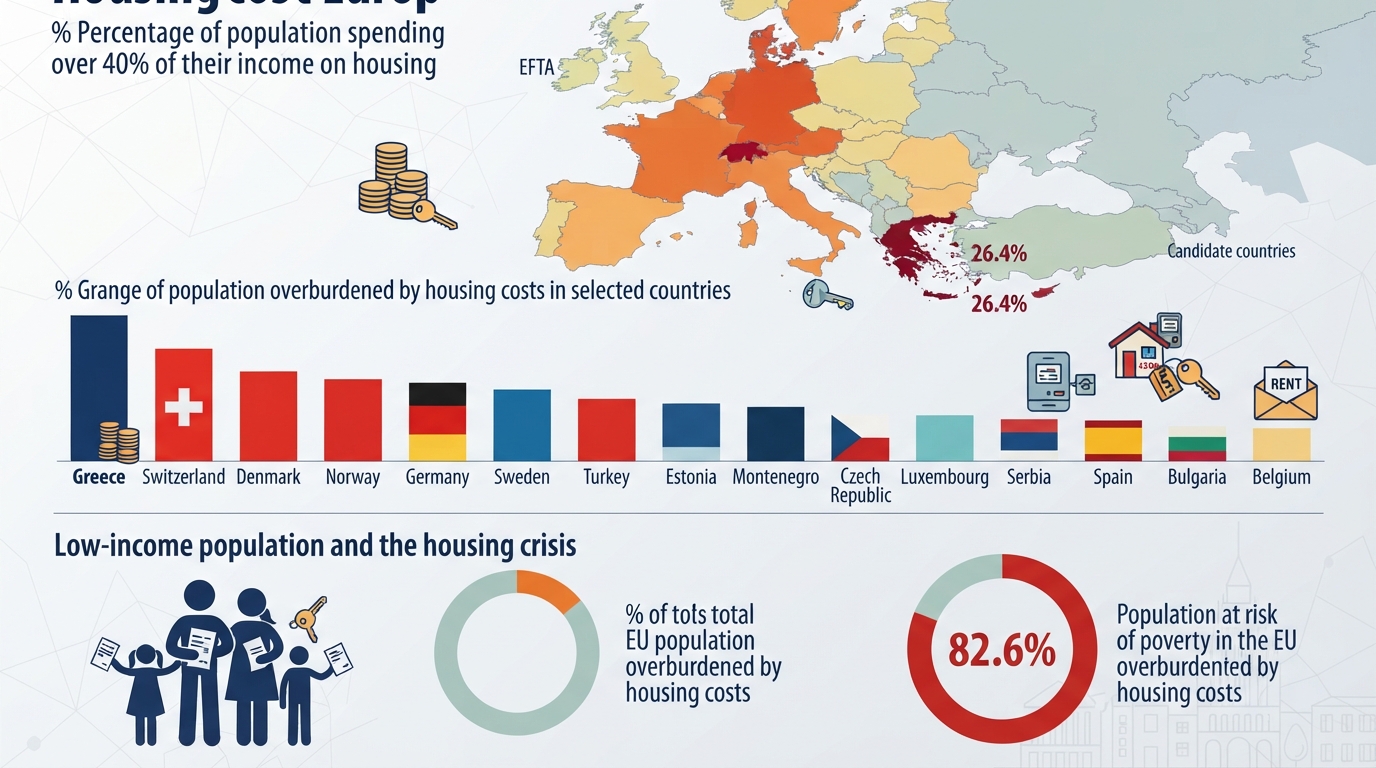
Millions of Europeans spend more than 40 percent of their income on housing. Euronews examined the countries where payments for real estate are the highest.
According to Eurostat data, housing prices in the European Union increased by an average of 69 percent from 2015 to the second quarter of 2026. In some countries, these prices have more than doubled. Rent and energy costs also continue to grow.
"Europe faces a crisis caused by rising housing prices and increasing costs associated with it," the European Council said in a statement.
The housing crisis is having a particularly strong impact on people who spend more than 40 percent of their income on housing costs. In 2025, this indicator averaged 7.7 percent in the European Union.
"The main reasons for the growing housing costs are the increase in rent and home purchase prices, while incomes are growing more slowly relative to them. This is affecting low-income groups in particular," said Dr. Hanna Widmer, a scientist at the Swiss Federal Institute of Technology in Zurich (ETH Zürich).
According to Eurostat, housing costs are the monthly amounts households pay for housing. They include rent or mortgage interest payments, utilities such as water, electricity, gas, as well as regular payments such as insurance, maintenance, repairs, and taxes.
Disposable income is a household's total income after taxes and social contributions are paid. It also includes social transfers such as pensions.
Among European countries with available data, Greece is the country where housing costs pose the greatest financial burden on the population. This comparison includes 27 EU countries, two members of the European Free Trade Association, and five EU candidate countries.
In 2025, 26.4 percent of the population in Greece spent more than 40 percent of their income on housing costs. This is more than three times higher than the EU average of 7.7 percent. Denmark ranks next among EU countries with 14.7 percent. The figures for Germany (11.2 percent), Sweden (10.8 percent), Estonia (8.8 percent), the Czech Republic (8.2 percent), and Luxembourg (8.1 percent) are significantly higher than the EU average.
Greece
26.4
Switzerland
15.3
Denmark
14.7
Norway
13.5
Germany
11.2
Sweden
10.8
Turkey
10.0
Estonia
8.8
Montenegro
8.7
Czech Republic
8.2
Luxembourg
8.1
Serbia
7.9
Spain
7.2
Bulgaria
6.9
Belgium
6.7
Netherlands
Poland
1,496
Switzerland
1,385
Netherlands
1,173
Sweden
1,143
Romania
952
Czech Republic
895
Denmark
881
Belgium
796
Although its population is significantly smaller than that of other countries, Greece ranks sixth in this regard. In the country, 2.7 million people spend more than 40 percent of their income on housing costs.
Naturally, low-income populations suffer more from this problem. In the European Union, among those at risk of poverty, this indicator reached 29.1 percent. People at risk of poverty refer to those whose income is below the threshold set for the country. This threshold is set based on 60 percent of the national median income. It also takes into account the number and composition of people in the household.
In 2025, taking household composition into account, the median income in the European Union was 22,939 euros per year, or 1,912 euros per month. 60 percent of that was equivalent to 1,147 euros per month. Greece ranks first in this regard as well. In 2025, 82.6 percent of the population at risk of poverty in the country lived in households spending more than 40 percent of their income on housing costs.