

States plans to penalise inactive developers
The housing committee says undeveloped land that has planning permission could be heavily taxed.
States plans to penalise inactive developers
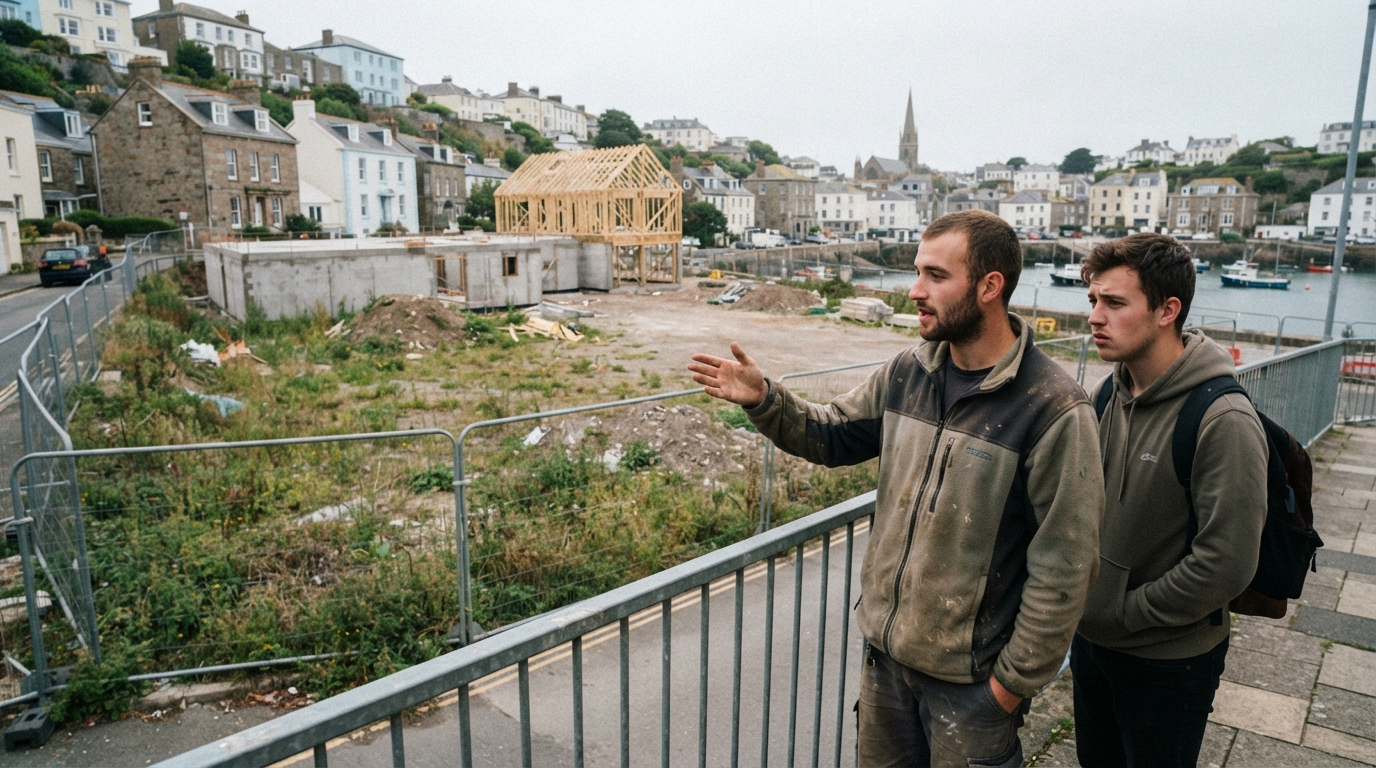
Sheldon Bourgaize (left) and his colleague Josh both said the high cost of housing was forcing people off the island
As young people in Guernsey struggle to take their first steps onto the property ladder, the Committee for Housing is considering penalising developers who leave land idle without building homes, in an effort to boost construction and bring prices down.
Builder Sheridan Bourgaize said he had always intended to buy a home in Guernsey, but rising prices and the increasing cost of living had changed his mind.
"A lot of the younger generation is about to move off island in all honesty," he said, blaming the high cost of property.
Property prices have risen by more than 52% over the past decade, with the average house now costing £608,844, while rents have increased by 65% to an average of £2,138 a month.
The affordability ratio, which measures the purchase-price-to-earnings ratio, now stands at 14.1 times earnings.
Last year, a report from the Guernsey Community Foundation said: "Concerns about rising living costs and difficulties finding somewhere affordable to live are forcing the island's residents, especially young families, to move away, or to plan to move away.
"Even though they want to stay, they don't see a future here."
The Committee for Housing has blamed a shortage of supply in the market for the high prices and their steep rise in recent years.
During rush hour in St Peter Port, I spoke to people at the Weighbridge including Matt Horton, a 33-year-old jeweller, who said the property market was hard for young people.
"It's extremely difficult and you need a leg up really to get anywhere on the island," he added.
Lily Le Maitre, 19, lives with her parents and hopes she will soon be able to rent before buying her own home
Lily Le Maitre, 19, said she currently lives at home with her parents "but I would like to move out in the future, but it is quite expensive".
"The whole saving and everything. It's quite a lot. I'll probably rent to start off with, but I would like to buy in the future," she said.
"I'm going to have a positive mindset and I think I'll get there, eventually."
Clare Bichard said the cost of a deposit was holding her back from buying her first home
Clare Bichard said she was fortunate because her rental property had a good landlord, but she recognised that others she knew were not so lucky: "A lot of people I know are struggling to find places.
"A lot of people with pets are having issues trying to find somewhere that will even allow them.
"It's just far too expensive for everyone at the moment."
Rosie, who works in finance, said: "I've got quite a few friends that are in a situation where they're having to look for housing now and renting is really high, so it's really tough.
"Wages don't really go up in connection with inflation and everything, and with GST now as well that's even less money in your pocket to pay for things, so yeah, it's tough."
In the States last week, as part of debate on unsuccessful proposals from Deputy David Goy to tax unused buildings, Committee for Housing President Steve Williams said that in the next 12 months his committee could begin penalising landowners who have planning permission but do not start building.
He said it could take the form of a higher rate of Tax on Real Property.
Deputy Williams said: "We just need more supply and we need it on all fronts. It's not just about the government putting money in on affordable housing, we also want the private sector doing their bit."
He confirmed that in the next few months his committee would be looking to access a £150m loan agreed by deputies in the last term, but not yet taken out, with the intention of using that money for new social housing.
The committee is expected to publish a policy letter on the issue in December for debate in January.
Figures from the States showed that last year the number of vacant homes had risen to 183, which is 22 more than in 2024 and makes up 0.7% of the island's housing stock.
Simon Holland, from developer Hillstone, said he opposed the move because he believed it would be unfair, as it could punish developers who were unable, rather than unwilling, to proceed with building work.
"If I was to obtain planning consent for a scheme that was viable at submission, but not viable by the time the States had approved it, would it be fair to tax me on not building the scheme out? I would say not.
"If developers have approval for a viable housing scheme and the market is strong and they have the resources, they will build the houses."
In the last political term the States zero-rated a planning rule that meant developers had to make a portion of their projects affordable housing, after people in the industry complained that it had stalled housebuilding.
Despite this, work on new homes remains sluggish, with the most recent States figures showing that last year there were 62 new properties added to the market.
That figure has steadily declined in recent years, with 155 in 2021, 125 in 2022, 94 in 2023 and 94 in 2023.
Simon Holland said the States would be better off doing the things it could control and building social housing using non-local contractors, rather than taxing developers.
Holland said he does not have much faith in the island's economy at the moment and believed that was a view shared among developers and had contributed to the lack of housebuilding.
Policy and Resources' Treasury Lead Charles Parkinson predicted 0.5% growth in GDP next year and admitted recent years had seen sluggish growth despite a lack of publicly available stats.
Holland warned there was an over-inflated view of the kind of profits made by developers in Guernsey.
"There is an overly glorified view of property development profits. The reality is that it's a difficult industry to make a profit from."