

Are wealthy buyers stoking St Andrews' housing crisis?
New figures shows nearly one in five properties in St Andrews were registered to an address outside of Scotland when purchased.
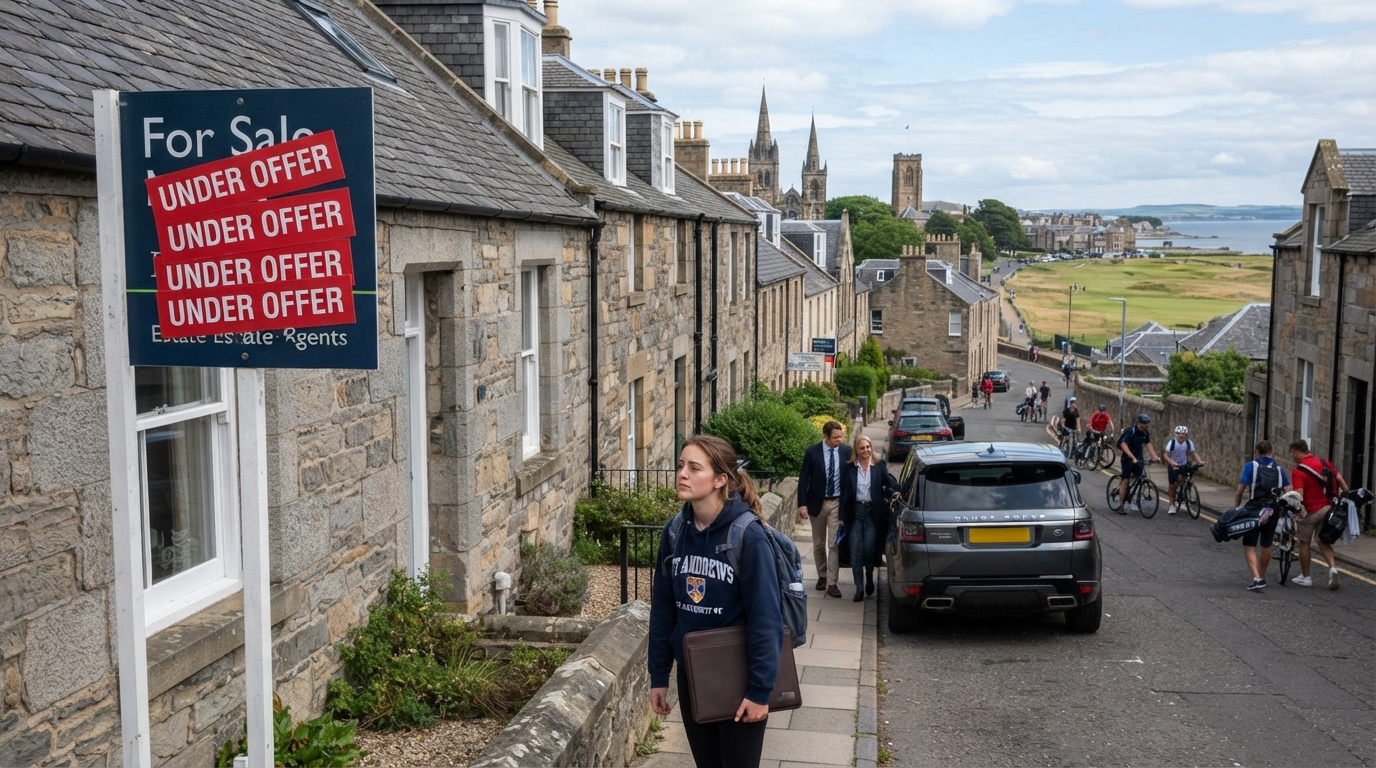
Are affluent buyers fuelling St Andrews’ housing crisis?
St Andrews’ growing popularity is continuing to place strain on local services and the availability of affordable homes.
A world-class university and the home of golf, set in a picturesque coastal town, help explain why so many people are drawn to living in St Andrews.
But the Fife town is facing an affordable housing crisis, with property prices being pushed up by the influence of wealthy buyers from outside Scotland.
New figures show that nearly one in five properties in St Andrews were registered to an address outside Scotland when they were bought, including 164 buyers from the United States alone.
Residents say more must be done to strike a better balance between meeting the needs of the town’s much-valued students and tourists, and those of permanent residents.
The most recent census recorded St Andrews’ population at just over 16,000.
Yet on its busiest days, a walk through the town can feel more like moving through the centre of a crowded European city.
Locals recognise the economic gains from the town’s appeal to visitors, but say the impact on house prices and rents is taking its toll.
Fife Council has said that securing reasonably priced housing in St Andrews is a “major challenge” and has introduced measures such as quotas for affordable housing in new developments in an effort to help.
The university has also limited student numbers to around 10,000 for nearly a decade because of pressure on housing and other local amenities.
Francesca Bisi, a fourth year PhD student in the School of Art History, knows these pressures well, as she is commuting from a nearby village after failing to find affordable accommodation in the Fife town.
“It has been really stressful to try to navigate the housing market here, and even in my fourth year it’s something that is still causing a huge challenge,” she said.
“”It distracts from my work, distracts from my studies and really takes a huge toll on my mental health as well.
“I know that any savings that I’ve been able to put aside that year always end up being drained in whatever down payment because in this market you know you can’t really afford to be picky with what you find and you just feel lucky that you found any place at all.’’
According to data from property firm Rightmove, average advertised rents in St Andrews over the past year were £1,702 a month, compared with the Scottish average of £1,245 a month.
Amy Elvins, from the St Andrews University Students’ Association, said this has created a gap in a housing market already hampered by a shortage of supply.
She said: “The high rents in St Andrews have ultimately meant that all power lies with landlords, which means that students are potentially having to work full time.
“It has created a market in which the understanding is that all houses in town will be filled so it doesn’t really matter the standard and the price that they are.
“It means that members of the community are also being priced out and what we ultimately need is more affordable rentable housing.”
The overwhelming majority of property and land in Scotland is registered to people and companies based in the country.
, external shows a total of 28,825 titles - 1.4% of the total - on the land register where the owner had an address outside the UK at the time of purchase.
Figures released to BBC Scotland show that in the KY16 8 and KY16 9 postcodes in St Andrews, 5,494 titles in the land register were lodged with people or firms based in Scotland at the time of purchase - 81% of the total.
A further 845 (12%) were registered to addresses in the rest of the UK, and 444 (7%) were outside the UK.
A breakdown of the properties registered overseas shows they were bought by people or firms in 51 different countries or crown dependences, including Russia and the Cayman Islands.
In total, 164 St Andrews titles were registered to a United States address (37% of all overseas registrations), followed by Switzerland (30) and Hong Kong (28).
RoS data shows St Andrews is ranked fourth among the top ten postcode sectors in Scotland with the highest number of overseas buyers.
The other nine places in the top ten are all in Edinburgh, with Quartermile in first place, where more than a third of the properties in the development were bought by people based overseas.
Local estate agents have reported steady demand from wealthy parents buying homes for their children to live in while at university, as well as from people attracted to the town by its golf courses.
Data from property firm Rettie shows the average sale price for houses in St Andrews over the past 12 months was £482,879 - more than twice the Scottish average - and up from £312,464 ten years ago.
Dr John Boyle, the firm’s director of research and strategy, said the Fife town was a “hot market in a Scottish context”.
He added: “When the tourists come here they think this might not be a bad place to retire to.
“So you’ve got a lot of downsizer demand within the community and you’ve got the university setting so both a lot of students and a lot of staff.
“St Andrews along with [Edinburgh’s] New Town, Morningside and west end Glasgow, it’s the handful of real prime areas across the country
“It’s very sought after by a whole range of different buyers including buyers that have got significant amounts of money to go and spend on finding a place to live there.”
Ben Stuart, director of residential and business services at the University of St Andrews, pointed to the institution’s annual £480m contribution to Scotland’s economy, supporting 9,000 jobs in the Fife and Tayside area.
He said: “St Andrews obviously borders with the ocean and green belts. There’s not a lot of space left to provide that type of housing.
“All entities have to get together here and understand how they can relieve the pressures.
“Students are often unfairly blamed for the housing situation, when evidence shows it is a much more complex picture.”
Stuart said this was reflected in property prices and the trends identified by BBC Scotland News.
He added: “Quite often, those with the deepest pockets are simply outbidding - by a substantial margin - locals who try to acquire property in town.
“And often those with the deepest pockets are from overseas.”
Debbie MacCallum, a local entrepreneur and chairwoman of St Andrews Business Improvement District, said the town’s international profile supported thousands of jobs and was “hugely valuable to our local businesses and the wider economy”.
She added: “However, a globally recognised town also has to work for the people who live here all year-round and St Andrews is, first and foremost, a community.
“As demand for property grows, we need to continue having sensible conversations about how we balance the benefits of international investment with the need for homes, businesses and services that support a thriving local community.”
The major upcoming shift in the local housing market is a series of new developments on the town’s outskirts that will provide more than 1,000 new homes.
That will raise overall supply, but John Mills, head of housing for Fife Council, also noted that 30% of the homes on these sites will be affordable housing.
He added: “We know that finding affordable housing in St Andrews is a major challenge and there is no single solution.
“That’s why we’re taking a range of steps to help improve housing options for local people.”
Mills pointed to policies such as control areas for the number of short-term lets and an ongoing review of how key workers are allocated council housing.