

How much of GDP is spent on education in Europe?
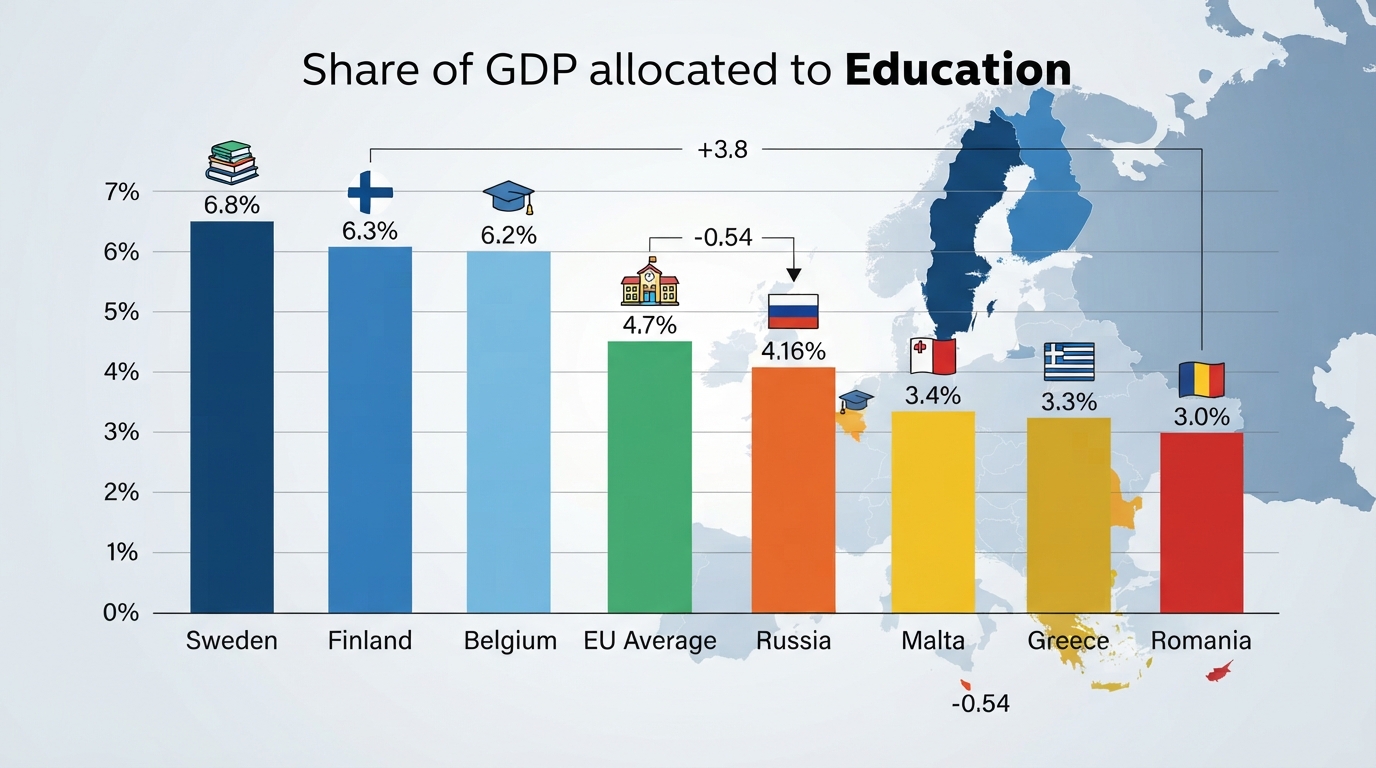
In the European Union, public spending on education in 2023 averaged 4.7 percent of GDP. The highest share of GDP spent on education was in Sweden - 6.8 percent, and the lowest was in Romania - 3 percent.
How much of GDP is allocated to education in Europe?
According to Eurostat, in 2023, European Union countries spent an average of 4.7 percent of their GDP on education.
This figure remained unchanged compared to 2022, but is lower than in 2020. That year, education spending in the European Union reached 5 percent of GDP.
Sweden leads
Among the European Union countries, Sweden spent the most money on education relative to GDP. In 2023, the country's education spending amounted to 6.8 percent of GDP.
Finland was in second place (6.3 percent), and Belgium completed the top three (6.2 percent).
Thus, the ratio of funds allocated to education to the size of the economy in these three countries was significantly higher than the average for the European Union.
The lowest figure was in Romania
The European Union country that spent the least amount of money on education relative to GDP was Romania. In the country, this figure was 3 percent.
Greece (3.3 percent) and Malta (3.4 percent) were next.
Thus, there is a significant difference between the top and bottom of the ranking: in Sweden, the share of education spending in GDP is 3.8 percentage points higher than in Romania.
In Russia, the figure is around 4.16 percent
According to the data provided, in Russia, the amount spent on education in 2023 was approximately 4.16 percent of GDP.
This is 0.54 percentage points lower than the EU average of 4.7%.
Overall, the data show that the share of the economy spent on education in EU countries varies significantly across countries.