

Infographic: How has the global economic center changed over the past 200 years?
The global economic center has shifted several times over the past two centuries. In the 19th century, Great Britain gained leadership in the world economy due to the Industrial Revolution, but in the 20th century, this position passed to the United States. Today, the center of global economic influence is increasingly shifting towards Asia.
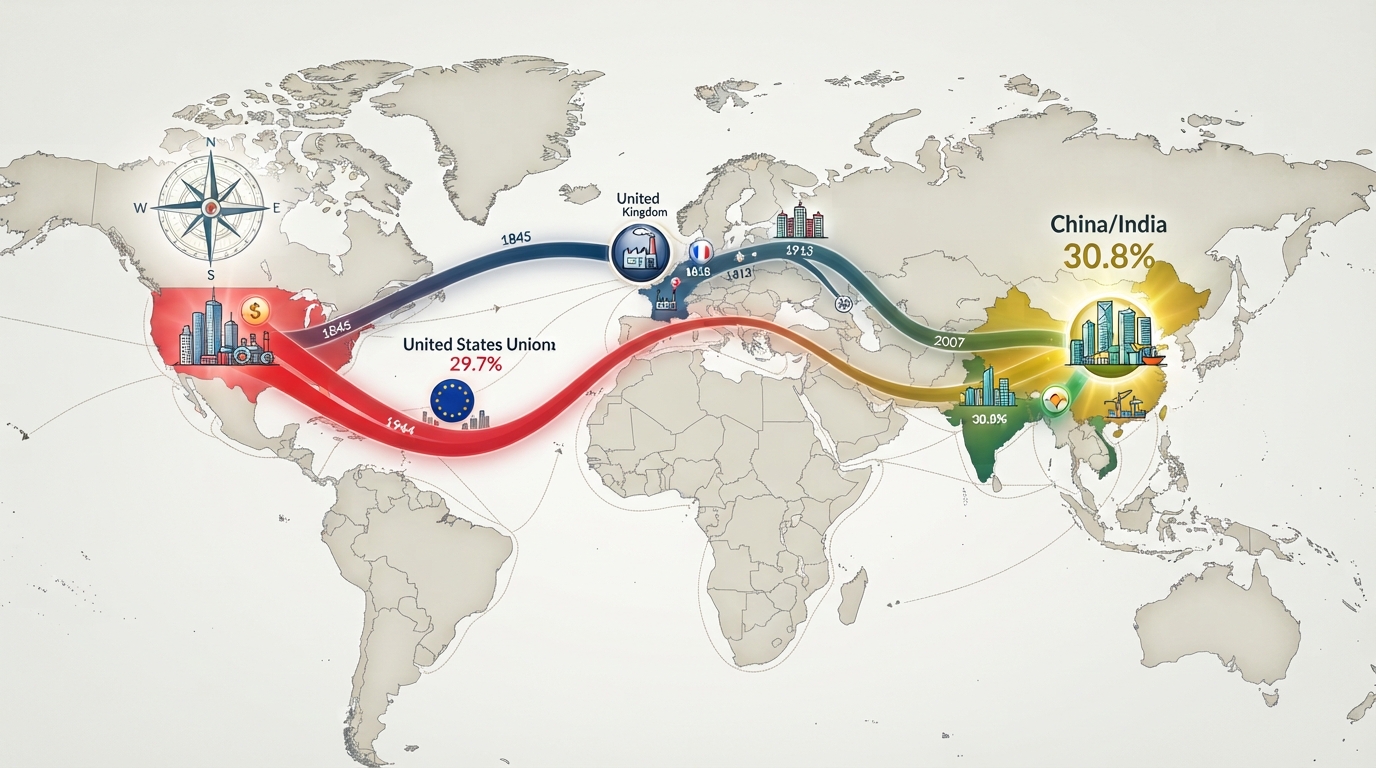
Infographic: How the World’s Economic Center Has Changed Over the Last 200 Years
This infographic by Visual Capitalist shows the share of major economies in global gross domestic product (GDP) from 1820 to 2025. The study is based on data from the Maddison Project Database, the COLDAT Colonial Dates Dataset, and projections from the International Monetary Fund (IMF). All calculations are made in purchasing power parity (PPP), which allows for an objective comparison of economies across countries.
As the first country to experience the Industrial Revolution, Great Britain became the world’s economic leader in the 19th century. By 1845, the British Empire accounted for 23.8 percent of global GDP. This period is known in history as the Pax Britannica, a period of relative stability among major powers. The empire's greatest economic powerhouse was India, which it colonized until 1947.
France also reached the peak of its economic power in the mid-19th century, accounting for 6.6 percent of the world economy in 1858. Russia and Germany reached their peak in 1913, on the eve of World War I.
World War II radically changed the global economic balance. By 1944, the United States produced 29.7 percent of world GDP. This is the highest share recorded for a single country in the entire period covered by the study. The United States became the main economic center of the 20th century due to its leadership in high technology, industrial production, financial system, and international trade.
European countries, after the wars, unified their economic potential through the European Union. In 2007, on the eve of the global financial crisis, the EU accounted for 17.9 percent of the world economy. Later, this share decreased and decreased again after the UK left the EU.
China, on the other hand, has been one of the most important centers of the world economy for many centuries. However, the political instability of the 19th and 20th centuries and the inability to adapt to the industrial revolution sharply reduced its share. The situation changed with the market reforms of the late 20th century. The country quickly became the world's largest manufacturing center and restored its economic power.
By 2025, China's share in world GDP was 21.8 percent. The combined share of China and India reached 30.8 percent. Experts explain this by the large population, relatively low production costs and economic growth rates.
According to analysts, the future shift of the world economic center towards Asia will depend on China solving demographic problems, increasing labor productivity and maintaining stable economic growth.