

Ranking of countries with the highest government spending
Public spending plays an important role in the economy of any country. Budget funds are directed to finance healthcare, pensions, education, infrastructure, defense, and other socially important sectors.
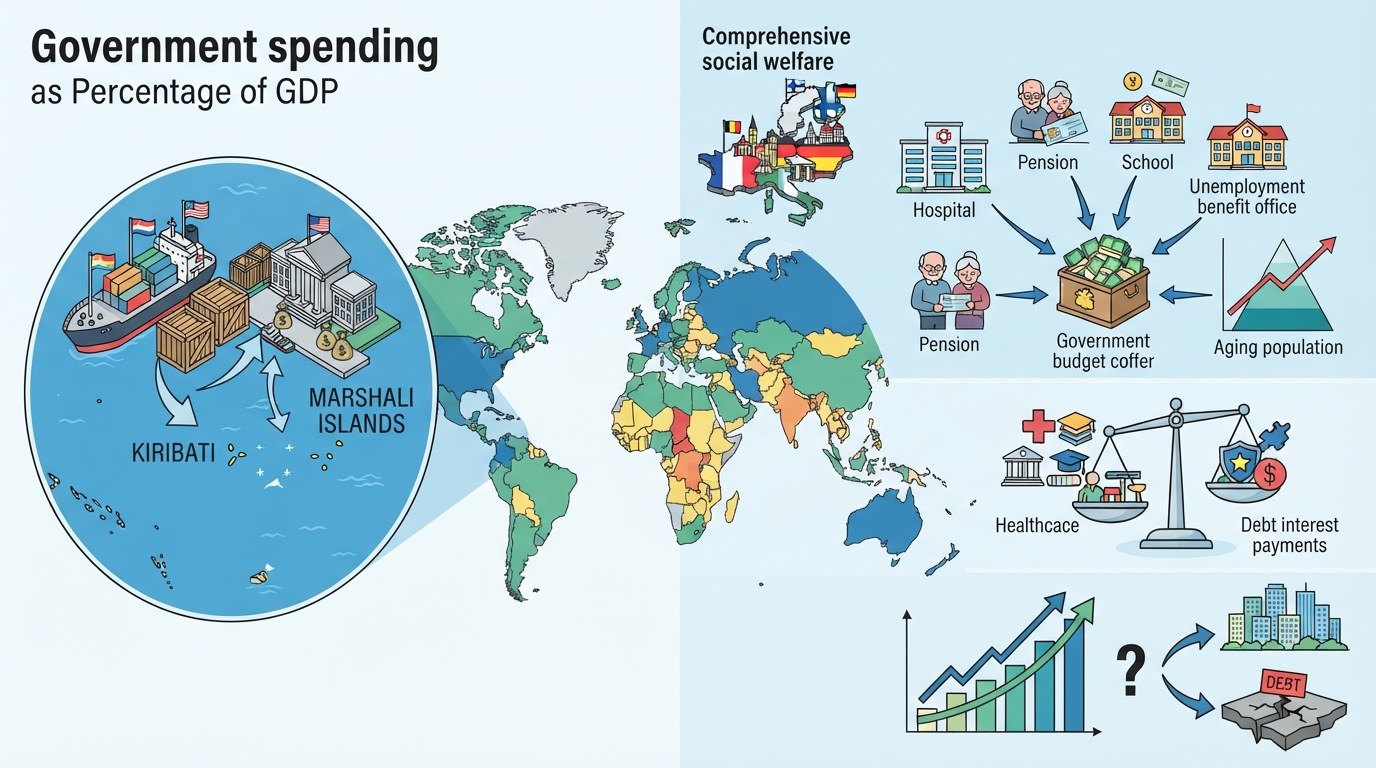
**Ranking of Countries with the Highest Government Spending: Why the Differences?**
The share of funds spent on government needs in a country's economy varies significantly from country to country. These differences are related to population structure, social policies, economic model and government budget priorities. This infographic, prepared by Visual Capitalist based on data from the International Monetary Fund (IMF), compares the share of government spending in different countries in terms of gross domestic product (GDP).
**Kiribati Takes First Place in the Ranking**
According to the IMF, Kiribati leads the world in terms of the share of government spending in terms of GDP. The top of the ranking is also occupied by a number of countries in Northern and Western Europe, where government spending accounts for about half of GDP or more. At the same time, most large developing economies spend a relatively small portion of their national product on government needs.
The fact that small Pacific nations like Kiribati and the Marshall Islands are ranked alongside European economies may seem surprising at first glance. One of the main reasons for this is the high dependence of these island nations on foreign financial assistance and international grants. Such funds allow them to finance a significant part of the costs of public services, despite the small size of the national economy. According to the Lowy Institute's Pacific Aid Map project, Kiribati receives a large amount of international assistance for development purposes. As a result, the country's public spending is close to its annual GDP.
**Why is Public Spending High in Europe?**
In European countries, however, a different trend is observed. A developed social protection system is one of the main factors in the high level of public spending. In particular, the ratio of public spending to GDP:
* In Finland - 57.7 percent;
* In France - 57.2 percent;
* In Belgium - 54.5 percent;
* In Italy - 50.6 percent;
* In Germany - 49.4 percent.
In these countries, the state finances the health system, pensions, unemployment benefits and other comprehensive social programs. This naturally increases budget expenditures. Another important factor is the aging of the population. In developed countries, the increase in the number of pensioners increases the amount spent on pension provision and medical services. Therefore, some of the richest countries in the world regularly take place in the rankings of countries with the highest state expenditures.
**As the economy develops, state spending also grows**
Historically, there is a tendency for state spending to increase with economic development. Because governments also develop education, health and social protection systems as economic opportunities expand. However, the exact amount of state spending does not depend only on the level of economic development. The country's budgetary policy, population demographics and the role of the state in the economy are also of great importance.
**Does High Government Spending Mean Higher Living Standards?**
Not always. High government spending can improve the quality of services provided to the population, improve infrastructure, and contribute to long-term economic growth. However, the result depends not only on how much is spent, but also on how efficiently budget funds are allocated.
If government spending exceeds budget revenues for a long time, chronic budget deficits can arise and public debt can increase. This creates additional financial risks for the economy. It is also important where budget funds are directed. Some countries allocate large amounts of money to health, education, and social protection, while others spend more on infrastructure, defense, or servicing public debt. Therefore, even in two countries with the same share of government spending in GDP, economic growth, living standards, and social well-being can differ significantly.