

"Green AI" module to be launched in Uzbekistan as an experiment
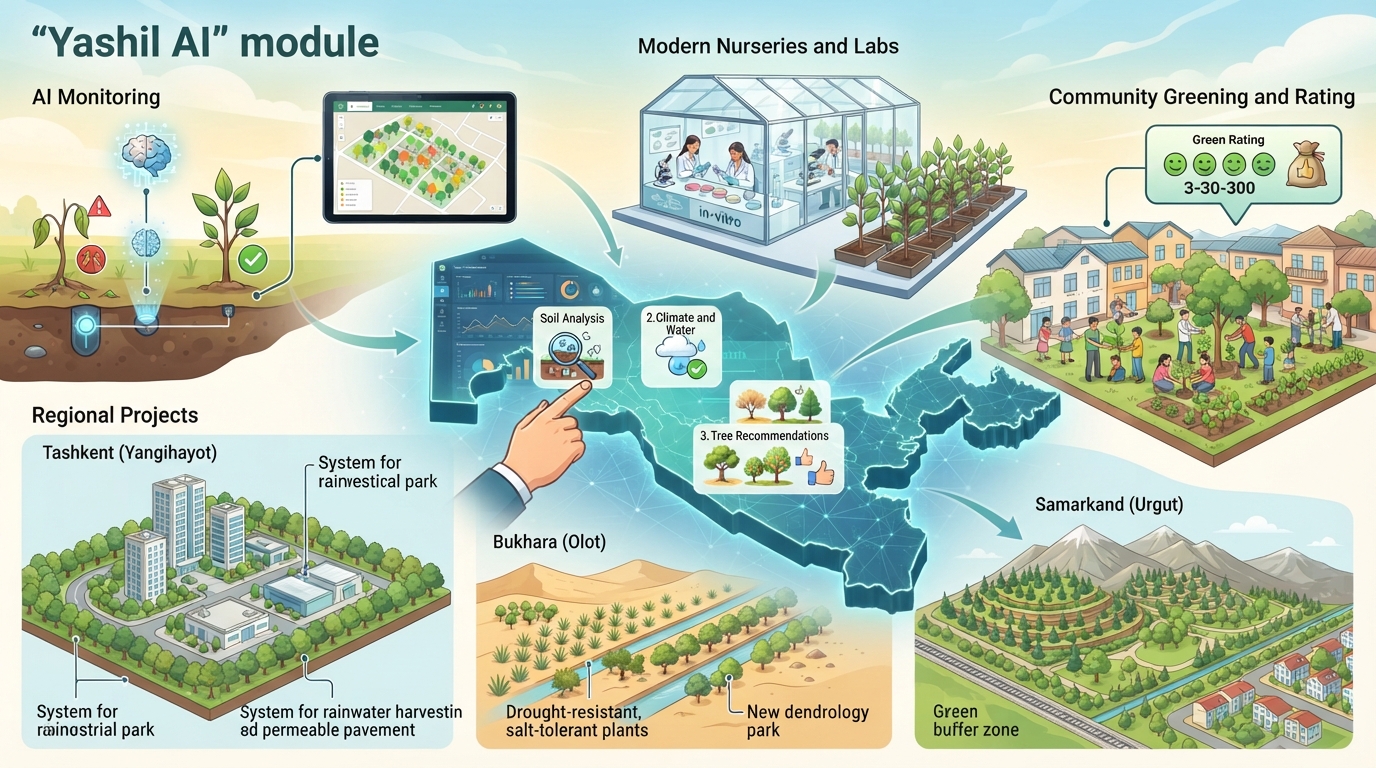
It is planned to launch the "Green AI" module on an experimental basis in Uzbekistan
A system for planning and monitoring greening works using artificial intelligence may be introduced in Uzbekistan. A proposal was made to launch the "Green AI" module on an experimental basis within the framework of the "Yashil Makon" (Green Space) project.
In the presentation on taking the "Yashil Makon" nationwide project to a new level, which Shavkat Mirziyoyev became acquainted with, it was noted that this system is intended to analyze the soil composition, climate, and water supply of regions, and generate recommendations on the most optimal areas for planting seedlings and the tree species suitable for them.
Additionally, with the help of "Green AI", it will be possible to early detect the drying of seedlings, water scarcity, diseases, and pest threats. It is planned to create the possibility of alerting responsible officials about identified problems and monitoring the greening results on a single map.
In addition to artificial intelligence, the presentation proposed establishing "in-vitro" laboratories and modern nurseries to propagate healthy seedlings suitable for the regions. It is also planned to gradually replace water-intensive ornamental lawns with drought-resistant plants.
It is also planned to introduce a "green rating" system in neighborhoods (mahallas). The rating will take into account the share of green areas, the number of trees relative to the population, the survival rate of new seedlings, and the participation of residents in greening. It is proposed to incentivize neighborhoods with high indicators with additional funds and microgrants for "green" projects.
Specific greening projects have also been developed depending on the regions. In particular, in the Yangihayot district of Tashkent, it is planned to create neighborhood and public parks, shaded avenues, and "green belts" around industrial enterprises. Solutions such as collecting groundwater and reusing it for irrigation, using water-permeable pavements, and preparing compost from organic waste are also envisaged.
In the Olot district of Bukhara, it was proposed to expand the green cover through plants suitable for desert conditions and requiring less water, develop local nursery production, and establish a dendrological park and a salt-tolerant plant garden. It is also planned to establish protective forest belts along roads and canals.
In the Urgut district of Samarkand, greening suitable for mountainous and foothill conditions, establishing a dendrological park and public parks, and creating "green belts" around industrial zones and railways are envisaged. Measures to restore the natural vegetation cover based on local tree and shrub seeds in the "Omonqoton" national nature park have also been proposed.
Furthermore, it was proposed to carry out work on greening the areas based on the "3-30-300" principle. According to it, every person should be able to see at least three trees from their place of residence, work, or study, at least 30 percent of the area should be covered by tree canopy, and a green recreation area should be located within 300 meters of their home.
These proposals are aimed at transforming the "Yashil Makon" project from merely planting trees into a unified system of selecting, irrigating, caring for, and monitoring their condition.