

From Russian cages to Irish sanctuary: The five-year rescue journey of Bu and Tyapa
For Bu and Tyapa, the five-year journey from Russia to the Irish countryside was anything but straightforward.
From Russian cages to Irish sanctuary: The five-year rescue journey of Bu and Tyapa
After spending years in cramped cages, two brown bears are settling into a new life after an extraordinary rescue effort that crossed several countries, was thrown off course by two major conflicts and involved more than 100 people.
For Bu and Tyapa, the five-year journey from the Republic of Dagestan in Russia to the Irish countryside was far from simple.
One bear had been made to perform in a circus throughout their life, while the other was kept in a cage so small they could not stand upright.
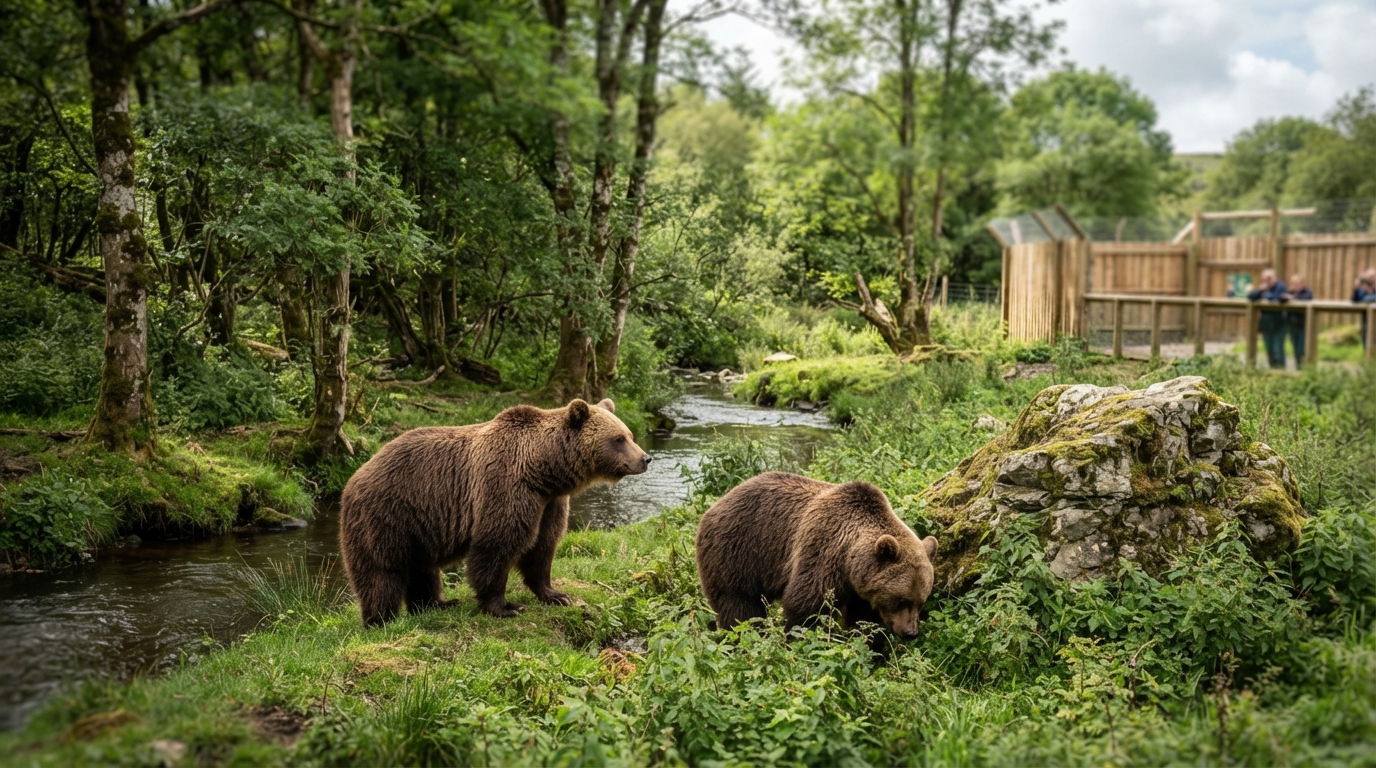
Now, the bears are adapting to an entirely different environment among the trees and grass at Wild Ireland, a sanctuary for rescued animals in County Donegal.
Wild Ireland founder Killian McLaughlin first heard about Bu and Tyapa in 2021 and pledged to bring them to safety in Donegal.
The sanctuary, in Burnfoot, opened in October 2019 and offers a safe haven for animals including brown bears, monkeys, wolves and lynx.
McLaughlin said the two bears were in extremely poor health when they were first rescued.
Former circus bear Bu had spent years trapped in a small indoor cage after being forced to perform.
McLaughlin said Tyapa had lived in a cage measuring just 2.5m by 2.5m by 2m, too low for him to stand upright and without a roof, leaving him exposed to severe winter cold and scorching summer heat.
The bear had no water dish and depended on a hose for drinking water. McLaughlin said he was being raised to be killed for a future taxidermy display.
When the bears were rescued, both were severely underweight and showed signs of psychological trauma.
Blood tests also found serious kidney issues linked to long-term dehydration.
Russia's invasion of Ukraine in February 2022 made the original transport route through Ukraine impossible, McLaughlin said.
An alternative route through the Middle East was then considered, but those plans were disrupted again in February 2026 when the worsening conflict involving Iran caused airspace closures and flight disruptions across the region.
More than 100 people took part in the rescue operation, including volunteers, lawyers, veterinarians, animal transport specialists, cargo teams and officials in Russia, the United Arab Emirates and Ireland.
The bears travelled from Moscow via Abu Dhabi to Dublin, arriving in the Republic of Ireland on 3 August 2026
In late October 2025, Dima and Yana Kim, who work at Tiger House, a sanctuary near St Petersburg that cares for former circus tigers, set off on a 36-hour drive to Dagestan to rescue the bears.
Bu and Tyapa had to be cut out of their rusting steel cages, sedated and placed in secure transport crates for the trip back to Tiger House, where they received veterinary care and completed quarantine.
After months of preparation and repeated delays, the bears eventually travelled from Moscow via Abu Dhabi to Dublin, arriving in Ireland in August.
Since arriving at Wild Ireland, McLaughlin said both bears have put on weight, their coats have improved, and follow-up blood tests have shown their kidney function has returned to normal.
He said their habitat offers woodland, water and space to explore, along with sheltered areas where they can retreat or move out of public view if they want privacy.
"These bears have suffered trauma and the first step of that recovery process is get them back out into the forest, get their paws into the soil and on the grass and get them exploring.
"We hope they can now have a full and happy life."
Working with bears is certainly not an everyday job, but for Wild Ireland team member Chloe McElhatton, it is one she thoroughly enjoys.
Chloe has been working at Wild Ireland for just over a year. She studied zoology at Queen's University Belfast, completing a four-year degree before joining the team.
"This is obviously a very unique job, and it's quite different from what most people would do," she said.
"We've done a lot of work hiding food around the bear habitats, encouraging them to search and forage for it themselves and this promotes their natural behaviours and helps them become more comfortable in that new open space," she said.
"Over time, we've seen their confidence build, and you can see great changes, both physically and mentally, in both of them."
Liam, who is from France, said the bears were among his favourite animals to see when visiting the park.
"Very big and very impressive," is how he described Bu and Tyapa.
"I saw chickens, some wolves and some monkeys and then the bears which were definitely my favourite."
Chris Roberts is from Manorcunningham, about 20 minutes from Wild Ireland, and has been visiting the site ever since it first opened in 2019.
"I've lost count of how many times we've been here, but we really wanted to come down today to see if we could catch a glimpse of Bu and Tyapa.
"It was fantastic to see them in the flesh.
"We absolutely loved it and are delighted to see them doing so well, especially considering their backstory and the awful conditions they were once kept in."