

The uncertain future of Canada's 30 rescued belugas
An international rescue operation for the last 30 captive whales in Canada made headlines. Then five of them died.
**The uncertain future of Canada's 30 rescued belugas**
Marineland was once a famous Canadian attraction, remembered for its “Everyone loves Marineland” jingle.
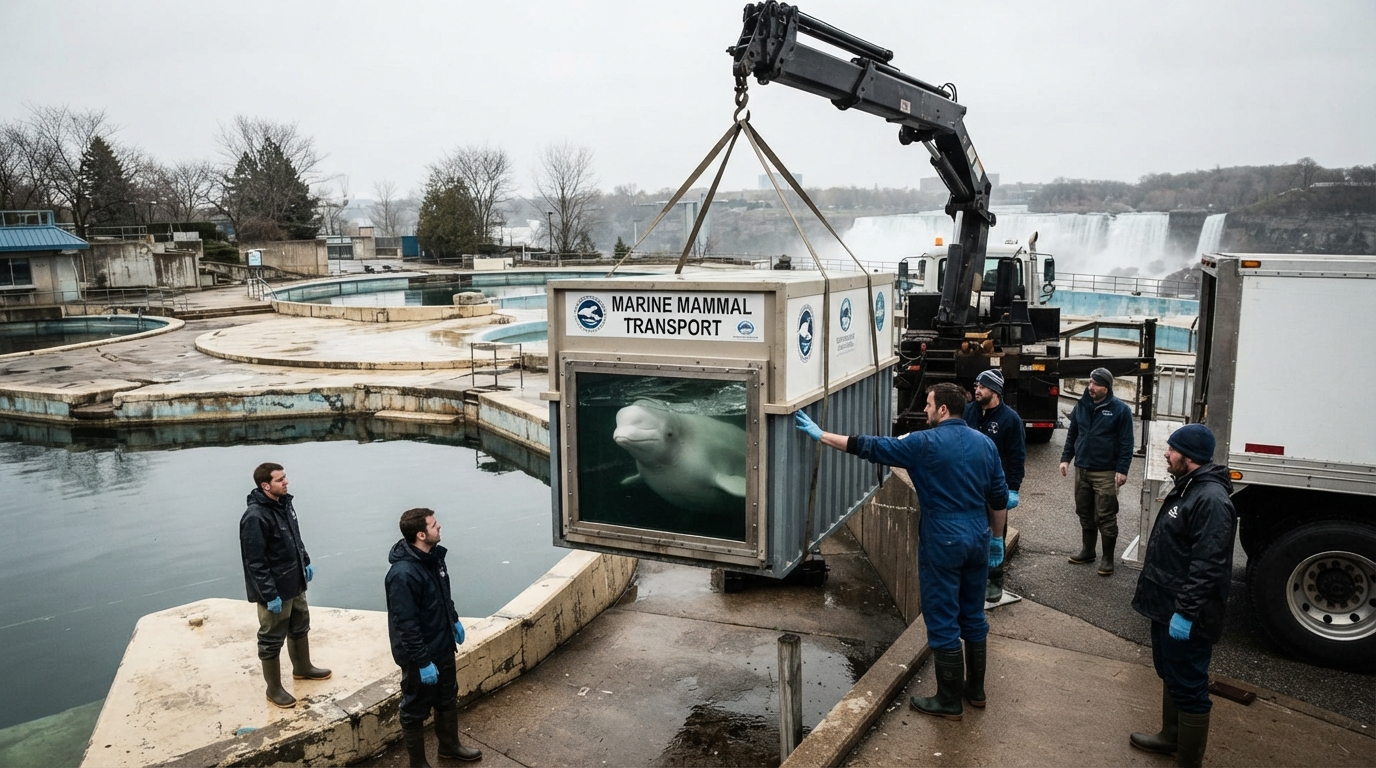
Tofino moved from one handler to the next as they knelt in shallow water and rubbed his sides. Soon after, a crane lifted the beluga whale, weighing more than 1,500kg, into a lorry for transport out of Canada to his new home, SeaWorld San Antonio — the final one of 30 belugas and four dolphins to depart Marineland, a closed sea park near Niagara Falls.
Marineland had to secure a new home for its whales. But after the Canadian government turned down its proposal to sell them to China because of animal welfare concerns, the park’s operators said they would need to be euthanised.
That triggered an international rescue effort involving several aquariums, resulting in the biggest transfer of captive whales ever carried out this summer. Yet hopes that the animals were moving to better lives have been reduced by several deaths within the group.
Photographer Carlos Osorio captured the relocation, which saw whales flown to Chicago, Atlanta, San Diego, San Antonio, and even Valencia, Spain.
Osorio remembers viewing drone footage from above as Tofino seemed to bid farewell.
Tofino was the last captive whale in Canada. The country outlawed cetacean captivity and breeding seven years ago, and Osorio felt the significance of the moment.
“This is the last one to happen, and it’s never going to happen again,” he says.
Even with the rescue effort, five of the belugas have since died, along with one dolphin.
Chicago’s Shedd Aquarium has recorded the highest number of deaths. Peekachu, 23, Rain, 20, Orisis, 26, and Caspian, 27, were all moved from Marineland, while longtime Shedd resident Beethoven, 34, also died after eight Marineland belugas were transferred there over the summer.
Necropsies showed chronic inflammatory disease in the gastrointestinal systems of Peekachu and Rain.
Investigators also found foreign objects in their stomachs, including feathers, large rocks and flecks that appeared to be paint — items Shedd believes were swallowed before the whales were moved to Chicago.
Osiris’s preliminary examination found chronic liver disease.
Oceanogràfic València in Spain, Europe’s largest aquarium, reported the deaths of one beluga, Jelly Bean, and one dolphin, Echo. The dolphin arrived with “serious vision problems” and other health issues, it said, and “began having difficulties swallowing and respiratory problems” in the hours before she died.
Experts say it is too soon to assess the results of the transfers, particularly given that the whales were facing euthanasia and had been living in an ageing facility. According to a Canadian Press count, about 20 whales died at Marineland between 2019 and September 2025.
Once the country’s most popular amusement park, Marineland shut in 2024 after years of animal welfare concerns and financial troubles, and after the death of its longtime owner.
Public views on keeping whales in captivity have also shifted dramatically since Marineland opened in 1961. Like Canada, more countries are moving to ban or limit the practice, including France and Mexico.
Melissa Matlow, a spokeswoman for World Animal Protection Canada, says there are about 3,600 captive cetaceans worldwide — marine mammals that include whales, dolphins and porpoises.
But there are few options for whales born in captivity who lack the skills needed to survive in the wild.
Matlow says that leaves a “growing animal welfare crisis on our hands”.
Still, her organisation had concerns about moving the Marineland whales.
“If an animal was not healthy enough to withstand the stress of transport, it should not have been transported,” she said in a statement.
In early October, Shedd said it knew some of the Marineland belugas “could have substantial, longstanding medical needs”.
Assessments before the transfer “informed our planning but could not reveal every underlying condition or predict how each whale would respond to the transition. The rescue offered a path to continued, specialised care”.
It said the remaining rescued belugas are showing positive signs, including eating well.
Because they cannot be released, “the next best thing we could do is provide sanctuary for them, where they can at least live in the ocean, and they can have back their autonomy”, says Lori Marino, a neuroscientist behind the Whale Sanctuary Project, which she hopes could eventually house about 12 to 15 whales.
“I look at it as an exit ramp,” she adds.
She said the project began a decade ago, but construction only started in the past two months. Fundraising is still under way and needs another C$6m ($4.2m; £3.1m).
But offshore sanctuaries have not yet been proven to be a successful answer for retired performing whales.
One offshore beluga facility is being developed in Iceland, but in July organisers decided more work was needed and postponed the arrival of two whales until next summer.
“They are kind of more theoretical and aspirational at this point,” says Michael Weiss, research director at the Center for Whale Research in Washington state, adding that they would certainly “improve the welfare of the animals” compared with concrete tanks.
“It’s a very old idea,” he says, noting that net pens have been used to rehabilitate injured wild whales, or temporarily while reintroducing captured orcas to the wild.
Many critics point out that Canada’s law banning captivity also banned whale breeding — but the facilities that received the animals do not have the same laws, and some are likely to breed them, continuing whale captivity.
Jason Jones, senior curator of animal well-being at Georgia Aquarium, says “breeding is a natural part of an animal’s life”.
“Breeding is part of good animal welfare, and so we want to make sure that they get the opportunity to do so.”
Georgia Aquarium recently received two male Marineland belugas, Balor, 10, and Zephyr, 7. They joined the four females already there.
They arrived “bright, alert and responsive” and quickly started “vocalising to the females on the other side of the gate”, he says.
“There was a little bit of a meeting and greeting period, but afterwards they were all kind of swimming together in a big group.”
“They were exploring their new habitat, coming over and participating in sessions, eating and interacting with enrichment. So those were all really positive signs from the get-go, and we’ve just seen progress since then.”
Phil Demers, a former Marineland handler, said, like many people the BBC spoke to, that the end of Marineland is “bittersweet”.
He is glad to see the facility closed, and hopes Canada’s ban will encourage changes in other countries. But for now, the ban will not end captivity for the Marineland whales, only change their habitat.
He says people interested in whales should go on a whale-watching tour, or watch a nature documentary on TV.
“I’d rather see a whale fart in the wild than do a triple backflip in a tank,” he says.