

Baby orangutans found in Indian forest spark trafficking inquiry
The critically endangered apes were found far from their natural habitat in the eastern Indian state of Odisha.
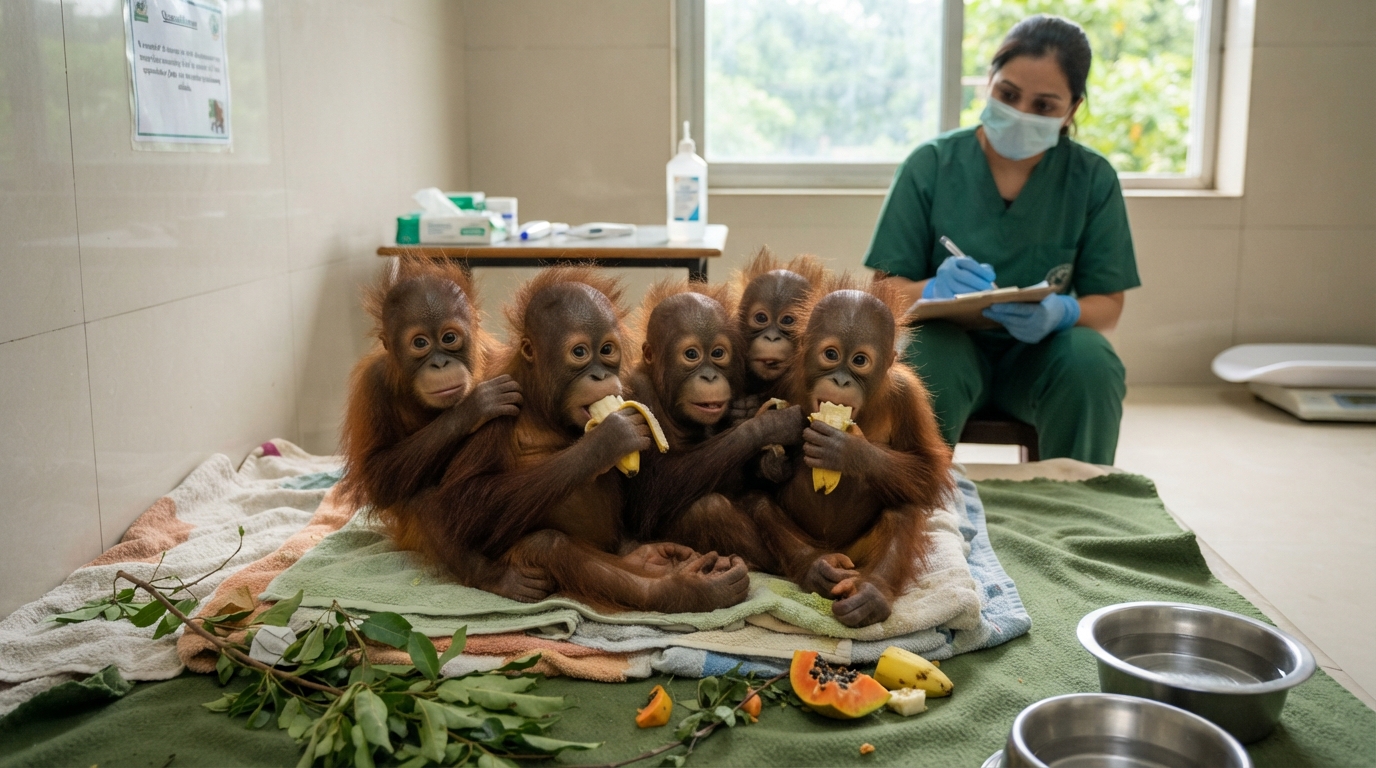
Baby orangutans discovered in an Indian forest trigger trafficking probe
Five baby orangutans have been discovered in a forest in Odisha, India’s eastern state, far outside their natural range, leading to an inquiry into how they arrived there.
Photos and videos shared widely online show the young apes huddled together on the forest floor and eating bananas, thousands of kilometres from the tropical rainforests where they belong.
Odisha’s forest minister said investigators are looking into whether the animals were brought into the country by an international smuggling ring and left near a highway.
The orangutans were rescued early on Tuesday in Balasore district after local residents saw them and informed forest officials.
They were given first aid before being moved to Nandankanan Zoological Park in the state capital, Bhubaneswar, where they are now in quarantine and under observation.
Balasore District Forest Officer Pratik Prakash Indalkar told the BBC that the animals could not have reached Odisha on their own and may have been transported by road.
“The five animals were found in Ranakata, a proposed reserve forest in Bhogarai block, near the West Bengal border,” he said.
“The area is covered mainly by casuarina trees and is not a dense forest. It is also close to a state highway.”
The Odisha government has also reportedly requested India’s Wildlife Crime Control Bureau to investigate. Police, forest officials and a special task force are part of the probe.
Forest officials think the orangutans had been in the area for just two or three days.
A search of the forest turned up no other orangutans or any clues about how the animals got there, Indalkar said.
Officials described them to the BBC as infants, though some local reports say they are between one and two years old.
Their young age makes the find especially worrying, wildlife expert Biswajit Mohanty said.
Young orangutans usually stay with their mothers for several years, learning the skills they need to survive on their own. Females also reproduce slowly, typically giving birth only once every eight years.
The discovery of five young orangutans together, thousands of kilometres from their natural habitat and with no adult animals nearby, has therefore raised questions about how they ended up in Odisha.
There are three known living orangutan species - Bornean, Sumatran and Tapanuli - and all are listed as critically endangered by the International Union for Conservation of Nature, or IUCN.
Their numbers have fallen sharply over the years because of deforestation, habitat loss and hunting.
International commercial trade in orangutans is banned under Cites - the global agreement regulating trade in endangered wildlife. They are also protected under Indian wildlife laws.
Even so, orangutans are still trafficked for sale as exotic pets and to private collectors.
This is not the first time young orangutans have been found in India.
In 2022, two baby orangutans were found abandoned at a checkpoint near the border between Assam and Mizoram. Officials suspected they had been brought into India through neighbouring Myanmar.