

From growth to opportunities
35 years later. What has Tajikistan's economy become over the years of independence?
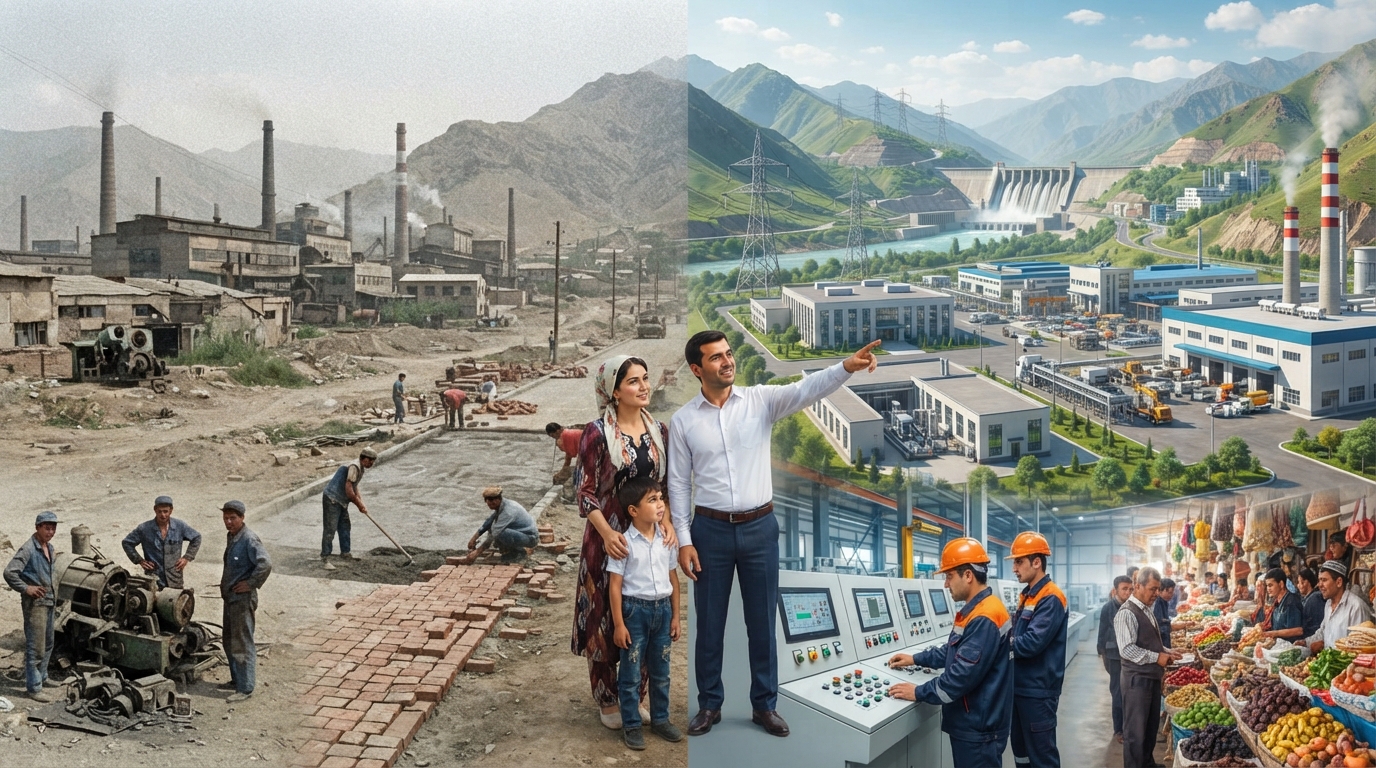
**From Growth to Opportunities**
Over 35 years of independence, Tajikistan's economy has traveled a path from a collapse in production and severed economic ties to high growth rates, the emergence of new enterprises, and major infrastructure projects. But to what extent have these changes affected the lives of ordinary people? We look into how the country's economy has changed, what role industry and labor migration have played in it, and whether it has been possible to translate GDP growth into increased well-being.
Tajikistan did not gain independence from scratch in an economic sense. In 1991, the republic possessed industry, hydropower, agriculture, construction and textile enterprises, as well as trained personnel.
The problem lay elsewhere: almost this entire system was part of a massive Soviet mechanism. Raw materials could come from one republic, equipment from another, and finished products went to markets across the USSR.
After the collapse of the Union, the customary ties were destroyed. Enterprises were left without suppliers, sales markets, and financing. And then, the civil conflict of 1992–1997 was added to the economic crisis. As a result, Tajikistan had to simultaneously build a new state, restore its economy, and search for its own economic model.
After 35 years, the picture looks completely different. In 2025, the country's GDP reached about 176.9 billion somoni, and the economy grew by 8.4%. According to the World Bank, Tajikistan's nominal GDP was about $17.6 billion, and GDP per capita was approximately $1.4 thousand.
New enterprises, roads, and energy facilities have emerged, and production and construction have grown.
But GDP is an important indicator that, alas, cannot be put directly into a family wallet. Therefore, behind the big numbers, the main question remains: to what extent has economic growth translated into jobs, higher incomes, and new opportunities for ordinary families?
### The Economy at the Start: What Tajikistan Inherited
One of the republic's largest industrial facilities was the Tajik Aluminum Plant. Light industry enterprises, the construction sector, an agricultural complex, and energy facilities were operational. However, most of the production was oriented not toward the domestic market, but toward Union-wide cooperation.
After 1991, many production chains virtually ceased to exist. Enterprises faced shortages of raw materials and equipment, loss of sales markets, and financial difficulties.
Therefore, the first years of independence became the most difficult period for the country's economy. Production fell sharply, and many enterprises shut down or operated far below full capacity.
At the same time, the economic model itself was changing. While previously key decisions were made within a unified Soviet planning system, now the country had to independently determine which industries to develop, where to attract investment, where to create jobs, and how to enter global markets.
### The 2000s: A Period of Recovery
After the end of the civil conflict, a new phase began. In the 2000s, the economy gradually began to recover.
The main sources of growth became construction, industry, energy projects, foreign investment, trade, and services. But there was also another factor that over time became one of the key features of the country's economic model — labor migration.
Earnings of relatives abroad helped families build housing, pay for children's education, and cover daily expenses. Remittances supported domestic consumption and contributed to poverty reduction.
At the same time, dependence on the external labor market revealed a weak spot in the economy: there was still a shortage of jobs with acceptable wages inside the country. This duality persists today.
### Growth Against the Backdrop of Neighbors
If we compare today's Tajikistan only with the Tajikistan of the 1990s, the changes look immense. The country restored economic growth after a deep crisis, increased production, built new infrastructure facilities, and formed new economic sectors.
But an economy does not develop in a vacuum. Over the same 35 years, other Central Asian countries have also changed.
Kazakhstan relied primarily on the oil and gas sector and large foreign investments. Uzbekistan relied on a large domestic market, an industrial base, and gradually opened up its economy. Kyrgyzstan developed trade, services, gold mining, and a more liberal economic model.
In Tajikistan, the main drivers of growth became energy, industry, construction, agriculture, and labor migration. However, a simple comparison of final figures explains little. The starting conditions were too different.
Kazakhstan possessed significant reserves of natural resources. Uzbekistan had the largest population in the region and a more developed industrial base. Tajikistan, on the other hand, began its independent path against the backdrop of a civil conflict and the destruction of a significant part of its former economic ties.
Therefore, comparing the economies of the region's countries is worth doing with consideration not only of today's GDP, but also of the starting point from which each of them began.
### Industry: Betting on Factories
In recent years, industry has become one of the main directions of Tajikistan's economic policy. Industrialization has been declared a strategic goal.
In Soviet times, an enterprise in Tajikistan might have been just one link in a production chain stretched across several republics. But modern industry is being built under completely different conditions. Today, the task is to create enterprises capable of operating independently for both the domestic market and export.
Part of the Soviet industrial heritage was lost during the years of independence. Many machine-building, light industry, and processing enterprises reduced production or ceased operations.
At the same time, new sectors emerged and expanded: construction materials production, mining, metallurgy, the cement industry, agricultural processing, and energy.
In 2025, the volume of industrial production in the country reached about 66.7 billion somoni, increasing by more than 22% over the year.
Now the task has become more complex. Opening a factory is not the end of the story, but rather its first chapter.
It is important for the economy to transition from growing the number of enterprises to growing the quality of production and manufacturing high-value-added products.
For example, aluminum brings more economic opportunities to the country if finished products are manufactured from it, rather than just exporting primary metal.
The next stage of industrialization is therefore linked not so much to the quantity of new enterprises, but to technologies, skilled personnel, and deep processing of raw materials.
### Migration: A Problematic Pillar
Labor migration remains one of the most prominent features of Tajikistan's economy.
According to the World Bank, in 2025, remittances accounted for about 47.9% of the country's GDP. For comparison, in Kyrgyzstan this figure was about 26.6%, and in Uzbekistan, about 14.4%.
For families, this money represents very concrete economics: home repairs, food, children's education, medical treatment, and major purchases.
For the state, the picture is more complex. The more the economy depends on the earnings of citizens abroad, the more obvious the question becomes: why is a significant part of the workforce forced to seek more attractive earnings outside the country?
Migration has become an effective mechanism for economic adaptation and supporting millions of families. But the long-term goal remains different — to create a domestic labor market where decent work at home is a realistic alternative to leaving.
### Population Incomes: Have People Felt the Growth?
Over 35 years, not only the structure of the economy and the volume of GDP have changed. The standard of living has also changed. Roads and housing were built, enterprises and businesses emerged, and the service sector expanded.
However, the main criterion of economic success for an individual is much simpler than official statistics: how many opportunities has their family received? Economic growth becomes tangible when it translates into higher wages, jobs, accessible education, business opportunities, and better quality of services.
According to the Agency on Statistics of the Republic of Tajikistan, in 2025, the monetary incomes of Tajikistan's population reached about 165 billion somoni. This amount includes wages, income from entrepreneurship and agriculture, pensions, benefits, and other receipts.
The average monthly nominal accrued wage of employees in 2025 was about 2767 somoni. Real wages, adjusted for price changes, also grew.
But there is an important "but" here: statistics are good at averaging, while life is much worse at it.
Family incomes vary greatly depending on the region, profession, and availability of permanent work. For many households, an important role is still played by migrant earnings, small business, and personal subsidiary farming. Therefore, the average wage helps assess the direction of the economy's movement, but far from always describes the real budget of a specific family.
### Have People Become Richer Than at the End of the USSR?
At first glance, the question is simple. In practice, it is difficult to answer it correctly. The Soviet ruble and the modern somoni cannot be directly compared. The economic systems are also completely different.
In the USSR, education, medicine, housing, and many other services were provided under a different model, and the state regulated prices for many goods. At the same time, there were shortages and a much more limited choice of goods and services. However, individual indicators allow us to see the general picture.
At the end of the Soviet period, Tajikistan belonged to the republics with relatively low income levels. In 1990, the average monthly wage of workers in the Tajik SSR was about 207 rubles, while the average for the USSR was about 275 rubles.
After the collapse of the Union, production and population incomes fell sharply. A steady recovery began only in the 2000s.
Today, the size of the economy exceeds the level at the beginning of independence, and GDP per capita is significantly higher than the figures of the early 1990s.
But here again, the main difference between economic growth and the growth of well-being arises. For some, opportunities have appeared that previously practically did not exist: private business, work in new industries, modern technologies, new markets. For others, the problems of recent decades have not gone anywhere: a lack of jobs, low incomes in certain regions, and the need to go abroad to work.
### From an Economy of Survival to an Economy of Opportunities?
Over these 35 years, Tajikistan has covered a vast distance — from the severe economic crisis of the 1990s to an economy that in recent years has demonstrated high growth rates.
The country has restored its economy, is developing energy and industry, building infrastructure, and trying to create new production facilities. The first stage — survival — was passed long ago. The recovery stage is also behind us.
Now the main challenge lies elsewhere: to turn an economy of growth into an economy of opportunities — so that an increase in GDP means not only new roads, factories, and major projects, but also more productive jobs, higher incomes, business development, and an improved quality of life.
Because after 35 years, the main question for the economy is measured not only in billions of somoni, but much more simply: how many opportunities it creates for people.